Jack O'Connell - The Skin Palace
Здесь есть возможность читать онлайн «Jack O'Connell - The Skin Palace» весь текст электронной книги совершенно бесплатно (целиком полную версию без сокращений). В некоторых случаях можно слушать аудио, скачать через торрент в формате fb2 и присутствует краткое содержание. Год выпуска: 2011, Издательство: MysteriousPress.com/Open Road, Жанр: Современная проза, Триллер, на английском языке. Описание произведения, (предисловие) а так же отзывы посетителей доступны на портале библиотеки ЛибКат.
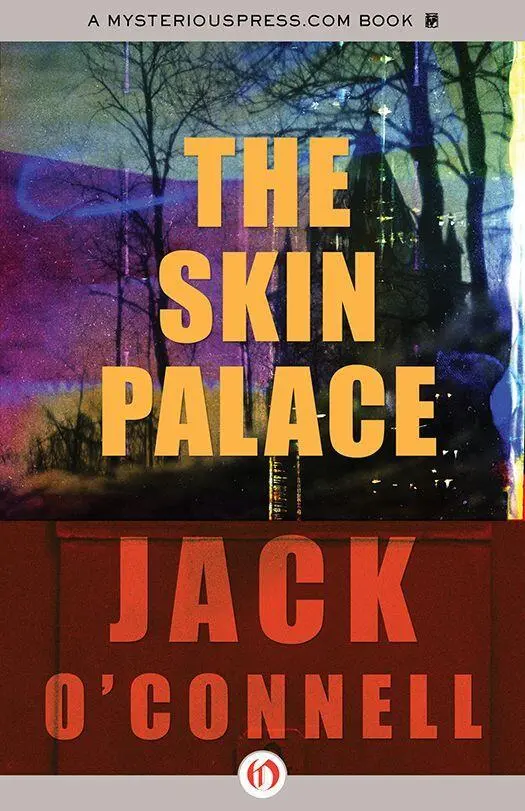
- Название:The Skin Palace
- Автор:
- Издательство:MysteriousPress.com/Open Road
- Жанр:
- Год:2011
- ISBN:нет данных
- Рейтинг книги:3 / 5. Голосов: 1
-
Избранное:Добавить в избранное
- Отзывы:
-
Ваша оценка:
The Skin Palace: краткое содержание, описание и аннотация
Предлагаем к чтению аннотацию, описание, краткое содержание или предисловие (зависит от того, что написал сам автор книги «The Skin Palace»). Если вы не нашли необходимую информацию о книге — напишите в комментариях, мы постараемся отыскать её.
The Skin Palace — читать онлайн бесплатно полную книгу (весь текст) целиком
Ниже представлен текст книги, разбитый по страницам. Система сохранения места последней прочитанной страницы, позволяет с удобством читать онлайн бесплатно книгу «The Skin Palace», без необходимости каждый раз заново искать на чём Вы остановились. Поставьте закладку, и сможете в любой момент перейти на страницу, на которой закончили чтение.
Интервал:
Закладка:
She stands up from the lightpost, gets her balance, and glances across the street to see Der Geheime Garten. The café Mr. Quevedo mentioned. The place where she can find the story of Terrence Propp.
And then she’s moving across the street and in the front door. The café is narrow but deep. The ceilings are ridiculously low as if the restaurant had been contract-built for the sole enjoyment of dwarfs. The lighting is dim and the deep red walls don’t help. Against the far wall is a short marble bar backed by a mirror that has naked, Reubenslike women painted on it. There are maybe a dozen or so tables, only one of which is currently occupied, by a gangly, pale, anemic-looking boy with large ears that wing out from his head. He doesn’t seem to notice her standing in the entryway. There’s a fat paperback titled Zoopraxography spread open on his table, but he’s engrossed in a spiral notebook, chewing on a blue pencil.
A small man with jet black, slicked-back hair and what looks like a greasepaint mustache, just this tiny dark line above his lip, comes out of a back room carrying a tray, sees Sylvia, smiles and moves toward her. He’s dressed in a suede-looking dinner jacket that matches the color of the walls. He’s wearing a silver earring in the shape of an American Beauty rose.
“A table?” he asks and she nods.
He looks back over his shoulder at the almost-empty room and says, “And will there be anyone joining you?”
She doesn’t like the remark, though she thinks it was fairly innocent. And she’s hoping the guy can lead her to Rory Gaston. So she says, “No thank you,” and he grabs a single menu from the top of the maître d’s station and says, “This way, please.”
He seats her in a rear corner of the place. He places the menu over a chipped-up china setting, a kind of antique ink-blue plate trimmed with tea roses around the edge.
“Could I get you something to drink while you study the selections?” he asks.
She’s about to shake him off when her mouth opens and she hears herself order a Pernod.
“Very good,” he says, his spirits seemingly brightened by her choice, and he marches off to the bar.
Sylvia sits still for a long minute and collects herself. She runs her hands through her hair a few times. She looks around the walls for a pay phone to call Perry but doesn’t see one. And then she realizes that she doesn’t want to call Perry. Because she knows he’ll be crazy when he hears about what’s happened. It would be an appropriate reaction. She leaves the house. She walks down to the border of the worst part of the city. She sits down and drinks tea in an erotic bookstore with an elderly, blind Latino that she’d never laid eyes on before. She walks into the middle of a goddamn riot and wrestles with a cop, for God sake. She loses a camera. And she waits out the balance of the storm in the most beautiful pornographic movie theatre in America watching scenes from Glutton For Ravishment II with the director and starlet. How would she end that phone call— Be home soon, Perry. Just having a cocktail in the Whorehouse Café …
The waiter returns with the drink and puts it down on the table. “Does anything appeal to you?” he asks and when he sees her confusion he eye-motions to the menu.
“I’m sorry,” she says, “I haven’t had a chance to look.”
He nods and goes to turn away and she says, “Hold on,” and picks up the menu, thinking maybe she should put something in her stomach, maybe it would settle her down and help her think.
The entire menu is just one printed page and as she scans it she realizes every offering is some variation on oysters. And she’s never heard of one. They feature names like Oysters Delluc Piquate and Oysters L’Herbier in the Half-shell, Cavalcanti’s Oyster Bisque and Feyder’s Saucy Oyster Canapés and Fried Oyster Epstein.
She looks up at the waiter and says, “Your specialty?”
He gives a little pleased-with-himself smile and says quietly, “Food of the gods.”
She smiles back. “And the goddesses, I hope.”
“Of course.”
“Why don’t you surprise me,” she says.
He takes the menu and moves off before she can broach the subject of Mr. Gaston. And then as she watches the waiter disappear into what she assumes is the kitchen, an awful thought occurs to her — what if there isn’t any Mr. Gaston? What if Mr. Quevedo was putting her on or just being cruel? She has no reason to think this is the case. But then she had no reason to think that Jack Derry’s Camera Exchange would vanish overnight. She had no reason to think that a walk to the edge of the Canal Zone would degenerate into a riot. And she had no reason whatsoever to think that she’d spend part of today watching hard-core porn on a thirty-foot screen.
The images come back now. The woman, Leni, on her back on that long wooden table. The young guy, wearing only a white apron around his waist and then not even that. The older Asian man, the dishwasher, approaching the two of them, bouncing from a badly feigned shock to full participation in about ten seconds. Bulkie rolls, sliced tomatoes, a jar of olives all falling to the floor as the three-some’s convulsions escalated. Leni, grabbing a handful of the dishwasher’s hair with one hand, a load of rye bread with the other. And her face as she looked into the camera, looked out of the screen and at Sylvia, closed, then opened, then closed those beautiful eyes and bit down on her bottom lip.
Sylvia takes along sip of her drink and it occurs to her how curious she is about Leni Pauline. Even in the dim light of the balcony, dressed in a bathrobe and her hair hanging, munching popcorn for God’s sake, the woman was gorgeous. And Sylvia realizes this contradicts everything she’s always assumed about porn stars. She doesn’t know where the assumption came from, but she’s always thought the women in those movies looked like retired strippers gone to seed. The image doesn’t even add up since she knows, has read, all about the teen runaways who end up before the camera, the sixteen-year-olds who use fake IDs to get the job.
Leni didn’t fall anywhere near either of those categories. She’s got to be twenty-five or so. And she’s got the look of some hip, urban model. Nothing retro or cheap. Sylvia thinks of her image there, in person, in the flesh, not the woman on the screen. She thinks of her in the balcony, without makeup or camera filters or kind angles. Leni looked like she could be the choice paralegal down at Walpole & Lewis. She looked like she could be the manager of some Newbury Street boutique in Boston, some place where Sylvia would have to get the nerve up just to go inside and browse. And Leni was quick with a line. The woman could more than hold her own against a personality like Hugo Schick’s.
Though Sylvia hates thinking in terms like this, she can’t get around the reality of the fact that from day one, a woman with a face and body and nerve like Leni Pauline starts off about five steps ahead of everyone else. So how did Leni end up on that screen? What series of events could have brought this woman in front of Schick’s camera? Sylvia has no idea why it intriques her so much, but she genuinely wants to know Leni’s story. And it annoys her that she probably never will.
She fingers the glass. She brings it up to her mouth and holds it there a second, taking in the smell. Then she takes another sip. It goes down warm and makes itself known all the way to the stomach. Then it settles in and radiates. It’s doing its job. She feels much better already.
The waiter returns, puts a steaming plate before her, and asks if she needs anything else. Sylvia tells him no, then grabs his arm before he can leave and asks, “Maybe a glass of wine? What would you recommend?”
Читать дальшеИнтервал:
Закладка:
Похожие книги на «The Skin Palace»
Представляем Вашему вниманию похожие книги на «The Skin Palace» списком для выбора. Мы отобрали схожую по названию и смыслу литературу в надежде предоставить читателям больше вариантов отыскать новые, интересные, ещё непрочитанные произведения.










Обсуждение, отзывы о книге «The Skin Palace» и просто собственные мнения читателей. Оставьте ваши комментарии, напишите, что Вы думаете о произведении, его смысле или главных героях. Укажите что конкретно понравилось, а что нет, и почему Вы так считаете.