Tash Aw - Five Star Billionaire
Здесь есть возможность читать онлайн «Tash Aw - Five Star Billionaire» — ознакомительный отрывок электронной книги совершенно бесплатно, а после прочтения отрывка купить полную версию. В некоторых случаях можно слушать аудио, скачать через торрент в формате fb2 и присутствует краткое содержание. Год выпуска: 2013, Издательство: Spiegel & Grau, Жанр: Современная проза, на английском языке. Описание произведения, (предисловие) а так же отзывы посетителей доступны на портале библиотеки ЛибКат.
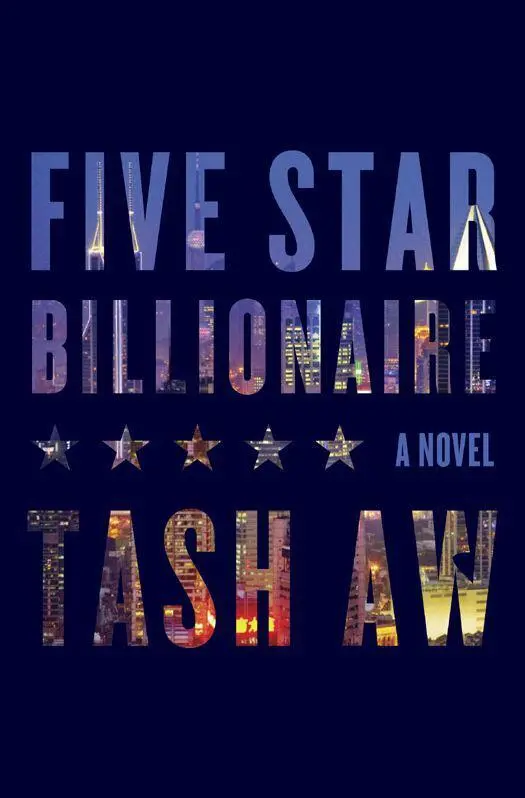
- Название:Five Star Billionaire
- Автор:
- Издательство:Spiegel & Grau
- Жанр:
- Год:2013
- ISBN:нет данных
- Рейтинг книги:3 / 5. Голосов: 1
-
Избранное:Добавить в избранное
- Отзывы:
-
Ваша оценка:
Five Star Billionaire: краткое содержание, описание и аннотация
Предлагаем к чтению аннотацию, описание, краткое содержание или предисловие (зависит от того, что написал сам автор книги «Five Star Billionaire»). Если вы не нашли необходимую информацию о книге — напишите в комментариях, мы постараемся отыскать её.
the dazzling kaleidoscopic new novel by the award-winning writer Tash Aw, offers rare insight into China today, with its constant transformations and its promise of possibility.
Five Star Billionaire — читать онлайн ознакомительный отрывок
Ниже представлен текст книги, разбитый по страницам. Система сохранения места последней прочитанной страницы, позволяет с удобством читать онлайн бесплатно книгу «Five Star Billionaire», без необходимости каждый раз заново искать на чём Вы остановились. Поставьте закладку, и сможете в любой момент перейти на страницу, на которой закончили чтение.
Интервал:
Закладка:
They took dinner that evening in the hotel restaurant, at a table set in an alcove that afforded a view of both the other diners and the undulating tea slopes, which spread across the verdant landscape like a fine rug. There were not many other people in the restaurant — a group of Taiwanese men still dressed in golfing clothes and two or three Western couples, weekend refugees from Shanghai. The room wore the minimalist aesthestic of a Buddhist temple, sparsely decorated with dark lacquered pillars and giant bronze pots sitting in pools of carefully trained light. Walter poured the wine as they began to eat, both of them delicately evading the matter of their impending business transaction, each waiting for the other to make the first move, neither wanting to seem vulgar or overanxious.
After her first glass of wine, Yinghui found that she was talking more than her companion was, that she had progressed from talking about her current life in Shanghai to her past in Malaysia. She wondered how it was that she had started to open up to him; she had not talked about her pre-Shanghai life since the day she set foot in Mainland China. She had left all that behind — for good, she had thought. But somehow it seemed easy to talk to Walter, or maybe it was just that he was skilled at obtaining information from her. He mentioned having recently been in London and asked if she knew it, and before long she was recounting humorous events from her university days. He was good at keeping her talking, interjecting brief questions that betrayed (she thought) a real interest in her life. Most of what she was telling him was completely irrelevant to their work — he did not need to know that she had named her first-ever business venture after a second-rate American film, or that she had a liking for Siamese cats — and yet she blithely spilled such information about herself upon him. He appeared to enjoy hearing this trivia, encouraging her with appreciative laughter here or a well-timed “oh, my God” there. His questions were well judged — earnest, probing, but never familiar. At one point, just as dessert arrived, she began to tell him about the fiancé she once had, all the disappointment she had endured. But she stopped herself.
Walter said nothing, allowing the silence to settle on the table. Their desserts lay before them — fragile, multicolored, architecturally precise confections arranged delicately on large white plates. Eventually he smiled and said softly, “It’s funny how life changes along the way — so full of disappointment but also surprises.”
It was a nothing comment, thought Yinghui, a platitude, but somehow, in its timing and delivery, it was perfect, as if he could sense what was going through her head and was trying to make her feel better without being intrusive.
She caught sight of her candlelit reflection in the window next to the table, her face slightly flushed from the wine, eyes shining, eager. She looked — it was so long since she’d been able to say this — like herself. “True,” she said. “You never know what’s going to be waiting around the next corner.”
She left the blinds and curtains open that night, the room in darkness. Lying in bed, she could make out the dragon’s-back undulations of the surrounding hills in the distance, their outlines fading into the night, leaving only hints of their shape; the paths that lined the river valley were lit here and there by isolated lamps, like fireflies lost in a field. As she fell asleep she decided that she would leave the curtains open, so that in the morning she would wake up with the strengthening spring light. For the first time in years, she did not set the alarm clock; when she thought about what the next day would bring, she could not articulate anything precise but felt only a warm sensation of unforced optimism, the way a child would. As she drew the fine cotton sheets around her shoulders and appreciated the silence of the air-conditioning, she was aware that she was smiling.
The next morning, despite the sunlight flooding the room, she slept until almost nine, an indecent hour by her standards. She hurriedly showered and got dressed, and when she walked into the breakfast room she knew that Walter was going to be there. His breakfast had already been cleared away, but he was reading a book; on the table, there was a cup of coffee in front of him and another place set for Yinghui.
“What are you reading?” she said as she sat down.
“Nothing special, just something silly I’ve been reading for ages and not really enjoying.”
She caught a glimpse of the cover as he slipped the book into his briefcase: The Poetics of Space , she thought it said, but couldn’t be sure. It was a book she had read at university, nearly twenty years ago, when such noncommercial issues as the poetics of space still mattered to her. She would never have thought that a man like Walter Chao would read a book like that, but now that she had met him and was beginning to discover what he was like, nothing surprised her anymore.
“I was thinking about the project,” he said, “about what it is that we are trying to do with the building. Are we trying to reimagine an entirely new space — I mean, create a completely new identity — or is it simply a reinterpretation of an existing idea? You know, using what’s there as a template for a modern version of its predecessor?”
Yinghui hesitated for a second. “Is there a difference? I mean, from a practical point of view. You want it to be a cultural-resource center with a theater and cinema, so that’s what it’s going to be, right?”
“My God, you are very practical in your thinking! The end product might be the same. But imaginatively there is a difference —how you reach the end result is really important. All the building work — every screw and nail, every coat of paint — has to be underpinned by a certain philosophy. Without it, the building has no soul.” He stopped and smiled sheepishly, looking into his cup and finding only the remnants of a foamy coffee. “Sorry, I get carried away sometimes.”
“No, please don’t apologize. What you’re saying makes complete sense. It’s just — well, I’m not used to businesspeople in Shanghai talking in such terms. Usually they only want to know how much, how fast.”
He signaled to the waiter for another coffee. “I agree. People nowadays are concerned with the bottom line — nothing else matters. What would you like for breakfast, by the way? I had noodles in soup and some guotie— really good. I saw the pancakes go past and they looked nice too. But maybe you prefer fruit and yogurt. With a figure like yours, I suspect you eat very healthily.”
Yinghui blushed. “Well, I try, but I don’t always succeed.” She had woken up starving and had been hoping for bacon and eggs, but now she felt she couldn’t have them. Walter Chao was obviously someone who observed what other people ate and drank. She needed to make a good impression, she thought, and so ended up ordering a continental breakfast, which she enjoyed.
As they chatted about the project they were embarking upon, Yinghui felt parts of her brain, for so long dormant, begin to reignite. It was strange, hearing words and expressions that she had not used for more than a decade trip off her tongue easily: “imaginative space”; “mimetic desire”; “empirical needs of architecture.” But soon they began to drift onto other topics — musings on cities they had visited, nostalgic recollections of past holidays, tiny incidents that remained etched in their memories. They discovered a shared liking for all that was offbeat — places, people, books, and music that others considered bizarre; they admired simplicity and spurned the flamboyant; they prized the unexpected, everything that was unannounced and discreet, and couldn’t care less for the kinds of things that other people thought of as majestic. She laughed out loud in agreement when he expressed a hatred for Gaudí’s Barcelona — too obvious, too obviously weird; he couldn’t stand it that people who liked Gaudí thought of themselves as “offbeat.”
Читать дальшеИнтервал:
Закладка:
Похожие книги на «Five Star Billionaire»
Представляем Вашему вниманию похожие книги на «Five Star Billionaire» списком для выбора. Мы отобрали схожую по названию и смыслу литературу в надежде предоставить читателям больше вариантов отыскать новые, интересные, ещё непрочитанные произведения.

![Scott O’Hara - Five-Star Fugitive [= Border Town Girl]](/books/432138/scott-o-hara-five-thumb.webp)







Обсуждение, отзывы о книге «Five Star Billionaire» и просто собственные мнения читателей. Оставьте ваши комментарии, напишите, что Вы думаете о произведении, его смысле или главных героях. Укажите что конкретно понравилось, а что нет, и почему Вы так считаете.