Tash Aw - Five Star Billionaire
Здесь есть возможность читать онлайн «Tash Aw - Five Star Billionaire» — ознакомительный отрывок электронной книги совершенно бесплатно, а после прочтения отрывка купить полную версию. В некоторых случаях можно слушать аудио, скачать через торрент в формате fb2 и присутствует краткое содержание. Год выпуска: 2013, Издательство: Spiegel & Grau, Жанр: Современная проза, на английском языке. Описание произведения, (предисловие) а так же отзывы посетителей доступны на портале библиотеки ЛибКат.
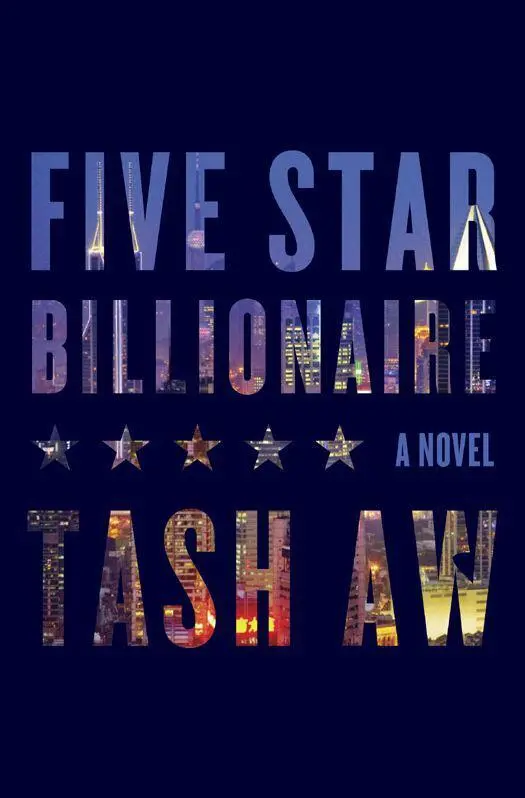
- Название:Five Star Billionaire
- Автор:
- Издательство:Spiegel & Grau
- Жанр:
- Год:2013
- ISBN:нет данных
- Рейтинг книги:3 / 5. Голосов: 1
-
Избранное:Добавить в избранное
- Отзывы:
-
Ваша оценка:
Five Star Billionaire: краткое содержание, описание и аннотация
Предлагаем к чтению аннотацию, описание, краткое содержание или предисловие (зависит от того, что написал сам автор книги «Five Star Billionaire»). Если вы не нашли необходимую информацию о книге — напишите в комментариях, мы постараемся отыскать её.
the dazzling kaleidoscopic new novel by the award-winning writer Tash Aw, offers rare insight into China today, with its constant transformations and its promise of possibility.
Five Star Billionaire — читать онлайн ознакомительный отрывок
Ниже представлен текст книги, разбитый по страницам. Система сохранения места последней прочитанной страницы, позволяет с удобством читать онлайн бесплатно книгу «Five Star Billionaire», без необходимости каждый раз заново искать на чём Вы остановились. Поставьте закладку, и сможете в любой момент перейти на страницу, на которой закончили чтение.
Интервал:
Закладка:
But maybe it would not have changed a thing. His mother might have lived to become a fat happy old woman and he would have been a failed pop star anyway. He changes the channel — he’s tired of watching lions savage zebras — and finds the pop channels. Before long he sees the latest of his music videos. It includes arty black-and-white footage of his last concert, which everyone hailed as a huge success. As he watches himself being lowered onto the stage in a messianic pose, surrounded by a twenty-strong dance troupe dressed as half-naked aliens, or in the middle of a complex dance routine, there is one thing he cannot fail to notice: the vacant expression on his face, the absence of any enthusiasm. And he remembers how difficult it was for him during those performances to feel present onstage. His body and voice did what they were trained to do, but he imagined himself elsewhere. It is so obvious now that he sees images of himself. Perhaps it is something he inherited from his mother, this absence of expression — her sole legacy to him.
This is why, when he sings love ballads — rather, when he sang love ballads (he must get used to speaking of his career in the past tense) — he often closed his eyes. Fans used to say that was because he felt so much pain, so much love, that it hurt him too much. But the truth is that he felt nothing, which is why he had to close his eyes — so that they would not betray him.
As he contemplates this emptiness once more, a text bleeps on his phone. It is his agent: Hv to leave hotel tmrw. Hv fixed rental apt 4u. Taxi at 11am. Some work is coming thru. Will call u soon .
Where r u
Taipei
Shd I come back
Better stay in Shanghai. Many journalists here. No work .
He looks at his room. Most people would panic at the thought of packing all their things overnight. But he has nothing to pack, no possessions at all, so he goes back to the chat rooms on the Internet. The girl he saw earlier is still online, still searching for someone. Her messages are not so bright and courageous anymore: Looking for any nice friend. I am alone tonight .
Gary draws his laptop to his knees and begins to type a reply. Hi … so am I .
12. WORK WITH A SOUL MATE,
SOMEONE WHO UNDERSTANDS YOU

T HANK YOU FOR YOUR INTEREST IN WORKING WITH ME, BUT I AM AFRAID I am otherwise engaged and will be unable to commit to any new business venture for at least six to twelve months. I am grateful for your inquiry and wish you great luck and success. Leong Yinghui.
She did not pause too long to consider the tone of the message before sending it out as a standard response to the many proposals that she was receiving. Every week since the awards ceremony, the number of people interested in developing a business with her, or hiring her in some capacity or another, was growing exponentially, it seemed. At first she responded fully and personally to each request, carefully considering the pros and cons of each proposal before dictating an email to her PA. Although many of the projects were vague and flimsy or downright ridiculous, there were more than a few that struck her as being potentially interesting, such as the proposal from a young woman who wanted to start a chain of tiny shops called Great Sunrise, selling socks and undergarments in the dead spaces in metro stations all across the city. But as the number of requests multiplied, her patience diminished, until eventually the banal outnumbered the intriguing, and, in refusing most, Yinghui began to find it easier to refuse them all. She knew that among the rubbish she was also throwing out possibly fascinating, life-changing opportunities. Not so long ago she would have pursued every faint trail to its end, but now things were different. Since meeting Walter Chao several weeks ago, she no longer had to worry about finding that single perfect project that would change her life. Besides, there were only so many times that one could revolutionize one’s life. Sooner or later the frantic somersaults of fortune have to end and the restlessness of desire fades. It was time — so all her friends said — that she started settling down. Such a strange expression, she thought: settling down , as if she were silt in a warm river, sinking slowly to the muddy bed. Still, it was an inevitable process, and mysterious too. Yinghui had never known how it would happen, until now.
“It’s like love,” one of her girlfriends said at dinner at their usual Hunanese restaurant (a rare occurrence, due to Yinghui’s massively increased workload, it was remarked).
“What do you mean?” Yinghui said, nibbling on a cumin-grilled lamb chop.
“The moment you’re in a relationship, guys start flocking to you. Before that, when you’re single, you search and search and wait and wait, but no one wants you. Guess business is just the same. Must be some law of the universe that makes people behave like that.”
Yinghui smiled. There was something poetic about the way recent weeks had developed — so dramatic that it seemed almost comical to her, as if life was playing a little joke, she thought. After years of struggling to mold her fortunes, fortune itself had taken hold of her life and sorted it out in one swift maneuver. Two weeks after their first meeting over dinner — an agonizing wait, which made Yinghui wonder whether he was deliberately keeping her on tenterhooks — when she received the file of documents from Walter (a slim leather folder containing not more than half a dozen sheets of paper), she sat in bed reading and rereading it late into the night. It was as if he had managed to access the furthest reaches of her memory, all her long-forgotten yearnings, and condensed his findings on a few pages of concise, matter-of-fact prose. At first she thought it was a joke or maybe she had been working too hard and, on the verge of a hysterical exhaustion-related breakdown, had begun to imagine things. But, no: She reread it, and it was not a joke. He was not a mind reader; it was just chance, pure and simple. All her messy ambitions had resurfaced, repackaged now in sophisticated, adult form: the hyper-businesslike version of her vague ramblings over a decade ago.
… in summary the project would, therefore, involve not just the preservation of the fabric of this historic building but the creation of a wholly contemporary, indeed revolutionary, state-of-the-art center for the performing arts as well as a cultural-resource center supported by a combination of public and private financing.
She turned back to the beginning of the folder, marked STRICTLY PRIVATE AND CONFIDENTIAL. It read like something she might have written herself fifteen years ago, when her interests extended beyond how to extract the most favorable terms of credit from textile suppliers:
First built as an opulent opium den in the early 1900s (the exact date is unclear, but is believed to be sometime between 1905 and 1908, not long after the end of the Sino-Japanese War), the building now known simply as 969 Weihai Lu was later bought by a tobacco magnate, who remodeled the rooms and added two wings to the structure, including ornate decorative touches such as scrolling classical plasterwork on the external pillars and marble fireplaces, some of which survive today. In its heyday in the 1920s and early 1930s, 969 Weihai Lu witnessed extravagant gatherings that reflected Shanghai’s position as one of the world’s most cosmopolitan and hedonistic cities. It was here that Yao Lee and other great singing stars often appeared at private parties, interpreting such sultry classics as “The Cocktail Song” and “Can’t Get Your Love” (often called “The Prostitute’s Song,” the first song to be banned by the Communist regime).
Читать дальшеИнтервал:
Закладка:
Похожие книги на «Five Star Billionaire»
Представляем Вашему вниманию похожие книги на «Five Star Billionaire» списком для выбора. Мы отобрали схожую по названию и смыслу литературу в надежде предоставить читателям больше вариантов отыскать новые, интересные, ещё непрочитанные произведения.
![Scott O’Hara - Five-Star Fugitive [= Border Town Girl]](/books/432138/scott-o-hara-five-thumb.webp)





Обсуждение, отзывы о книге «Five Star Billionaire» и просто собственные мнения читателей. Оставьте ваши комментарии, напишите, что Вы думаете о произведении, его смысле или главных героях. Укажите что конкретно понравилось, а что нет, и почему Вы так считаете.