Tash Aw - Five Star Billionaire
Здесь есть возможность читать онлайн «Tash Aw - Five Star Billionaire» — ознакомительный отрывок электронной книги совершенно бесплатно, а после прочтения отрывка купить полную версию. В некоторых случаях можно слушать аудио, скачать через торрент в формате fb2 и присутствует краткое содержание. Год выпуска: 2013, Издательство: Spiegel & Grau, Жанр: Современная проза, на английском языке. Описание произведения, (предисловие) а так же отзывы посетителей доступны на портале библиотеки ЛибКат.
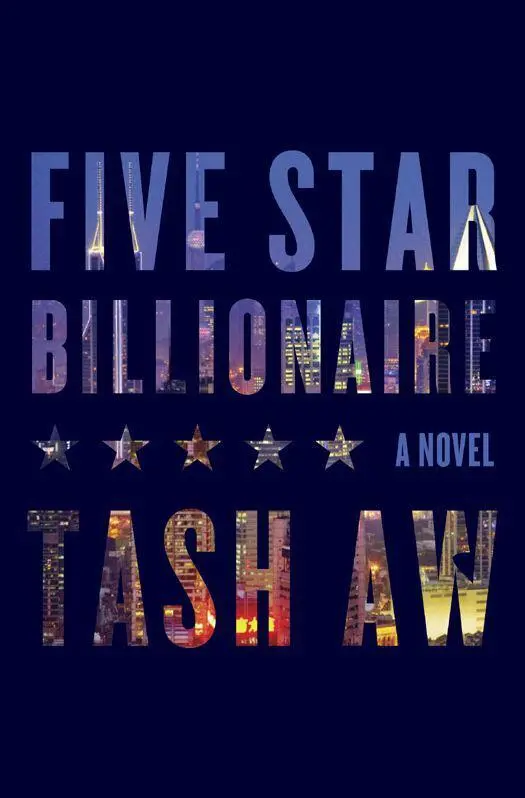
- Название:Five Star Billionaire
- Автор:
- Издательство:Spiegel & Grau
- Жанр:
- Год:2013
- ISBN:нет данных
- Рейтинг книги:3 / 5. Голосов: 1
-
Избранное:Добавить в избранное
- Отзывы:
-
Ваша оценка:
Five Star Billionaire: краткое содержание, описание и аннотация
Предлагаем к чтению аннотацию, описание, краткое содержание или предисловие (зависит от того, что написал сам автор книги «Five Star Billionaire»). Если вы не нашли необходимую информацию о книге — напишите в комментариях, мы постараемся отыскать её.
the dazzling kaleidoscopic new novel by the award-winning writer Tash Aw, offers rare insight into China today, with its constant transformations and its promise of possibility.
Five Star Billionaire — читать онлайн ознакомительный отрывок
Ниже представлен текст книги, разбитый по страницам. Система сохранения места последней прочитанной страницы, позволяет с удобством читать онлайн бесплатно книгу «Five Star Billionaire», без необходимости каждый раз заново искать на чём Вы остановились. Поставьте закладку, и сможете в любой момент перейти на страницу, на которой закончили чтение.
Интервал:
Закладка:
With the Japanese occupation of Shanghai, the mansion was abandoned and later was used for light-industrial purposes. The generous proportions of its rooms lent itself to housing a printing press, a tannery, and a match factory. Walls were demolished, and the entire west wing of the building was torn down in the 1950s as industrial space was continually constructed around the original mansion, completely enveloping and dwarfing it by the end of the 1960s. The labyrinth of narrow green-painted corridors dates from this period, as do the glass-and-lead ceilings in the north range of the site. Although this Communist-era architecture might fall foul of modern tastes, it is also a prime example of the starkly striking aesthetic that marked the Cultural Revolution, illustrating the peasant and industrial roots of that period of Chinese history.
We strongly refute the idea that the easiest architectural solution to 969 Weihai Lu is to tear it down. While reorganizing its space and reestablishing a use for it might be difficult, we believe that every effort must be made to preserve not only the traces of the original mansion but the seemingly ramshackle industrial structures that form the bulk of the building.
Reading the documents in the folder, Yinghui felt the same passions she had experienced in her twenties, when, recently graduated from university, her view of the world had been clumsy in its naïveté, when she had seen possibility in everything — and, in particular, herself. Now these sentiments were allied to a harsher, more solid appreciation of reality, which intensified that rush of optimism. These were no longer the empty dreams of youth: She could change the world now; she could make it a better place for everyone, principally herself.
She took a few moments to appreciate how far she had come over the years, her gradual transformation from a girl who could barely distinguish between the debit and credit columns in the business accounts of a tiny cash-only café to the cool, collected businesswoman she was today. She had never really understood the financial pages in the newspapers, had always resented their existence even more than that of the sports pages, and yet nowadays she read them diligently, paying particular attention to activity in the real estate and retail sectors. It had been a slow, painful metamorphosis, she thought: a third of her life spent changing who she was. It was amazing what grief and pride could do to a person. But she did not wish to dwell on this just now; she merely allowed a brief self-congratulatory smile before continuing with the papers before her.
She looked at the financial provisions — an up-front lump sum plus a percentage of the total earnings of the center on its completion. The projected profits (so many shop units, right in the middle of town, so many high-class tenants, so much advertising space) were astronomical yet suddenly attainable. She triple-checked the figures, calculating and recalculating them in RMB and U.S. dollars. It was, in so many ways, too good to be true.
But this was China, she told herself. The unfeasible had a habit of being true; she had to believe the unbelievable.
All she had to do was invest a not-inconsiderable sum of money — in fact, most of the capital she possessed, augmented by a large bank loan. That certainly added a note of realism, but it was only to be expected — a sign of her dedication to the project, a symbol of trust and cooperation. She liked the groundedness of the figure, the six zeros looking reassuringly weighty, anchoring her thoughts in the seriousness of the deal. This was business, after all, not a charity. Risks — yes, they existed, but she had taken far greater in her career so far.
Although it took her a few days to get back to Walter — she wanted to give him the impression that she was thinking long and hard about it, considering every minute detail — it had in fact taken her less than a minute to decide: She would do it.
“Great,” he said calmly when she rang him, as if her decision had been entirely expected. “What are you doing this weekend?”
“Not much — catching up on paperwork. Why?”
“How about going to Hangzhou for the weekend — to discuss our proposal in detail? Shanghai is too distracting for this kind of negotiation. I mean, we’re talking about ideas, not only money. Why don’t we escape for a bit, free our minds? One of the reasons I wanted you on board was that I need someone with imagination, not some boring businesswoman. Let’s just go and chat. I think it’ll be very beneficial for our … transaction.”
Yinghui smiled. She liked the way he spoke, his curious mixture of easy and awkward, as if in searching for the right words to express how he felt, he knew he was going to find the wrong turn of phrase. “Beneficial for our transaction.” What did he mean? Was it a pickup line, an invitation to a romantic weekend? Or did he intend to spend two days in a conference room, standing in front of a whiteboard and PowerPoint presentations, expecting her to contribute with earnest financial calculations?
“That sounds appealing,” Yinghui said. “It seems ages since I’ve had some time away from work. As for ideas, well, I don’t know if I have any these days.”
He laughed. “Of course you do. You’re bursting with beautiful thoughts. Shall I pick you up on Friday, say, early afternoon?”
When she put the phone down, Yinghui found she was still smiling. Maybe it was the thought of a weekend off work, her first in years; or maybe it was the idea of spending time with a man she barely knew; or perhaps it was simply the way he had delivered that line—“bursting with beautiful thoughts”—a pretty but, frankly, strange way to describe a new business associate. Maybe it was because she wanted to believe it was true: that she was still full of beautiful thoughts.
THEY ARRIVED AT THEIR hotel a few miles north of West Lake late in the afternoon, the driveway up to the main reception building rising and falling gently as it traced the undulations of the tea plantations that covered the hills in that area. They had driven from Shanghai with little conversation, other than to comment on the heavy traffic, the mass of cars that did not thin out no matter how far they traveled from the city. There was a point in the drive when, although they were both silent, Yinghui knew that Walter was thinking the same thing as she was: whether they would ever escape Shanghai, for its boundaries seemed never to end, stretching virtually all the way to Hangzhou. Perhaps their weekend would not be one of escape after all; perhaps, mired in a glorified suburb of Shanghai, they would simply speak of business and nothing else, all those beautiful thoughts remaining unexpressed.
But then, quite suddenly out of the unremarkable urban mess of downtown Hangzhou, they found themselves along the banks of West Lake, the surface of the water flat and cold and gray, tinged with mist so that the hills that rose on the far shore looked dreamy and indistinct. Pagodas rose from the perfect flatness of the water; arching bridges traversed little creeks that fed into the lake — like a perfect mise-en-scène of a play that Walter was directing. Within minutes they were driving through tea plantations, the rows of velvety bushes stretching toward pine-covered hills in the distance. Every so often they would pass perfect models of traditional villages, handsomely restored and decorated with osmanthus trees; there were tourist buses along the route, big parties of old men and women from other provinces following their flag-waving leader like children on a school outing.
They were greeted at the hotel by the Swiss manager, who showed them to their rooms — their respective rooms. Yinghui wandered around the suite: an entire village house gutted to create a bedroom and living room almost as large as her apartment in Shanghai, with a bathroom almost as large as the bedroom, and an outdoor terrace made from smooth cedar planks with a small pool set along its far edge. “Just to avoid any awkwardness,” Walter had said in the car, “my company is going to pick up the tab this weekend, so please don’t worry about anything.” He had said it as if issuing instructions, giving the impression that he did not want to discuss the matter — indeed, that he was not used to discussing such trivial questions as bill-paying. As she wandered around the room, admiring the gray silk furnishings and the tasteful low lighting, she thought about how Walter had organized everything thus far, leaving her with nothing to do except turn up. Even though he had not said anything about dinner that evening, she knew that it would already have been taken care of, as would everything else for the remainder of the weekend. She tried to remember if anyone had ever done this for her — anticipated her every need and provided every conceivable comfort — but she was certain that no one ever had. She had grown so accustomed to handling every tiny detail that she did not quite know how to feel now that someone was taking charge of her this way. It felt odd, certainly — but not disagreeable.
Читать дальшеИнтервал:
Закладка:
Похожие книги на «Five Star Billionaire»
Представляем Вашему вниманию похожие книги на «Five Star Billionaire» списком для выбора. Мы отобрали схожую по названию и смыслу литературу в надежде предоставить читателям больше вариантов отыскать новые, интересные, ещё непрочитанные произведения.

![Scott O’Hara - Five-Star Fugitive [= Border Town Girl]](/books/432138/scott-o-hara-five-thumb.webp)









Обсуждение, отзывы о книге «Five Star Billionaire» и просто собственные мнения читателей. Оставьте ваши комментарии, напишите, что Вы думаете о произведении, его смысле или главных героях. Укажите что конкретно понравилось, а что нет, и почему Вы так считаете.