Tash Aw - Five Star Billionaire
Здесь есть возможность читать онлайн «Tash Aw - Five Star Billionaire» — ознакомительный отрывок электронной книги совершенно бесплатно, а после прочтения отрывка купить полную версию. В некоторых случаях можно слушать аудио, скачать через торрент в формате fb2 и присутствует краткое содержание. Год выпуска: 2013, Издательство: Spiegel & Grau, Жанр: Современная проза, на английском языке. Описание произведения, (предисловие) а так же отзывы посетителей доступны на портале библиотеки ЛибКат.
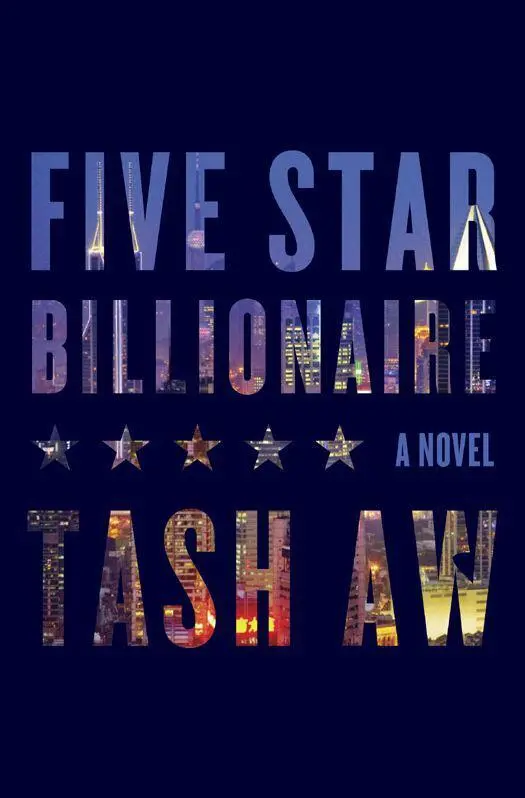
- Название:Five Star Billionaire
- Автор:
- Издательство:Spiegel & Grau
- Жанр:
- Год:2013
- ISBN:нет данных
- Рейтинг книги:3 / 5. Голосов: 1
-
Избранное:Добавить в избранное
- Отзывы:
-
Ваша оценка:
Five Star Billionaire: краткое содержание, описание и аннотация
Предлагаем к чтению аннотацию, описание, краткое содержание или предисловие (зависит от того, что написал сам автор книги «Five Star Billionaire»). Если вы не нашли необходимую информацию о книге — напишите в комментариях, мы постараемся отыскать её.
the dazzling kaleidoscopic new novel by the award-winning writer Tash Aw, offers rare insight into China today, with its constant transformations and its promise of possibility.
Five Star Billionaire — читать онлайн ознакомительный отрывок
Ниже представлен текст книги, разбитый по страницам. Система сохранения места последней прочитанной страницы, позволяет с удобством читать онлайн бесплатно книгу «Five Star Billionaire», без необходимости каждый раз заново искать на чём Вы остановились. Поставьте закладку, и сможете в любой момент перейти на страницу, на которой закончили чтение.
Интервал:
Закладка:
They all had to think big and think ahead, said Nik K.; that was the future of this small town.
My father had virtually no money, but, fired up by the prospect of turning handsome profits in no time at all, he set about finding a lump sum with which to pay Nik K. He wrote to his distant relatives in Machang and Kuala Krai and cousins of cousins in Gua Musang and Kuantan — people he had never met but had heard of through the intricate spiderweb network of rural Chinese families. The note he sent was a cross between a begging letter and a financial prospectus, appealing to both their sense of pity and their greed. He got on his scooter and made long trips south to visit them in their villages to explain that the only way out of his predicament was to make a fortune; the only way he could be saved from ruin was to turn everyone into rich men. Double or quits; the only way was up.
Before long, he had enough money to pay Nik K. for the Tokyo Hotel, and the deeds were transferred into his name. But immediately there was a further problem: He needed money for the renovation works. He drew up a list of basic repairs: replacing a section of the roof; securing the windows; replacing the wiring; restoring the water and electricity supplies; clearing the tangled mess of shrubs and trees from the small plot of land at the back. The amount of money needed for these works was nearly double what he had paid for the building. His despair did not last long, for Nik K. again came to the rescue: He had contacts in the property world, people who owed him favors because he’d given them valuable tips on where to buy and sell pieces of land. He could arrange a loan for my father, he said, no questions asked — the sum of money my father needed was peanuts for these people. And so my father entered into a speedy, seamless arrangement with a Chinese merchant on 17 percent interest. I remember the figure well because it seemed a strange number, stranded between 15 and 20, as if someone had made an unreasoned compromise. To my father, this figure would have meant very little. His lenders could have asked him for 0.1 percent or 98 percent, and he would have cheerily agreed. When he was in one of these moods, riding on a high of optimism and desire, he would have said yes to anything. The number was also memorable to me because, as it happened, I was about to turn seventeen — an event of which my father was blissfully ignorant.
He began work on the Tokyo Hotel not long before I arrived back from Johor, but even by the time I returned to Kota Bharu, it was clear that the renovation works had run into problems. He had started to clear the scrubby forest from the quarter-acre plot of land behind the hotel, but, alone and equipped only with a parang and an ax, he was easily defeated by the dense vegetation. At the end of a long day, the huge pile of branches and tree stumps he had cut seemed to make little difference to the immensity of unyielding foliage that remained. Without a bulldozer or a team of men with chain saws, he could not overcome the jungle. So he turned his attention to restoring the electricity and plumbing in the hotel. He’d always been good at this sort of thing, having worked as a handyman at various building sites in the past (he said). He began digging channels in the floors for the laying of new wires and pipes, knocking down some walls and scraping the plasterwork off others — better to make a mess at the start, he had said in a letter to me, just before I abandoned my technical studies to join him. Although I had completed only one year of my electrician’s course, I had already learned enough to know that he had no clue what to do.
Fortunately, his shoddy wiring was never allowed to progress to a point where it might endanger his life and that of others. Alerted by news of building work at the Tokyo Hotel, two officials from the town council arrived at the site to find out what was going on. They found my father stripped to the waist, surrounded by piles of broken masonry and half-mixed mortar and coils of electric cable. “I’m going to start running a hotel,” he blithely informed them. “As soon as I get the works finished.”
There were rules and regulations, they told him: He couldn’t just fix up a building and start running a hotel. It was the eighties now, there was a modern system of doing things, and, anyway, this wasn’t some kampung where everyone could do what they wished. He had to apply for planning permission for the renovation work; all the electricity and plumbing had to be done by someone with proper qualifications and would need to be inspected; then he would need to apply for a license to run a hotel; he’d need a certificate to show he had done a course in safety and hygiene. All that would take time — and money.
In the meantime, the leaks in the roof were turning the loosened plasterwork to mud on the upper floors, and on the ground floor a flash flood lifted up the floor tiles my father had proudly laid not a few weeks previously, redistributing them in a kaleidoscope of cheap color. Not one to be easily defeated, my father channeled his optimism (and remaining money) into painting the façade of the building, on the grounds that a cheery exterior would give the hotel the beginnings of a new life and lead — somehow — to a turn in fortunes. Although he did not say as much in his letters, I knew that he was waiting for me to return to help him — to save him.
I arrived to find the building clad in bamboo scaffolding, the top half mottled with patches of whitewash that accentuated the dirty gray background. My father had retreated to a small room at the rear corner of the ground floor, where he had erected a canvas camp bed and a two-ring table-top cooker attached to a gas canister. There were streaks of mud snaking faintly across the floor — traces of the flash flood he had mentioned — but otherwise the room seemed dry and sound and cool, and a faint breeze came in through the single glassless window.
The rest of the building was a disaster. As I walked up the staircase that had long since lost its banister, it was virtually impossible to imagine what the interior had been like when it was first built as a hotel (which must have been around the time of my birth — not all that long ago). Partition walls made of thin board lay half dismantled, uneven pyramids of bricks lay piled up in the middle of empty spaces, dried-up pools of not-quite-mixed cement crept across some floors, and there were gaps in the roof that afforded me a glimpse of the gray rain clouds that hung low in the sky. I could not bring myself to ask my father whether it was he who had created this mess or if it had already existed when he bought the building. Nor could I bear to tell him that there was nothing I could do to help him. It was hopeless, just as I feared it would be.
Nonetheless, I spent two weeks with him, explaining how fuses and junction boxes worked, how to create intricate circuits with breakers and multiple switches. I drew designs on pieces of paper, which he admired and kept pinned to the wall in his room as if they were works of art. He learned quickly and praised my knowledge as if I were offering him great revelations; he spoke of how he would have a fridge in every room, and eventually air-conditioning too, how he would be so popular that people would have to ring days ahead to book rooms. I agreed and enthused; it was the best thing I could do for him: to make him believe that his dreams could come true. After a fortnight of playing around with lengths of wire and patching up holes in walls with flimsy plasterwork that wouldn’t quite stick, I made excuses as to why I had to leave to go back down to Johor. My course would teach me more skills that I could use to help him; maybe I could also learn masonry and plumbing, which would come in handy when the hotel was up and running.
Читать дальшеИнтервал:
Закладка:
Похожие книги на «Five Star Billionaire»
Представляем Вашему вниманию похожие книги на «Five Star Billionaire» списком для выбора. Мы отобрали схожую по названию и смыслу литературу в надежде предоставить читателям больше вариантов отыскать новые, интересные, ещё непрочитанные произведения.

![Scott O’Hara - Five-Star Fugitive [= Border Town Girl]](/books/432138/scott-o-hara-five-thumb.webp)









Обсуждение, отзывы о книге «Five Star Billionaire» и просто собственные мнения читателей. Оставьте ваши комментарии, напишите, что Вы думаете о произведении, его смысле или главных героях. Укажите что конкретно понравилось, а что нет, и почему Вы так считаете.