Tash Aw - Map of the Invisible World
Здесь есть возможность читать онлайн «Tash Aw - Map of the Invisible World» — ознакомительный отрывок электронной книги совершенно бесплатно, а после прочтения отрывка купить полную версию. В некоторых случаях можно слушать аудио, скачать через торрент в формате fb2 и присутствует краткое содержание. Год выпуска: 2010, Издательство: Spiegel & Grau, Жанр: Современная проза, на английском языке. Описание произведения, (предисловие) а так же отзывы посетителей доступны на портале библиотеки ЛибКат.
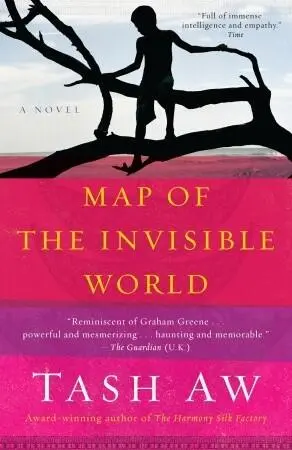
- Название:Map of the Invisible World
- Автор:
- Издательство:Spiegel & Grau
- Жанр:
- Год:2010
- ISBN:нет данных
- Рейтинг книги:4 / 5. Голосов: 1
-
Избранное:Добавить в избранное
- Отзывы:
-
Ваша оценка:
Map of the Invisible World: краткое содержание, описание и аннотация
Предлагаем к чтению аннотацию, описание, краткое содержание или предисловие (зависит от того, что написал сам автор книги «Map of the Invisible World»). Если вы не нашли необходимую информацию о книге — напишите в комментариях, мы постараемся отыскать её.
comes an enthralling novel that evokes an exotic yet turbulent place and time—1960s Indonesia during President Sukarno’s drive to purge the country of its colonial past. A page-turning story,
follows the journeys of two brothers and an American woman who are indelibly marked by the past — and swept up in the tides of history.
Map of the Invisible World — читать онлайн ознакомительный отрывок
Ниже представлен текст книги, разбитый по страницам. Система сохранения места последней прочитанной страницы, позволяет с удобством читать онлайн бесплатно книгу «Map of the Invisible World», без необходимости каждый раз заново искать на чём Вы остановились. Поставьте закладку, и сможете в любой момент перейти на страницу, на которой закончили чтение.
Интервал:
Закладка:
Out on the street she felt light-headed and uncertain. It was a long way to her hotel, too far to walk. She had kept her coat on in the restaurant and only now, in the fading afternoon, did she realize that she had been sweating. She had been sweating in the restaurant and now she was cold. She was cold and she had drunk too much wine. Maybe she could make her way to the Luxembourg Gardens again, where she would watch the children running amid the piles of fallen leaves, laughing and calling out to their young mothers. She could sit on a bench, maybe, near the curving stone balustrade that Karl had liked when he was a young man, younger than she was now. She would like that, she thought. As she began to walk a man fell in step beside her. It was the man with the mustache who had smiled at her during lunch. He wore a gray herringbone coat and a felt hat. “Bonjour,” Margaret said. She realized how miserable she sounded, how miserable and cold and lonely. They walked for a while and chatted about things that Margaret cannot now remember. What she can recall is that after some time they reached a handsome building of pale stone. They paused at the heavy door. It was painted black and carved with foliage; next to it there were dark plaques with CABINET MÉDICAL and people’s names written in gold letters. They went up to a room. In it there were two armchairs and a sofa covered in old, blue cloth embroidered with gold bees. There was a beautiful writing desk and a neat pile of cream-colored paper on it. He lit the fire, and when she felt warm again he led her into a smaller room, where there was a bed and nothing else. This is what you call a garçonnière , Margaret thought. The man’s name was Georges, and he had broad, kind hands.
In the weeks that followed she saw her lover once or twice a week (she was someone’s mistress, she thought, a real-life maîtresse: how exciting). She liked going to his pied-à-terre, which was warmer than her lodgings and not at all drafty. They went to the Louvre to look at paintings. He showed her a gallery full of portraits of heroic figures, Roman soldiers preparing for war, swords aloft, their women weeping in distress. There was another painting in the same style of a man lying dead in a bathtub. Margaret did not like these paintings, but she did not say so. She found them mannered and showy, and embarrassingly artificial; Karl would not have liked them, she thought. As she stood with Georges in front of a large canvas depicting a mass of beautiful classical warriors (Spartan, she thought, though she wasn’t sure and didn’t really care), she saw a young man making notes. He had made a sketch too, a crude one showing the principal figures as jelly like blobs with arrows showing their names. He looked up at her and winked, and then continued to scribble. He was writing in English, she noticed. The next day, when she returned on her own at the same hour, he was there again, in front of the same painting.
“Are you English?” she asked, although he was obviously Mediterranean, not at all Anglo-Saxon.
He shook his head. “Australian. You?”
“Guess.”
He narrowed his eyes and shook his head, smiling. “French? Dutch? Don’t know. Have I failed a really important test?”
Margaret laughed. She was pleased he did not say “American.” She liked his dark eyes and timid smile.
They were both young and lonely in Paris, which is a terrible place to be young and lonely. And so they became friends.
Her days did not seem so long and empty now, and she no longer dreaded the winter nights that started midway through the afternoon. They went on long walks together, and Margaret was glad to have company, for it meant that she did not have to think about Karl and the places he had been. Their walks were sometimes guided by her new friend, sometimes haphazard; she no longer felt obliged to trace the invisible path of Karl’s former life in this beautiful, cold city. She was also glad to be able to speak in English, a language she’d never thought she would miss. It was silly of her to be glad of this, she knew, but she was glad all the same. Even better than speaking English was listening to it, and on their walks she would often remain quiet for long stretches, just enjoying the sound of her companion’s voice. He talked a lot; he knew many things about many things. He told her about Rimbaud, for example, who at twenty-two had joined the Dutch army as a mercenary to fight guerrillas in Aceh, but after a few brief weeks witnessing malaria, dysentery, snakebites, and amputations had fled the East Indies. Rimbaud believed that in life one will go where one does not want to go, do what one would rather not do, and live and die in not at all the way one ever had in mind. “Isn’t that so true?” Mick exclaimed. “Look at us!”
Margaret also learned the following things: that her new companion was named Michael, that he was of Greek descent, and that there were many Greeks in Australia; that his ancestors were from Laconia but his parents had been uncommunicative rather than laconic; that, on leaving home on the eve of the battle from which he would never return, Leonidas, a great Laconian, advised his wife simply: “Marry a good man and bear good children.”
Margaret could ask Michael anything and he would have the answer:
“Do you know a poem by Victor Hugo — something about a lady-bug, and a boy who wants to kiss a girl?”
“Of course. ‘La Coccinelle.’”
“What happens in it? A boy thinks a girl wants him to kiss her, but instead all she wants him to do is to get rid of a ladybug on her neck. Is that right?”
“Hmm. No. Let me think. No. The girl wants the boy to kiss her, but doesn’t say so. She says, ‘Something is tormenting me, look.’ And she offers her face and neck to the boy. But the boy sees only the insect and not the kiss. It’s about missed opportunities in life, about being too bashful and not taking your chance when it presents itself to you; about regretting things in old age — about not grabbing those fleeting moments of love, I suppose. Why do you ask?”
“Oh, no reason. It just came into my mind.”
In truth it didn’t really matter what she and her new Laconian friend spoke about. Margaret simply enjoyed the unfamiliar yet somehow comforting cadences of his voice, reminding her of another part of the world far, far away from Europe and even farther away from America. It reassured her to know that this other world was still there and that she had not forgotten it.
This is how Margaret remembers meeting Mick. She remembers everything he said very clearly, even now, in this sprawling Asian city where he has become middle-aged and less talkative — laconic, or maybe just downright uncommunicative. She remembers sitting with him in a cheap restaurant near the Panthéon, eating soup and ham and bits of stale baguette, and the excitement she felt when he folded the newspaper and handed it to her, showing her a picture of Queen Juliana of Holland greeting Mohammed Hatta in Amsterdam (with her near-photographic memory, she can still recall the caption: LA HOLLANDE ET L’INDONÉSIE PROCÈDENTE AU TRANSFERT DE SOUVERAINTÉ, as well as the circular grease stain that had seeped through the picture).
Mick was with her when she arranged her passage to Java, on the Willem Ruys , sailing from Rotterdam to Tanjong Priok. He also came to see her off at the Gare du Nord. She told him to come and meet her in Asia, and that if he didn’t, she would come looking for him and spank his bottom. They laughed. And Margaret remembered that she had said good-bye in this way to Karl; she remembered, also, that she believed she would never see either man again.
“Don’t worry.” Mick smiled. “You’ll be lounging around in tropical splendor in some palace in Jakarta and I’ll just turn up on your doorstep.”
Читать дальшеИнтервал:
Закладка:
Похожие книги на «Map of the Invisible World»
Представляем Вашему вниманию похожие книги на «Map of the Invisible World» списком для выбора. Мы отобрали схожую по названию и смыслу литературу в надежде предоставить читателям больше вариантов отыскать новые, интересные, ещё непрочитанные произведения.








Обсуждение, отзывы о книге «Map of the Invisible World» и просто собственные мнения читателей. Оставьте ваши комментарии, напишите, что Вы думаете о произведении, его смысле или главных героях. Укажите что конкретно понравилось, а что нет, и почему Вы так считаете.