Tash Aw - Map of the Invisible World
Здесь есть возможность читать онлайн «Tash Aw - Map of the Invisible World» — ознакомительный отрывок электронной книги совершенно бесплатно, а после прочтения отрывка купить полную версию. В некоторых случаях можно слушать аудио, скачать через торрент в формате fb2 и присутствует краткое содержание. Год выпуска: 2010, Издательство: Spiegel & Grau, Жанр: Современная проза, на английском языке. Описание произведения, (предисловие) а так же отзывы посетителей доступны на портале библиотеки ЛибКат.
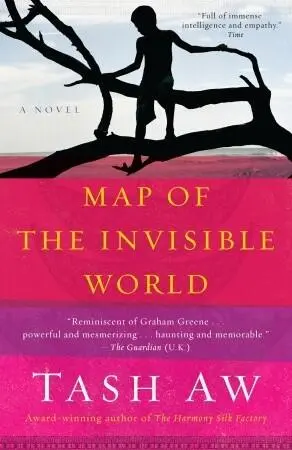
- Название:Map of the Invisible World
- Автор:
- Издательство:Spiegel & Grau
- Жанр:
- Год:2010
- ISBN:нет данных
- Рейтинг книги:4 / 5. Голосов: 1
-
Избранное:Добавить в избранное
- Отзывы:
-
Ваша оценка:
Map of the Invisible World: краткое содержание, описание и аннотация
Предлагаем к чтению аннотацию, описание, краткое содержание или предисловие (зависит от того, что написал сам автор книги «Map of the Invisible World»). Если вы не нашли необходимую информацию о книге — напишите в комментариях, мы постараемся отыскать её.
comes an enthralling novel that evokes an exotic yet turbulent place and time—1960s Indonesia during President Sukarno’s drive to purge the country of its colonial past. A page-turning story,
follows the journeys of two brothers and an American woman who are indelibly marked by the past — and swept up in the tides of history.
Map of the Invisible World — читать онлайн ознакомительный отрывок
Ниже представлен текст книги, разбитый по страницам. Система сохранения места последней прочитанной страницы, позволяет с удобством читать онлайн бесплатно книгу «Map of the Invisible World», без необходимости каждый раз заново искать на чём Вы остановились. Поставьте закладку, и сможете в любой момент перейти на страницу, на которой закончили чтение.
Интервал:
Закладка:
A military band on the mezzanine was playing silly, sugary tunes — folk songs that Adam thought he knew, though they had been altered to such a degree that he was not sure if they were the same songs. There was the one about the fisherman and the seagull. The fisherman was in love with the daughter of a rich farmer who wouldn’t let her marry the fisherman because he was too poor. So every day the fisherman would pour his heart out to the seagull, and the seagull would give him advice; it would sing to him and say, Never lose hope for love, for love will come back to you, never lose hope for love, for love is true even if man is not. That was the chorus. Except Adam was not sure it was the same song; he couldn’t tell because of the trumpets and the clanging of the drums. The song finished and they began “Bengawan Solo.” He heard a murmur of approval, a sigh of nostalgia accompanied by a ripple of applause. But above the music Adam sensed something else. A few soldiers had come into the lobby, spreading out as if to look for someone; with them was the waiter who had looked at Adam earlier, the one who had not wanted to serve him drinks, who was now pointing in the general direction of the Batik Bar. The soldiers craned their necks to try and see into the crowd. Adam bowed his head; he knew they were looking for him.
A few more soldiers stood outside the doors, facing in. They had guns, cocked and ready. Some of the guests in the lobby noticed that soldiers had come into the building. Adam paused next to a middle-aged couple. “What’s happening?” the woman asked. “Oh, nothing, darling, don’t worry,” replied the man, but he sounded worried. The music continued, but Adam could feel the unease in the crowd; some people had stopped talking and were watching the soldiers push their way toward the restrooms. Adam looked up briefly in the direction of the doors. He would make a run for it; he would wait until a new group of people arrived, and when the doors opened to let them in he would make a dash for it. Hadn’t Din said that the president himself was due to arrive very soon? Surely no one would notice a boy slipping out just as the president’s entourage arrived. He had to keep calm, be patient, then break for freedom. Chance, he thought, just surrender to chance.
But no one seemed to be arriving. Whereas previously there had been a constant stream of guests stepping out of limousines, now it was as if the hotel had been sealed off. Adam looked around him cautiously. The noise had died down; just a bit of nervous laughter, one or two men trying to sound jolly; all other sounds were drowned out by the music. The song was definitely “Bengawan Solo,” even though the band played it as though it were a military march. Adam tried to remember how it really sounded; he imagined it playing on the radio as it always did; children would sing it at village celebrations and their parents would become teary and melancholic and talk about the war and the occupation. “Bengawan Solo … Trapped by mountains/you journey forever and finally/escape to sea.” “But it’s just about a river,” Adam would say to Karl. And Karl would smile and say, “Not just that, Son; one day you will see.” Adam thought about this now and he remembered how the song really sounded, away from this place.
He would make a break for it. At the count of three. A path had formed between him and the doors, a narrow alley that snaked its way through the static crowd. Adam began to step forward, feeling a sudden surge of strength in his legs. But at the end of his path he suddenly saw the waiter who had been looking for him, the waiter who was definitely from the islands and who knew that Adam did not belong in this place. The waiter raised his hand, beckoning to the soldiers. He was waving them over to Adam, pointing into the crowd to where Adam stood. His eyes were wide with fear, and Adam realized it was the first time in his life he had ever inspired fear in someone. He heard the clatter of boots on the marble floor across the foyer. He had to run, he knew he had to, but he couldn’t.
“Adam?” someone said. A woman appeared before him, someone he had brushed past earlier. “Is that you? Oh my god, it is you. I wasn’t sure if it was you. What are you doing here?” Her hair was pulled back from her face; her eyes were lined with black and shaded with a dark turquoise and her lips were pink and glossy. She wore a blue and red kebaya with red shoes; she looked like a film star, Adam thought. “It’s me, Zubaidah,” she said. “You know, Z. What a surprise to see you!” She reached out and took his hand, clasping it between hers as if greeting an old friend.
Two soldiers were now standing with the waiter. They were looking helplessly into the crowd, but not at Adam. Adam looked at the waiter and caught his eye, just for a second; but the waiter looked away swiftly. He stood with his shoulders hunched; he shrugged and shook his head before sloping away, leaving the soldiers to scan the room for the invisible enemy.
“So, are you best friends with the president too?” She laughed and raised her hand to brush away a wisp of hair from her face; on her wrist she wore a slim, silvery watch that glinted shyly.
Adam shrugged. He could not quite believe that this film-star woman was Z, but the voice was the same, the throaty giggle was the same. It was her.
“Isn’t this awful?” she said, half-whispering. “All these terrible people. I’m here because of my father. He forced me to come. My mother’s away and he needs to appear as if he has a nice, happy family. What could I do?” She spread her fingers, palms facing upward in a gesture of helplessness, and rolled her eyes. “In the end even revolutionaries have to do what their parents tell them. I like your shirt. It’s nice.”
“It belonged to my father,” Adam replied.
They heard raised voices from the far corner of the lobby; a scuffle. A woman gasped loudly; people in the crowd stirred, trying to see what was going on.
“It’s so stupid,” Z said. “People panic so easily nowadays. Ever since that ridiculous assassination attempt on the president, things have been getting worse. All these rich people think that Communists are trying to bomb them to pieces at every turn. Look at them. Who would want to bomb this lot? The shrapnel from the jewelry would be terrible.”
Adam noticed that there were even more guards outside now. Some of them ran into the lobby, heading for the corner where the rest-rooms were. The music stopped and everyone could hear the soldiers’ harsh voices echoing in the lobby. There was a murmur in the crowd; a few people began to leave, shepherded by soldiers into their waiting limousines.
“Maybe it is serious,” said Z. “Anyway, I think the party’s over.” The guests were being ushered out of the lobby by the soldiers and Adam could see that even the band had abandoned their instruments. “Come on, Adam, we should go.”
“I thought you were with your father?”
“He has his own driver. He never comes home anyway — his poor mistress has the pleasure of his company most days.”
As they left, they turned around to look at the commotion. Two soldiers had emerged from the men’s room, marching briskly with the old janitor between them. His hands were cuffed, resting on top of his head, and he had a bruise on his face that Adam had not noticed earlier. A third soldier was holding the satchel by its long strap; he held it away from his body as though it were a dead animal.
“Come on, let’s go,” said Z. “Don’t look. It’s so pitiful. He’s just an old man.” They walked to a black Cadillac and the driver opened the door for them. When the door closed, Adam found himself cocooned from the city; he could barely hear the noise of the traffic. The car joined the line of limousines fleeing the hotel, inching its way down the curving ramp.
Читать дальшеИнтервал:
Закладка:
Похожие книги на «Map of the Invisible World»
Представляем Вашему вниманию похожие книги на «Map of the Invisible World» списком для выбора. Мы отобрали схожую по названию и смыслу литературу в надежде предоставить читателям больше вариантов отыскать новые, интересные, ещё непрочитанные произведения.










Обсуждение, отзывы о книге «Map of the Invisible World» и просто собственные мнения читателей. Оставьте ваши комментарии, напишите, что Вы думаете о произведении, его смысле или главных героях. Укажите что конкретно понравилось, а что нет, и почему Вы так считаете.