Russell Banks - Affliction
Здесь есть возможность читать онлайн «Russell Banks - Affliction» весь текст электронной книги совершенно бесплатно (целиком полную версию без сокращений). В некоторых случаях можно слушать аудио, скачать через торрент в формате fb2 и присутствует краткое содержание. Год выпуска: 2012, Издательство: HarperCollins Publishers, Жанр: Современная проза, на английском языке. Описание произведения, (предисловие) а так же отзывы посетителей доступны на портале библиотеки ЛибКат.
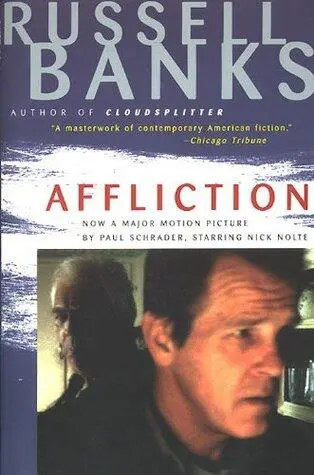
- Название:Affliction
- Автор:
- Издательство:HarperCollins Publishers
- Жанр:
- Год:2012
- ISBN:нет данных
- Рейтинг книги:3 / 5. Голосов: 1
-
Избранное:Добавить в избранное
- Отзывы:
-
Ваша оценка:
Affliction: краткое содержание, описание и аннотация
Предлагаем к чтению аннотацию, описание, краткое содержание или предисловие (зависит от того, что написал сам автор книги «Affliction»). Если вы не нашли необходимую информацию о книге — напишите в комментариях, мы постараемся отыскать её.
Affliction — читать онлайн бесплатно полную книгу (весь текст) целиком
Ниже представлен текст книги, разбитый по страницам. Система сохранения места последней прочитанной страницы, позволяет с удобством читать онлайн бесплатно книгу «Affliction», без необходимости каждый раз заново искать на чём Вы остановились. Поставьте закладку, и сможете в любой момент перейти на страницу, на которой закончили чтение.
Интервал:
Закладка:
By Wade’s and Lawford’s standards, and even by the standards of the much larger town of Catamount, the house was palatial. LaRiviere’s bid on the well had come in slightly high, but he had been hired anyhow, probably because of his reputation for being able to set up and drill on slopes that discouraged most flatland well drillers. LaRiviere could drive out to a hilly site when they got ready to set up the rig and in seconds could find the one piece of ground where the rig could be backed into place and the drill sent into the ground vertically. It was uncanny, at least to Wade, who inevitably had picked someplace else to drill. LaRiviere would survey the ground with a quick gaze, note Wade’s spot, pick another, then humiliate Wade by first having Jack Hewitt or Jimmy Dame park the rig where Wade had suggested. Every time, no matter how they jacked it, the rig ended up tilted at an angle that could not be corrected by the drill. Then LaRiviere would have Jack bring the truck down a few yards and to the left a ways, where a batch of chokecherry bushes had obscured the surface of the ground, and sure enough, the rig sat level as a cake in an oven, and the drill bit, lowered into place, aimed straight down to the center of the earth.
Though he had never met the man, Wade remembered J. Battle Hand clearly, mainly because of his name, which struck him as a lawyer-like name, the name of a man who fought like a tiger for his clients, who believed in justice and in absolute right and absolute wrong and would not defend a person unless he first believed in that person’s innocence and in the righteousness of his cause. It was clear, too, that he had become wealthy this way. J. Battle Hand was precisely the kind of attorney Wade needed for bringing a custody suit against his ex-wife. He needed a good rich man. Or, better, a rich good man.
He pulled in at Wickham’s, looked around for Margie and discovered what he had forgotten — she had worked yesterday, the first day of hunting season, and had today off. Nick told him that she had phoned in a message for Wade to call her if he came in. Half the booths and tables were filled with deer hunters, most of them local. These were not the fanatics and out-of-towners who had crowded the place yesterday morning. In one day the intensity of the hunt had been sufficiently diluted that here, along the sidelines, most of the observers and participants were able to affect little more than passive involvement with the killing still going on in the woods. It was not all that different from any other Saturday morning at Wickham’s. Two of the pickups parked in front had dead deer in the back, but they looked more like cargo than trophy. The town seemed to have settled into a seasonal rhythm, the deer-hunting season, which was as natural and unconscious an aspect of life as winter or spring: one simply went out and acted “natural,” and in that way one was able to behave appropriately too. Easy.
Wade got Nick to change a dollar bill, and he headed through the nearly empty restaurant to the game room in back. Nick himself was serving at the counter this morning; he had a high school girl waiting tables, a plump girl with a uniform two sizes too small for her and a face made up to look like a Las Vegas showgirl’s. Back in the game room, where the pay phone was located, a pair of teenaged boys were playing donkey ball and smoking cigarettes. Wade dropped a coin in, got Concord information and the number of J. Battle Hand, attorney at law, and dialed it.
It occurred to Wade that J. Battle Hand might not be in his office on a Saturday morning, he might be over in Catamount skiing, or lounging in front of a fire in his huge living room, so he was pleased and a little surprised to have a secretary ask him who was calling and then to say, “Just one moment, please, Mr. Whitehouse,” and then to find himself instantly and easily speaking with the man he wanted to represent him in what Wade regarded as the most complicated, ambitious, possibly reckless but nonetheless righteous thing he had ever undertaken: the attempt to gain regular and easy access to his own child. This might not be all that hard, after all, he thought, and he noticed that his hands had stopped shaking and his toothache had gone back to a dry rattle in his mouth. It had not bothered him much this morning anyhow, but it had been there nonetheless, like unpleasant background noise, a next-door neighbor playing his radio a little too loud.
Hand’s voice was low, calm, authoritative, just as Wade had hoped he would sound. He said, “I see,” many times, while Wade quickly explained what he wished Hand to do for him. When the lawyer suggested that, before they do anything, Wade come in to his office and talk, Wade explained that he worked up in Lawford and had trouble getting off on weekdays; he would like to come in today, sometime this afternoon, if possible. Hand said fine, how was two o’clock, and that was that.
No, sir, this was not going to be as hard or as confusing as he had expected. They had not talked about how much it would cost, of course, but Wade could tell from the sound of the man’s voice that Attorney Hand was a reasonable man. Whatever it cost Wade, it would be worth it to have Jill back in his life, and he could pay it out over years, if necessary. He could take out a bank loan, maybe, a second mortgage on the trailer, if he had to — and no doubt he would have to, for he had no savings whatsoever.
Then Wade called Margie. As soon as he heard her voice, he wanted a cigarette. He patted his shirt pocket and found that he was out. “Shit,” he said.
“What?”
“Wait a minute, I got to get a pack of cigarettes. Can you hold on?”
“Hurry up. I’m baking.”
“Be right back,” he said. He was suddenly frantic for a cigarette; the need was as physical and immediate as the need to urinate. He placed the receiver on top of the phone box and hurried out to the cash register and bought a pack of Camel Lights from Nick. By the time he got back to Margie, he was already smoking, his lungs and face feeling soothed and familiar again.
“I got to quit these things,” he said to her, but he could not imagine being able to endure for more than a minute the agitated unfamiliarity that smoking eliminated. It was a singular and specific kind of psychic pain, which had been caused by the cigarettes in the first place, and they were the singular specific remedy for it. If there were available to him a similar remedy for the general pain, a wide-body potion that eliminated the overall agitation and unfamiliarity that he believed he suffered every waking moment of his life, and if that potion were programmed to kill him in an even shorter and more exact time than the cigarettes were, Wade surely would have taken that remedy too. The final result may be death, but addiction is about eliminating pain with what causes the pain in the first place, and death was coming along anyway, so what the hell. But there was no such general remedy that he knew of, and though he did not always think so, he was probably lucky there was none. It was perhaps sufficient that at present it was only the cigarettes that were killing him.
While he spoke to Margie, he kept thinking of Mel Gordon’s wife, the dead Evan Twombley’s living daughter, standing between him and Mel Gordon like an angelic shield, protecting him from Gordon’s dark fury, and when Margie said that she could not spend the afternoon with him in Concord, she had to finish baking pies for Nick Wickham, Wade was almost glad. For the moment, his image of Margie Fogg could not compete with his image of Mel Gordon’s wife.
“It’s probably just as well,” he said. “I got to see my lawyer at two anyhow.”
“So. You’re really going to do that. The custody thing.”
“Yep.”
“Oh, God. I think you’ll be sorry. I think you’ll wish you had never opened this whole thing up again, Wade.”
Читать дальшеИнтервал:
Закладка:
Похожие книги на «Affliction»
Представляем Вашему вниманию похожие книги на «Affliction» списком для выбора. Мы отобрали схожую по названию и смыслу литературу в надежде предоставить читателям больше вариантов отыскать новые, интересные, ещё непрочитанные произведения.

Обсуждение, отзывы о книге «Affliction» и просто собственные мнения читателей. Оставьте ваши комментарии, напишите, что Вы думаете о произведении, его смысле или главных героях. Укажите что конкретно понравилось, а что нет, и почему Вы так считаете.