Russell Banks - Affliction
Здесь есть возможность читать онлайн «Russell Banks - Affliction» весь текст электронной книги совершенно бесплатно (целиком полную версию без сокращений). В некоторых случаях можно слушать аудио, скачать через торрент в формате fb2 и присутствует краткое содержание. Год выпуска: 2012, Издательство: HarperCollins Publishers, Жанр: Современная проза, на английском языке. Описание произведения, (предисловие) а так же отзывы посетителей доступны на портале библиотеки ЛибКат.
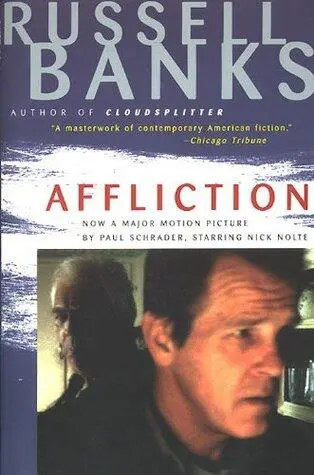
- Название:Affliction
- Автор:
- Издательство:HarperCollins Publishers
- Жанр:
- Год:2012
- ISBN:нет данных
- Рейтинг книги:3 / 5. Голосов: 1
-
Избранное:Добавить в избранное
- Отзывы:
-
Ваша оценка:
Affliction: краткое содержание, описание и аннотация
Предлагаем к чтению аннотацию, описание, краткое содержание или предисловие (зависит от того, что написал сам автор книги «Affliction»). Если вы не нашли необходимую информацию о книге — напишите в комментариях, мы постараемся отыскать её.
Affliction — читать онлайн бесплатно полную книгу (весь текст) целиком
Ниже представлен текст книги, разбитый по страницам. Система сохранения места последней прочитанной страницы, позволяет с удобством читать онлайн бесплатно книгу «Affliction», без необходимости каждый раз заново искать на чём Вы остановились. Поставьте закладку, и сможете в любой момент перейти на страницу, на которой закончили чтение.
Интервал:
Закладка:
“Maybe. But I’d be a hell of a lot sorrier if I just let it go. Kids grow up fast,” he said. “And then it’s over. You get old, and the kids are grown into strangers. Look at my old man and me.”
“Your father,” she said. “Your father was not like you. That’s why you and he are strangers.”
“That’s the whole point. My father … well, I don’t want to get into that.”
“And Lillian, she’s not like your mother, either. Lillian’s going to fight this like a she-bear. Believe me.”
“Yeah,” he said. “I know. But that’s the whole point too. If Lillian was like my mother, I wouldn’t be doing any of this in the first place, you know.” He lit a second cigarette off the first and inhaled deeply. “Besides, me and my old man, we aren’t really strangers.”
“No.”
“In fact,” he said, “I was kind of thinking of going up there tomorrow. I haven’t been by to see them in months. You feel like coming?”
“Sure,” she said in a flat voice. She was giving up on Wade: his inconsistency was patterned and self-serving, and there was no way in for her. She might as well just let him be who he is and enjoy him for that as much as possible. More and more often these days, she found herself regarding Wade from a distance. She knew what it meant: sooner or later she would not want to sleep with him anymore. Right now, however, she was lonely, she was, and she felt imprisoned by her body, she did, and she wanted out, badly, and sleeping with Wade, even if only on occasion, provided her with brief reprieves, like conjugal visits, and she was not about to give that up. She was not.
“Wade,” she said, and she said his name in a low voice that was instantly meaningful to him, like the start of a catechism, and they began their old ritual sequence:
“Yes.”
“Can you come by my place tonight?”
“Yes.”
“Will you?”
“Yes, I will.”
“Do you want to?”
“Yes, I do.”
“What will you do with me, Wade?”
He cupped his hand over the mouthpiece and cast a glance at the teenagers playing donkey ball in the corner of the room. In a low voice, he said, “I’ll do everything you want me to do.”
“Everything?”
“Everything. And a few things you don’t want me to do.”
“Ah-h-h,” she said. “You’re not at home now, are you?”
“No.”
“So we can’t do it over the phone,” she said.
“No. We can’t. I’d look… I’d look pretty silly if we did. I’m in Nick’s back room.”
“You wouldn’t look silly. Not to me you wouldn’t. I love to see you do that,” she said. “You know what I’m doing now, don’t you?”
“Yes. Yes, I do. I surely do. But I’m not going to listen anymore,” he said. “Besides, I thought you were baking.”
“Ummm. I am.”
“I’m gonna hang up on you. Before I make a fool of myself in public. I’ll come by later,” he said. “I’ll come by and make a fool of myself in private. If that’s okay by you.”
She assured him that, yes, it was fine by her, and they said goodbye and hung up. Wade sighed heavily, and the two boys looked over at him and stared for a second.
“Hello, Wade,” the taller one said. “Getcha deer yet?”
“Nope,” he said. “I give up hunting five years ago, boys. Give it up for women. You oughta try it. Great for your sex life,” he said, and he hitched up his pants and headed out the door, his mind refilling with the golden light cast by his image of Mel Gordon’s wife.
The office of J. Battle Hand was on the first floor of a white Federal town house on South Main Street in Concord. It had snowed only a few inches in Concord the day before, and then it had rained, which had washed away the accumulated snow, but it was cold under a low dark-gray midafternoon sky, as if it were going to snow again, and the sidewalks were smeared here and there with half-frozen puddles.
Wade was unused to sidewalks and made his way carefully from his car to the steps of the building, up the steps and in, where he passed a door that announced the presence of a women’s health center, whatever the hell that was, and an accountant’s office, and walked to the back, where he entered a carpeted outer office and was greeted by a smart-looking young woman with a boy’s haircut and one dangling earring and long thin arms. She looked up from her red typewriter and smiled at him.
He took off his cap and wished suddenly that he had changed his clothes before coming down from Lawford. Maybe he should have worn his sport coat and necktie and his dress pants. He felt huge and awkward in the room, all thick neck and wrists. Country.
The young woman raised her eyebrows, as if expecting him to tell her what he had come to repair. The furnace? A broken water pipe on the second floor?
“I… I got an appointment,” Wade said. “With Mr. Hand.”
“Your name?” She stopped smiling.
“Whitehouse.”
She checked a pad on the desk, punched a key on the phone and said into the receiver, “A Mr. Whitehouse to see you.” Then silence, and she hung up and got up from her desk and motioned for Wade to follow her.
She was tall, as tall as he, and wore a black-and-white-checked miniskirt and smoky stockings that made her legs look slender and firm. Wade followed her calves and the backs of her knees, and they led him into a second office. The woman told him to take off his coat and sit down and said that Mr. Hand would be right with him. She offered him a cup of coffee, but he declined, because he knew his hands were trembling. Then she left him, closing the door behind her.
There were two dark-green leather chairs and a matching sofa in the windowless room, and the walls were lined with the red and blue spines of thick books. There was a second door, in the far corner of the room, and Wade settled into the chair that faced it and waited. His toothache was clanging away, but he felt pretty good.
After a few seconds he began to hope that Mr. Hand, for unknown reasons, would not appear and that somehow Wade could sit right where he was forever, outside of time, safely beyond his past and just this side of his future. He was warm enough and comfortable enough, and there was an ashtray on the low table next to him, so he could smoke. Which he did.
He was halfway through the cigarette, when he heard a click, and the door swung open and in, and to his astonishment a person in a wheelchair entered. It was a rubber-tired wheelchair with a tiny electric motor powering it, all chrome bars and spokes. The man driving the chair was slumped off to his left, flicking buttons on a control box with the fingers of his left hand. He brought the chair swiftly through the doorway, turned it abruptly, as if it were a remote-controlled toy car, toward Wade, then drove it forward to within a few feet of Wade’s chair, where it stopped suddenly and parked.
The driver looked like a ventriloquist’s dummy dressed in a dark pin-striped suit. His head was disproportionately large, and his face, in alarming contrast to the slumped inertness of his body, was bright and expressive. He had dark hair, gray at the temples, a square sharply defined forehead and brow and large pale-blue eyes. His skin was waxy white and taut, like paper-thin porcelain, the skin of a person who has long endured great pain, and when he smiled to greet Wade, it was almost a grimace, which seemed to require a mighty and consciously engaged physical exertion, as if he had to will his facial muscles to move one at a time.
But move they did, and when they did, his face lit up with intelligence and, Wade thought, humor. Maybe the man had deliberately prepared this surprise, had costumed and masked himself and sat in his wheelchair for hours behind that door waiting for Wade to arrive. Wade wanted to laugh out loud, to say, “Wow, hell of a getup there, Mr. Hand! Happy Halloween and trick-or-treat and all that, eh?” He wanted to reassure the man that the masquerade had worked, that he was indeed surprised, and he was scared too.
Читать дальшеИнтервал:
Закладка:
Похожие книги на «Affliction»
Представляем Вашему вниманию похожие книги на «Affliction» списком для выбора. Мы отобрали схожую по названию и смыслу литературу в надежде предоставить читателям больше вариантов отыскать новые, интересные, ещё непрочитанные произведения.







Обсуждение, отзывы о книге «Affliction» и просто собственные мнения читателей. Оставьте ваши комментарии, напишите, что Вы думаете о произведении, его смысле или главных героях. Укажите что конкретно понравилось, а что нет, и почему Вы так считаете.