Russell Banks - Continental Drift
Здесь есть возможность читать онлайн «Russell Banks - Continental Drift» весь текст электронной книги совершенно бесплатно (целиком полную версию без сокращений). В некоторых случаях можно слушать аудио, скачать через торрент в формате fb2 и присутствует краткое содержание. Год выпуска: 2007, Издательство: Harper Perennial Modern, Жанр: Современная проза, на английском языке. Описание произведения, (предисловие) а так же отзывы посетителей доступны на портале библиотеки ЛибКат.
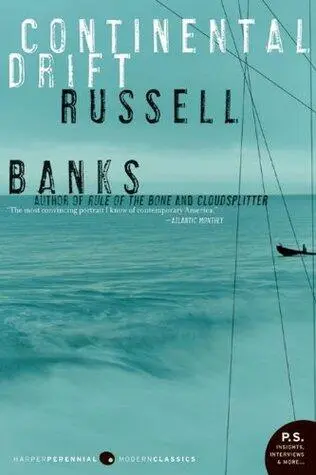
- Название:Continental Drift
- Автор:
- Издательство:Harper Perennial Modern
- Жанр:
- Год:2007
- ISBN:нет данных
- Рейтинг книги:4 / 5. Голосов: 1
-
Избранное:Добавить в избранное
- Отзывы:
-
Ваша оценка:
Continental Drift: краткое содержание, описание и аннотация
Предлагаем к чтению аннотацию, описание, краткое содержание или предисловие (зависит от того, что написал сам автор книги «Continental Drift»). Если вы не нашли необходимую информацию о книге — напишите в комментариях, мы постараемся отыскать её.
is a masterful novel of hope lost and gained, and a gripping, indelible story of fragile lives uprooted and transformed by injustice, disappointment, and the seductions and realities of the American dream.
Continental Drift — читать онлайн бесплатно полную книгу (весь текст) целиком
Ниже представлен текст книги, разбитый по страницам. Система сохранения места последней прочитанной страницы, позволяет с удобством читать онлайн бесплатно книгу «Continental Drift», без необходимости каждый раз заново искать на чём Вы остановились. Поставьте закладку, и сможете в любой момент перейти на страницу, на которой закончили чтение.
Интервал:
Закладка:
“No,” she says in a flat voice, and it’s clear to Bob that she doesn’t want to, either.
But he goes on. “Ted Williams is like a god to me, ever since I was a kid. My father took me once to Fenway Park down in Boston, and it was really to see Ted Williams play. He was old then, Ted Williams, I mean, not my father, and about to retire. Old for a ballplayer. Anyhow, we got there and got seats out behind the third baseline so we could see him better. He played left field. And then it turned out he didn’t play that day, I think they put Yastrzemski in, who was only a kid then, just come up from Pawtucket or someplace. Williams was sick or something. My father, he was more pissed off than I was, I think, and he bitched and moaned about it all the way home, and that was the only time we ever went to a ball game together. Whenever I asked to go again, he’d say, ‘Remember last time we drove all the way down to Boston and Williams didn’t even play.’ And then, the next year, I think it was, Williams retired, and from then on left field belonged to Yaz. I really should’ve gotten Yaz’s autograph last spring up in Winter Haven. Actually, I should’ve gotten Ted Williams’ autograph today….”
“Bob,” Elaine says, interrupting him. “We have to talk.” She turns and faces him, holding a wooden spoon in her hand as if about to wave it at him to make her point.
“Yeah?” He whips out his cigarettes and lights one, and his hands are trembling. “Everybody seems to want to have a fucking talk with me these days.” Then, without his knowing how or why, his voice has changed pitch and tone, and he’s shouting at her. “Ave wants to talk to me! You want to talk to me! Anybody else around here wants to talk to me?” he barks, turning to the children, who look up startled, confused.
“Bob, for heaven’s sake …”
“I can’t even come in here and get a little excited about seeing my goddamned childhood hero, a man who’s a fucking god to me, without bringing me down for it!”
“All I said was …”
“All you said was, ‘I want to have a talk with you,’ in that damned accusing way of yours, as if I was a fucking little kid, like you’re going to tell me what’s what and how it’s all my fault! I know already what you got to say to me.”
She folds her arms over her breasts. “What, then? You tell me.”
“I know. I know.”
“What?”
He spins and walks toward the door, stops, and without looking at her, says, “You want to tell me what I already know. You want to tell me what shit this all is. Shit. This … this whole damned life.”
“Is it? You feel that way about it?”
He remains silent for a second. “Yeah. It’s shit. All of it, shit, shit, shit. And now you want to tell me how it’s all my fault,” he says in a low, cold voice. “You like doing that, telling me how it’s all my fault.”
“Is it?”
“No! No, goddamn it! It’s not all my fault!” He’s bellowing again, glaring at her from the door. “It’s shit, all right, but it’s not my fault!”
“Bob, the girls! Please! You’ll wake the baby.”
“Send ’em outside. We’ll get this settled now, once and for all, dammit!”
“Send them outside yourself,” she answers. “They’re your children too, remember.”
“Ruthie, Emma! Get outside for a while and play in the yard or something. Me and Mommy got to talk about something private.”
The girls whine and argue that the show’s not over yet, they don’t want to go outside, it’s raining. They turn back to the screen, and Ruthie slides her thumb into her mouth.
“Take your damned thumb out of your mouth!” Bob shouts. “And get the hell outside when I tell you to! It’s not raining now.”
Quickly, they obey, careful not to touch him as they pass him at the door.
Elaine turns down the burner on the stove and sits heavily at the kitchen table. She crosses her legs and lights a cigarette, waiting. “Well?”
“Well what?”
“Whose fault is it?”
“How the fuck should I know? I’m not a genius. You think you know, though. You’re the fucking genius. You think it’s all my fault because we’re broke all the time and living like niggers in a shack in the middle of nowhere, eating goddamned macaroni and cheese out of a goddamned no-name box.” He looks scornfully over at the saucepan on the stove. “You could use a little more imagination, you know. You didn’t show much interest when I brought up getting some shrimp tonight. I could’ve gotten ten or fifteen pounds of shrimp easy, the way they’re running, and we could freeze what we didn’t eat right off, or we could sell some. The catwalks along the bridges are crowded these nights with people using a little imagination.”
“You forgot to get the nets,” she says, “because you saw an old retired baseball player.”
“Well, you didn’t want me to go out shrimping anyhow. All you do is bring me down about things I get excited about. You, you never get excited about anything anymore. All you do is mope around here with a long face.” He crosses to the television set and snaps it off. “I hate that fucking thing!”
“Bob, you can’t hear yourself, or you’d shut up. Can you listen to me for a minute?”
“Gimme a beer.”
Elaine gets up and opens the refrigerator and passes a can of Schlitz over the counter, as if she were a waitress and he a customer. Then she stands at the counter, both hands grasping the edge of it, and says to him, “Now, you listen to me for a few minutes. I know you’re working hard, as hard as anyone can. And I know you’re worried and scared. Like I am. And you’re right, it’s true, this life is shit,” she says, and the word “shit,” because he’s never heard her say it before, sounds to Bob so powerfully derogatory in her mouth that he shudders. To Bob, Elaine has made the term suddenly so strong that he instinctively wants to defend this life, his life, against it. But he’s too late. He has said it himself, and now, with her saying it, he sees the word and his life as one thing, as waste, excrement, offal, as a secret, dirty thing that should be hidden or buried, as a thing to be ashamed of.
His mind is flitting wildly about, a maddened bird in a cage, pursued by a word that repels him but that cannot be denied, and he hears only bits of what Elaine is telling him, for, having no sense of the impact of her use of the word, believing she was merely quoting him, reassuring him, she thought, Elaine goes on to tell him what she knows he does not want to hear. She tells him that their daughter Ruthie is ill, “emotionally disturbed,” the counselor at school said, and that she’s going to have to start getting twice weekly treatment at the mental health clinic in Marathon, which will cost money, not a lot of money, but because they’re poor, more money than they have, which is no money at all, so she, Elaine, has decided to take a job in Islamorada. In fact, she accepted the job this morning, waiting on tables at the Rusty Scupper five nights a week. “I know,” she says rapidly, trying to stave off the explosion, “I know I should’ve talked it out with you first, but it had to be done, Bob, and I just saw the sign this morning when I took the girls to the beach…. No, that’s not true. I asked Horace next door if he knew of any jobs, when he took us up to the beach, and he told me about it, and I just went in and asked about the job and got it offered to me, so I took it. And I know I should’ve told you about Ruthie when the school called, but it was only yesterday, and it seemed so hard a thing to tell you, Bob, because of all you have to worry about, and the way you’ve been lately, kind of distant and lost in your own thoughts and depressed and all. I just wanted to wait till I had a way to pay for it before I told you about it, so it wouldn’t seem so bad.”
Читать дальшеИнтервал:
Закладка:
Похожие книги на «Continental Drift»
Представляем Вашему вниманию похожие книги на «Continental Drift» списком для выбора. Мы отобрали схожую по названию и смыслу литературу в надежде предоставить читателям больше вариантов отыскать новые, интересные, ещё непрочитанные произведения.





Обсуждение, отзывы о книге «Continental Drift» и просто собственные мнения читателей. Оставьте ваши комментарии, напишите, что Вы думаете о произведении, его смысле или главных героях. Укажите что конкретно понравилось, а что нет, и почему Вы так считаете.