Russell Banks - Continental Drift
Здесь есть возможность читать онлайн «Russell Banks - Continental Drift» весь текст электронной книги совершенно бесплатно (целиком полную версию без сокращений). В некоторых случаях можно слушать аудио, скачать через торрент в формате fb2 и присутствует краткое содержание. Год выпуска: 2007, Издательство: Harper Perennial Modern, Жанр: Современная проза, на английском языке. Описание произведения, (предисловие) а так же отзывы посетителей доступны на портале библиотеки ЛибКат.
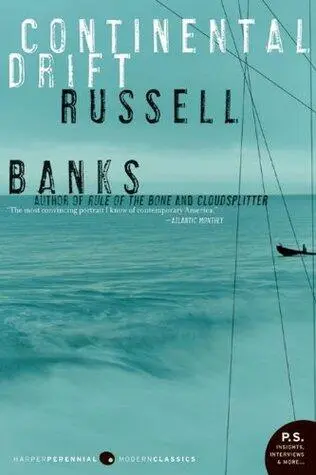
- Название:Continental Drift
- Автор:
- Издательство:Harper Perennial Modern
- Жанр:
- Год:2007
- ISBN:нет данных
- Рейтинг книги:4 / 5. Голосов: 1
-
Избранное:Добавить в избранное
- Отзывы:
-
Ваша оценка:
Continental Drift: краткое содержание, описание и аннотация
Предлагаем к чтению аннотацию, описание, краткое содержание или предисловие (зависит от того, что написал сам автор книги «Continental Drift»). Если вы не нашли необходимую информацию о книге — напишите в комментариях, мы постараемся отыскать её.
is a masterful novel of hope lost and gained, and a gripping, indelible story of fragile lives uprooted and transformed by injustice, disappointment, and the seductions and realities of the American dream.
Continental Drift — читать онлайн бесплатно полную книгу (весь текст) целиком
Ниже представлен текст книги, разбитый по страницам. Система сохранения места последней прочитанной страницы, позволяет с удобством читать онлайн бесплатно книгу «Continental Drift», без необходимости каждый раз заново искать на чём Вы остановились. Поставьте закладку, и сможете в любой момент перейти на страницу, на которой закончили чтение.
Интервал:
Закладка:
She stops scrubbing for a second and stares at him outside in the yard a few feet beyond the door. He’s still a large man to her, muscular and brown and kindly-looking, a bearish man. His face is open and sad and confused. “Bob,” she says in a low, even voice. “You still have to pay for it. You can charge your shrimp nets and your pots and pans or anything you want, but you still have to pay for it.”
“Yeah, I know, I know. Things’ll pick up soon,” he says. “I promise.” He turns abruptly, walks to his car and gets in, finishes off the beer and tosses the empty can onto the floor. Starting the engine, he looks over at Allie Hubbell and raises his hand in a short wave.
Allie grabs her can of beer, takes a sip, replaces it at her side. She doesn’t wave back.
Bob drops the car into gear and moves slowly away from the trailer, turns around in Horace’s driveway, causing the German shepherd to come barking out from under the trailer, and leaves.
4
The dream bothers Bob. It feels like a rash across his belly beneath his shirt, so that he rubs against it when he least expects to, in the car idling at a stop sign as he emerges from the road and prepares to turn north on Route 1, at the roadside grocery store where he stops to pick up another can of Schlitz, out on the highway again, when he looks to his right and sees rain clouds roiling up in the southeast.
He remembers not so much the dream as the emotions it carried, conflicting emotions that Bob can’t imagine resolved: shame and pride; solitude, desertion, being left behind — a child’s horrified view of these conditions — and social acceptance, the security of rite and family affection; fear of death, pure terror of it, and an uncontrollable longing to confront it, an obsessive curiosity, almost. The images come and go — his mother’s hands crossed on her chest in the coffin, his father’s glad hand clapped on his suited shoulder, Elaine nudging him from behind, saying, Go on, Bob, you can do it, you should do it, and the abandoned, sweltering airplane, the smoke, the holy water from the font splashing into the coffin. But somehow the images from the dream are mixed with his memories of the actual people and events they shadow. He remembers the spring night his father came home after work at the tannery and sat in his easy chair and picked up the Catamount Patriot and saw a picture of his son and discovered that Bob had been selected to the all-state high school hockey team, just as Eddie had been the year before. The local sportswriter had coined the phrase “The Granite Skates” for Bob and Eddie when they had played together that year, and the headline read: SECOND GRANITE SKATE ALL-STATE ICEMAN. His father said nothing to commemorate the event, Bob now recalls. He ignored it completely, until finally at supper Bob asked him if he’d seen the paper yet, and the man nodded and smiled across the table, and Bob smiled back. That was all. Eddie was gone by then — had been working ten months at Thom McAn’s, had his own apartment on Depot Street above Irwin’s bar and in a year would leave for Florida — or there might have been an animated, prideful discussion of the award, backslapping and jokes, fantasies and teasing, which would have left: Bob feeling sated instead of somehow disappointed and then embarrassed by his disappointment, even ashamed of it.
In everything his father did and said, there seemed to be one lesson: life is grudging in what it gives, so take whatever it gives as if that’s all you’re ever going to get. A dog finding a tossed-out bone doesn’t celebrate; it simply sets to gnawing, before the bone gets yanked away. Bob knew his father had a secret, fantasied version of things that was different, that often, after everyone had gone to bed, he’d sit in the living room half-drunk, playing “Destiny’s Darling” on the phonograph, but that was the man’s weakness, not his strength. Bob understood his father’s weakness; it was his strength that left him confused.
His mother he viewed as all weakness, all fantasy and delusion, a vessel filled with a resigned optimism that she used to make her passivity and helplessness coherent to herself. There was, of course, God’s will, and, too, there was a blessedness, a magical election, that she believed her sons possessed — at least until incontrovertible evidence proved otherwise, and even then, there was always the possibility that God had long-range plans that just hadn’t been revealed yet. She knew her boys were destined to be rich and famous, and she suspected that one of the reasons (there were doubtless many) God had made her poor and obscure was to help make her sons rich and famous, a kind of trade-off. In the end, she treated Bob’s and Eddie’s few accomplishments and honors exactly as her husband treated them, as if they were to be expected. She would smile and nod approvingly, as if to say, See, God’s looking after you, just like I said He would.
Neither parent, then, treated the boys’ futures as something the boys themselves had any control over. And when you come right down to it, Bob thinks, as he drives north on Route 1 into Islamorada, they were both right. That’s what Eddie’s finding out, and because it’s coming late, it’s coming hard. He’s been lucky, that’s all, which is the basic difference between his life so far and mine, Bob decides. It’s not intelligence or hard work or courage. It’s luck. And luck can’t last a lifetime, unless you die young.
On the north side of Islamorada, a half mile before the bridge that crosses to Windley Key, Bob turns off at the Whale Harbor Tackle Shop, a long, low building on the bay that’s more a general store than a tackle shop, with a marina and boatyard behind it. There are only a few cars in the lot, and Bob parks deliberately behind a white Chrysler convertible with the top down. He gets out of his car and strolls around it and for a few seconds admires the Chrysler, standing next to it while he finishes off the can of Schlitz, rubbing his tee-shirted belly and examining the rolled and pleated red leather upholstery, which smells like nothing but itself and reminds Bob of polished wood, Irish tweed, gleaming brass. Glancing at his own face in the tear-shaped outside mirror, Bob suddenly sees himself as he must look from inside the store, a man in work clothes guzzling beer and drooling over someone else’s luck. Abruptly, he turns and heads inside, pitching the empty can into the trash barrel by the door as he enters.
He wishes he’d taken his captain’s hat with him when he left home, as he believes he’s treated with more respect here with the properly crumpled captain’s hat on his head than he is without it. The hat ordinarily embarrasses him, especially when he’s not running the Belinda Blue, and off the boat he usually bends it and stuffs it into his back pocket. The hat had been sort of a joke anyhow, a present given to him by Ave one night over beers at the Clam Shack after Bob had gotten his commercial license. He sensed that somehow Ave was mocking him with the hat, or maybe Honduras was, he couldn’t be sure, so he accepted it with mixed feelings and wore it reluctantly after that, as if it were merely and strictly part of the uniform that men with his job were supposed to wear.
Inside, beyond the high rows of canned goods, picnic supplies, beachware, past the racks of suntan lotion, the beer and soft drink coolers and the bins and shelves of household goods, Bob passes over into the serious side of the store, the tackle shop, where on both sides of a long glass counter there are pyramids and cones of fishing rods, shelves and tall displays of hand-tied flies, plugs, jiggers and lures, line, weights, knives and reels, with repair equipment and worktables behind the counter and huge color photographs on the walls of record-breaking marlin, tuna and bonefish, game fish held up dead to the camera by their captors.
Читать дальшеИнтервал:
Закладка:
Похожие книги на «Continental Drift»
Представляем Вашему вниманию похожие книги на «Continental Drift» списком для выбора. Мы отобрали схожую по названию и смыслу литературу в надежде предоставить читателям больше вариантов отыскать новые, интересные, ещё непрочитанные произведения.
Обсуждение, отзывы о книге «Continental Drift» и просто собственные мнения читателей. Оставьте ваши комментарии, напишите, что Вы думаете о произведении, его смысле или главных героях. Укажите что конкретно понравилось, а что нет, и почему Вы так считаете.