Russell Banks - Continental Drift
Здесь есть возможность читать онлайн «Russell Banks - Continental Drift» весь текст электронной книги совершенно бесплатно (целиком полную версию без сокращений). В некоторых случаях можно слушать аудио, скачать через торрент в формате fb2 и присутствует краткое содержание. Год выпуска: 2007, Издательство: Harper Perennial Modern, Жанр: Современная проза, на английском языке. Описание произведения, (предисловие) а так же отзывы посетителей доступны на портале библиотеки ЛибКат.
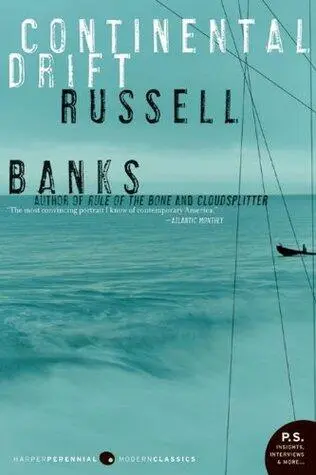
- Название:Continental Drift
- Автор:
- Издательство:Harper Perennial Modern
- Жанр:
- Год:2007
- ISBN:нет данных
- Рейтинг книги:4 / 5. Голосов: 1
-
Избранное:Добавить в избранное
- Отзывы:
-
Ваша оценка:
Continental Drift: краткое содержание, описание и аннотация
Предлагаем к чтению аннотацию, описание, краткое содержание или предисловие (зависит от того, что написал сам автор книги «Continental Drift»). Если вы не нашли необходимую информацию о книге — напишите в комментариях, мы постараемся отыскать её.
is a masterful novel of hope lost and gained, and a gripping, indelible story of fragile lives uprooted and transformed by injustice, disappointment, and the seductions and realities of the American dream.
Continental Drift — читать онлайн бесплатно полную книгу (весь текст) целиком
Ниже представлен текст книги, разбитый по страницам. Система сохранения места последней прочитанной страницы, позволяет с удобством читать онлайн бесплатно книгу «Continental Drift», без необходимости каждый раз заново искать на чём Вы остановились. Поставьте закладку, и сможете в любой момент перейти на страницу, на которой закончили чтение.
Интервал:
Закладка:
Behind the cash register at the far end of the counter, a tall, thick-bodied man, taller and thicker than Bob, is talking with great force to the balding man who runs the place, a wiry, pale-faced man in his forties nicknamed Tippy, as if he were a Keys “character,” an old conch, which does not suit him at all, for he is an essentially humorless, shrewd businessman who by his looks and manner could as easily be running a lumberyard in Toledo as this place. The tall man talking to Tippy, lecturing him, it seems, looks familiar to Bob, though all he can see of him is the back of his sandy-gray head, his broad back, tanned neck and arms. Tippy is listening intently, nodding in agreement, while the man plows on, gesturing with his hands, his low, slightly nasal voice rising and falling rhythmically with his hands. The man is wearing a white bill cap and aviator sunglasses, a white polo shirt that’s old and baggy enough to surround his ample stomach without pointing to it, floppy GI-style work pants with huge pockets, and smudged white tennis shoes.
Instantly, Bob decides that this is the man who owns the Chrysler convertible outside. Though there are a half-dozen others in the store who also might be said to own the car, it’s only this man, at least as far as Bob Dubois is concerned, who is capable of owning it, who deserves to own it. If that white car in the lot is Bob’s idea of a proper grownup’s car, then this man in front of him is his idea of a proper grownup.
For years, Bob was one of those people who believe that there are two kinds of people, children and adults, and that they are like two different species. Then, when he himself became an adult and learned that the child in him had not only refused to die or disappear, but in fact seemed to be refusing to let the adult have his way, and when he saw that was true not only of him but of everyone else he knew as well — his wife, his brother, his friends, even his own mother and father — Bob reluctantly, sadly, with increasing loneliness, came to believe that there are no such things as adults after all, only children who try and usually fail to imitate adults. People are more or less adult-like, that’s all.
Except, that is, for the man in front of him. For the first time since he himself was a child, Bob Dubois believes that he is looking at a full-fledged adult, and it’s as if he has stumbled onto a saint or an angel right here in the Whale Harbor Tackle Shop in Islamorada, Florida, a saint having an animated discussion with sober, businesslike Tippy — no, not really a discussion, because the saint’s doing all the talking. Tippy just nods and listens and nods again, and it’s as if the saint is telling Tippy how the world looks from his miraculously elevated position.
The saint swings his arms in tandem, clearly explaining a particular kind of cast, low, close to the water, snaking the line in under mangrove roots for bonefish. His large, gray-haired head and deeply tanned face seem to have an aura swirling around them as he speaks, as if he were either not really present or were more profoundly present than anyone else. His size, larger than a large man’s, and the swiftness of his gestures, the pure, muscular clarity of his motions and his crisp, good-humored, rapid-fire speech — everything about him that Bob can see and hear manifests the kind of superiority and self-assurance that only saints, or what Bob used to think of as adults, possess.
Bob moves a few feet closer along the counter, so he can hear what Tippy is privileged to hear. The saint glances to his left, sees Bob and goes on talking as if he has not seen Bob at all. Filled with wonder, afraid he will cry out, Bob says to himself, hopes he says it only to himself, for he cannot be sure, My God, it’s Ted Williams!
Ted Williams turns to him. Bob has said it aloud. “I’m … I’m didn’t mean interrupt …” Bob stumbles. His tongue feels like a hand, his hands like tongues.
Tippy looks at Bob as if he’s just discovered a counterfeit bill in the cash register. “Want help, mister?” he asks, folding his arms over his chest to make it clear that his question is only a question, not an offer.
Ted Williams peers down through the glass counter at the black and silver reels on the shelf and seems to be examining them for flaws rather than for possible purchase. He purses his lips and falls to whistling a tuneless tune.
Bob says, “I’m sorry … I mean, excuse me, but you’re Ted Williams, and … I didn’t mean to interrupt …”
Ted Williams looks up from the reels, casts a quick glance at Bob and nods, just a swift, impersonal dip and tug of his massive head, and returns to the reels, waiting, obviously, for Bob to get his business done and move away.
But Bob takes a step closer. “Mr. Williams, I’m from New Hampshire. The Red Sox … I’m a Red Sox … I mean, I love the Red Sox, Mr. Williams, since I’m a boy. And my father, him too, he loved the Red Sox, we all did. My father, he … he saw you play, down in Fenway, he’s dead now, he told me about it, and I saw you on television, when I was a kid, you know….” Bob’s mouth is dry, and he’s gulping for air. What’s the matter with me? This is crazy, he thinks. He’s only a man, just a human being like the rest of us. Visions of his father flood Bob’s mind, and he feels his eyes fill, and suddenly he’s afraid that he’s going to start weeping right here in front of Ted Williams. What’s happening to me? He clamps both hands onto the counter and steadies himself. He asks it again, What’s happening to me? And he sees his father’s face, sad and pinched, a cigarette held between his teeth, his lips pulled back as if in a snarl, while the man tightens the nuts on the front wheel of Bob’s bicycle. Bob says to Ted Williams, “My father wanted me to see you play, but he couldn’t. I couldn’t, I mean. I miss my father a lot, you know? I … I know it sounds foolish, but … well, that’s all,” he says, stopping himself. “I’m sorry, Mr. Williams.”
Ted Williams, without looking up, says, “No problem.”
Suddenly, Bob is running from the store in flight, bumping customers and knocking over displays, as if he’s stolen something. Outside, the sky is dark and low, and rain is pouring down. Bob splashes through puddles to his car, and when he gets in, discovers that he left the windows open. The seats are soaked. When he leans over and cranks up the window on the passenger’s side, he sees a small, white-haired woman inside the Chrysler convertible, her face angry and impatient as she draws the top down against the windshield bar and wrenches it closed.
Slowly, Bob closes the window next to him. He lays his head against the wet seat back and shuts his eyes. “Oh, Jesus,” he says. “Why, why, why? What’s the answer?” He watches his breath cloud over the windshield and window glass, while the rain pours down outside. When he can no longer see the world outside the car, he closes his eyes again and rests, like an animal momentarily hidden from its pursuers.
5
Elaine asks over her shoulder from the stove, “You get what you wanted?”
The girls, still posted in front of the television set, are watching a puppet who lives in a garbage can holler at a man in a bird suit. Bob takes up a position at the kitchen counter on the living room side and leans over it as if it were a fence. “I just saw Ted Williams,” he announces.
“Oh. Did you get what you wanted? You know, the nets for the shrimp. I managed to save the pan. Shrimp would be nice. A change.”
“Yeah. I mean, no, I … I guess I got so excited and all, seeing Ted Williams like that, alive. You know? Ted Williams! I mean, I knew he was alive, and I knew he had a place around here, in Islamorada, but I never expected to actually walk up on him like that. It’s really amazing to me. You probably can’t understand that.”
Читать дальшеИнтервал:
Закладка:
Похожие книги на «Continental Drift»
Представляем Вашему вниманию похожие книги на «Continental Drift» списком для выбора. Мы отобрали схожую по названию и смыслу литературу в надежде предоставить читателям больше вариантов отыскать новые, интересные, ещё непрочитанные произведения.



Обсуждение, отзывы о книге «Continental Drift» и просто собственные мнения читателей. Оставьте ваши комментарии, напишите, что Вы думаете о произведении, его смысле или главных героях. Укажите что конкретно понравилось, а что нет, и почему Вы так считаете.