Russell Banks - Continental Drift
Здесь есть возможность читать онлайн «Russell Banks - Continental Drift» весь текст электронной книги совершенно бесплатно (целиком полную версию без сокращений). В некоторых случаях можно слушать аудио, скачать через торрент в формате fb2 и присутствует краткое содержание. Год выпуска: 2007, Издательство: Harper Perennial Modern, Жанр: Современная проза, на английском языке. Описание произведения, (предисловие) а так же отзывы посетителей доступны на портале библиотеки ЛибКат.
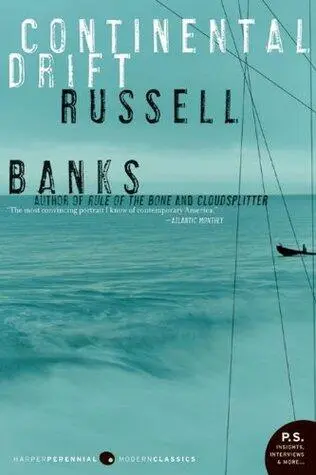
- Название:Continental Drift
- Автор:
- Издательство:Harper Perennial Modern
- Жанр:
- Год:2007
- ISBN:нет данных
- Рейтинг книги:4 / 5. Голосов: 1
-
Избранное:Добавить в избранное
- Отзывы:
-
Ваша оценка:
Continental Drift: краткое содержание, описание и аннотация
Предлагаем к чтению аннотацию, описание, краткое содержание или предисловие (зависит от того, что написал сам автор книги «Continental Drift»). Если вы не нашли необходимую информацию о книге — напишите в комментариях, мы постараемся отыскать её.
is a masterful novel of hope lost and gained, and a gripping, indelible story of fragile lives uprooted and transformed by injustice, disappointment, and the seductions and realities of the American dream.
Continental Drift — читать онлайн бесплатно полную книгу (весь текст) целиком
Ниже представлен текст книги, разбитый по страницам. Система сохранения места последней прочитанной страницы, позволяет с удобством читать онлайн бесплатно книгу «Continental Drift», без необходимости каждый раз заново искать на чём Вы остановились. Поставьте закладку, и сможете в любой момент перейти на страницу, на которой закончили чтение.
Интервал:
Закладка:
Moray Key, then, is a judicious place for Avery Boone to have begun his career as a fisherman. He studied the charts, talked long into the nights in bars in Islamorada and Marathon with the old hands, hired an experienced mate and explored the waters on his own, until he had memorized the channels, lights, reefs, currents and fishing grounds. His boat, the Belinda Blue , though slow and with a four-foot draft, was large and simple enough for him to take parties of four and six north into the bay, where he could fish either from the channels or, with the dinghy, on the flats; and she was enough of a deepwater boat that, once fitted with outriggers, depth sounder and fifty-channel receiver, she could be pushed as far out as the Hump and beyond. The Belinda Blue , however, compared to the flashy, fast, sports-fishing thoroughbreds that galloped to the Hump in less than an hour and returned before noon with record-breaking marlin and swordfish aboard, was a slow mule of a boat, so Ave had quickly specialized in taking amateurs, weekend fishermen from the North, families on daily outings, into the bay, leaving the deepwater fishing, the tournaments, leaving the big money, to the men whose boats were designed for nothing else.
He didn’t care. Ave was making a living now doing what he had always regarded as recreation, and he was doing it in year-round sunshine among people he liked and admired, fishermen, bartenders, small-time drug dealers, young women whose entire wardrobes consisted of string bikinis, designer jeans and men’s dress shirts, people who’d never worked more than part-time or not at all but who managed to keep a little cocaine or grass around and always had enough money and time to sit up late drinking tequila sunrises and listening to Jimmy Buffett tapes.
When some Miami-based developers built a forty-unit condominium complex overlooking the marina, Ave bought a unit on the second floor, above the pool and with a view of the Clam Shack below and the boats bobbing in their slips beyond. The directors of the Marathon branch of the Florida National Bank thought he was a good risk, and the Belinda Blue, appraised generously at $75,000, served as collateral. Then, one night a few months later, he met the girl named Honduras at a party aboard a sixty-foot sailing yacht owned by a Philadelphia dentist who spent his winters cruising the Caribbean with attractively tanned young male and female companions he picked up in ports like Montego Bay, Negril, Freeport and Nassau. The second Honduras saw Ave’s lean, handsome face and sandy hair, she knew his sign was Sagittarius, and ended up staying at his new condominium for several days, until the dentist in a pique left for Grand Cayman without her.
She stayed on with Ave, and a week later he bought the van, with which, as he told the directors of the bank in Marathon, he expected to supply fresh fish from the bay to restaurants up on Key Largo and Islamorada and south in Marathon. At Honduras’s urging, however, he had the van carpeted and upholstered throughout and installed a water bed and a quadraphonic stereo system, and never carried any fish anywhere, although he and Honduras started taking off for weekends in Miami and out to Key West, where Honduras had a number of friends with no visible source of income, ex-lovers and acquaintances who hung around glossy waterfront bars and lived in furnished apartments. Many of them played musical instruments and had more than a passing acquaintance with the technical vocabulary of the film and recording industries, which impressed Avery Boone from New Hampshire. He decided he was circulating on the fringes of show business.
His life had got expensive. But soon he was learning from his new friends how, with the Belinda Blue and his knowledge of the intricate maze of channels crisscrossing Florida Bay, he could afford that life. He risked several nighttime runs from Moray Key across to Flamingo City, loaded to the gunwales with bales of Colombia marijuana taken off a Panamanian freighter a few miles off Alligator Light, and cleared enough cash to start thinking about buying another boat, a high-speed 31-foot Tiara 3100, maybe, with twin 205-horsepower OMC Sea Drive engines, fitted with outriggers, a flying bridge and fighting chairs, a Loran C navigational unit and an extra fuel tank for occasional long-distance runs to places like Grand Cayman, the Bahamas, West Palm Beach, a boat that would let him fish the big tournaments from Pensacola to Nassau while someone else chugged in and out of Florida Bay in the Belinda Blue , lugging day-trippers and kids and dads with Christmas-present rods and reels to fish the flats, providing the business with a small but steady income and, when Ave came back in the Tiara from Grand Cayman, Nassau and West Palm Beach with plenty of cash but no fish to show for his efforts, providing a cover.
The second the Belinda Blue touches the pier at the Moray Key Marina, Bob Dubois jumps ashore, leaving the fishermen behind him. They look up from the afterdeck, and he’s gone. “Where’d the sucker go? Hey, Cap, where’re you off to so fast?” They look around in confusion. What now? They’ve caught twenty-six fish, sea trout and redfish, had one hell of a fine morning out there on the bay, got exactly what they paid for, but they’re not sure what comes next. And the fact that just as they docked at the marina the captain of the boat took off, just jumped ashore and disappeared, leaves them confused and slightly irritated.
The Jamaican mate says, “You wan’ keep dese fish, mon?” He wraps the last of the rods and reels in oilcloth and lays it in the locker atop the others. “Can filet dem if you want.”
There are four fishermen, friends and relations from Columbia, Missouri, partners in an insurance company. Two are sons-in-law, the older two are brothers, all four are red-faced, with fat pink bodies, loud voices. They’ve finished their three-day convention stay in Miami and have come out to the Keys in a rented car for a few days of “R and R,” which means drinking and fishing and calculating their combined financial conquests made during the convention — a couple of real estate packages in Louisville and a chemical manufacturing company trying to get started in Arkansas. They laugh and plan and count, and they remind Bob Dubois of his brother Eddie. The ease with which they hurtle through financial abstractions brings back to Bob Eddie’s hectoring lectures, his impatience and condescension, and Bob has found himself treating his clients the same way he usually ended up treating his brother, with sullenness, feigned inattention, partial deafness — as if he were out on the bay this morning for his own private amusement and the fat men in shorts, Hawaiian shirts and bill caps were keeping him from it. Naturally, since the men have hired him, his mate and the Belinda Blue , not vice versa, they condescend to him from an even greater height than they might otherwise, calling him “Cap” and referring to the Belinda Blue as “the tub,” and when their lines snarl on the reels or tangle with one another, simply handing Bob or his mate the rod and reaching into the cooler for another cold Budweiser.
It’s been a hard morning for Bob Dubois, then. Hard, too, for his mate, Tyrone, a knotty, dark brown Jamaican with a dense beard and finger-length dreadlocks. Tyrone is in his late thirties, has spent his entire adult life crewing for charter fishing boats on the Keys, the last three years working for Avery Boone, and it’s he more than anyone else who taught Ave, and now Ave’s old friend from the North, Bob Dubois, how and where to fish these waters. As a teenager, Tyrone fled a migrant work camp in the cane fields west of Miami and drifted across the Everglades and down the Keys, putting to good use everything he’d learned as a boy working for white American yachtsmen back in Port Antonio. Ave’s dependence on Tyrone’s knowledge, and now Bob’s, is like that of the Americans back in Jamaica; it gives Tyrone power in a world in which he is otherwise powerless.
Читать дальшеИнтервал:
Закладка:
Похожие книги на «Continental Drift»
Представляем Вашему вниманию похожие книги на «Continental Drift» списком для выбора. Мы отобрали схожую по названию и смыслу литературу в надежде предоставить читателям больше вариантов отыскать новые, интересные, ещё непрочитанные произведения.





Обсуждение, отзывы о книге «Continental Drift» и просто собственные мнения читателей. Оставьте ваши комментарии, напишите, что Вы думаете о произведении, его смысле или главных героях. Укажите что конкретно понравилось, а что нет, и почему Вы так считаете.