Russell Banks - Continental Drift
Здесь есть возможность читать онлайн «Russell Banks - Continental Drift» весь текст электронной книги совершенно бесплатно (целиком полную версию без сокращений). В некоторых случаях можно слушать аудио, скачать через торрент в формате fb2 и присутствует краткое содержание. Год выпуска: 2007, Издательство: Harper Perennial Modern, Жанр: Современная проза, на английском языке. Описание произведения, (предисловие) а так же отзывы посетителей доступны на портале библиотеки ЛибКат.
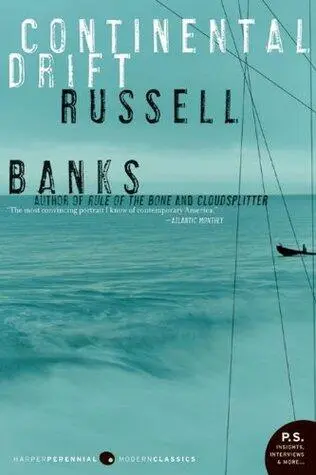
- Название:Continental Drift
- Автор:
- Издательство:Harper Perennial Modern
- Жанр:
- Год:2007
- ISBN:нет данных
- Рейтинг книги:4 / 5. Голосов: 1
-
Избранное:Добавить в избранное
- Отзывы:
-
Ваша оценка:
Continental Drift: краткое содержание, описание и аннотация
Предлагаем к чтению аннотацию, описание, краткое содержание или предисловие (зависит от того, что написал сам автор книги «Continental Drift»). Если вы не нашли необходимую информацию о книге — напишите в комментариях, мы постараемся отыскать её.
is a masterful novel of hope lost and gained, and a gripping, indelible story of fragile lives uprooted and transformed by injustice, disappointment, and the seductions and realities of the American dream.
Continental Drift — читать онлайн бесплатно полную книгу (весь текст) целиком
Ниже представлен текст книги, разбитый по страницам. Система сохранения места последней прочитанной страницы, позволяет с удобством читать онлайн бесплатно книгу «Continental Drift», без необходимости каждый раз заново искать на чём Вы остановились. Поставьте закладку, и сможете в любой момент перейти на страницу, на которой закончили чтение.
Интервал:
Закладка:
“So why does Bob need a gun?” Elaine asks.
The others, even Sarah, look at her as if she is simple minded. “Elaine, honey,” Eddie says, smiling. “You are not in Catamount, Cow Hampshire, anymore, sweetie.”
“Don’t call me sweetie. Please.”
“Okay, okay. Sorry.”
“Things are different here, Elaine,” Bob says.
“You bet your ass things are different here. We got niggers with guns and razors here,” Eddie says, suddenly serious. “We got Cubans who cut your balls off. We got Haitians with their fucking voodoo sacrifices and Jamaicans with machetes as long as your fucking arm. We got dark-skinned crazies of all kinds, all hopped up on their fucking pot and cocaine, riding around in brand-new Mercedes-Benzes without enough pocket money to put gas in the tanks. We got Colombians, for Christ’s sake, with fucking machine guns !”
“Oh, come on, Eddie, you’re going to send them back to New Hampshire scared out of their wits. It’s not that bad,” Sarah says. “Honest.” She unfolds her legs and takes a slow sip of her beer. “It’s not like Miami,” she adds, stretching her arms overhead and arching her back like a cat. She’s wearing a beige pantsuit that accentuates her tan and the long angularity of her body. Bob once saw her naked and was surprised at how closely her body resembled an adolescent boy’s body, long, tight, smooth, with tiny breasts, like white circles on her chest. He was also surprised by how attractive he found her body. It was in his and Elaine’s own bedroom in Catamount one hot summer afternoon a few years earlier, when Eddie, Sarah and Jessica had come up for a week in June to visit them and examine summer camps in New Hampshire for Jessica. Because of the unusual heat, Bob came home from work earlier than usual, and finding the house empty, guessed everyone had gone to the lake for a swim. When he strolled into his bedroom he caught Sarah there, naked, sitting on the edge of the bed painting her toenails. She looked up as he entered and made no attempt to hide herself from him. Her dark hair, cut short, was wet and brushed back like a swimmer’s, and to Bob she looked so clean and precise, so apparent and without mystery or guile, that he felt a great longing to make love to her, which surprised and frightened him and sent him back down the hall and rapidly down the stairs. At the bottom of the stairs, he turned, looked up and waited, as if he expected Sarah to appear there. After a few seconds, he took a long pull on his beer, swallowed and hollered, “Hey, I’m sorry, Sarah. I thought nobody was home!”
“That’s okay,” she called. “Everyone’s gone swimming. I stayed home to take a nap and a shower. I’m sure I’ll end up feeling better than they will.”
“Yeah,” he said. He knew from the music in her voice that if he went back up the stairs and entered the bedroom, took off his clothes and started kissing her along her throat, she would not even pretend to stop him, and afterwards she would never say a word about it to him or anyone else. That is the moment he remembers now whenever he looks straight at Sarah. He still can’t decide whether his decision to sit in his chair in the living room until Sarah was dressed and cheerfully downstairs was the right decision, for, like most people, Bob finds it difficult to know right from wrong. He relies on taboos and circumstances to control his behavior, to make him a “good man,” so that on those infrequent occasions when neither taboo nor circumstance prohibits him from satisfying an appetite and he does not satisfy that appetite or even attempt to do so, he does not know what to think of himself. He doesn’t know if he has been a good man or merely a stupid or scared man. Most people, like Bob, unchurched since childhood, now and then reach that point of not knowing whether they’ve been good, stupid or scared, and the anxiety it provokes obliges them to cease wondering as soon as possible and bury the question, as a dog buries a bone, marking it and promising to themselves that they will return to the bone later, when they have the time and energy to gnaw, a promise never kept, of course, and rarely meant to be kept. One of the more attractive aspects of Bob’s character, however, is his reluctance to bury these bones, his willingness to go on gnawing into the night, alone and silent, turning it over and upside down, persisting until finally it is white and dry and, in certain lights, a little ghastly. His memory is cluttered with these bones, like a medieval church basement, and it gives to his manner and bearing a kind of melancholy that attracts people who are more educated or refined than he is.
Turning away from Sarah, Bob asks his brother, “What the hell am I supposed to do with this gun? I haven’t shot a handgun since the service.”
Eddie laughs. “I don’t give a flying fuck what you do with it, so long’s you keep it with you when you’re at the store. The niggers know you got a gun in the store, believe me, they know, they get the word out. Leastways the niggers in this town do, because they all know each other. Then on a Friday night when they’re out looking for easy cash, they’ll keep on moving down the line. You’ll never have to use it. Just keep it with you when you go back and forth to the bank, and under the counter by the cash register the rest of the time, and if some nigger’s stupid enough to want to knock off the place, you blow the sonofabitch away. Like I said, I got a license.”
“I don’t like it,” Elaine says. She walks abruptly back to the kitchen.
“Who the hell does?” Eddie calls after her. “But what the Christ are you supposed to do? Some guy comes in, says, ‘If you have a minute, Mister White Motherfucker, give me what’s in the cash drawer, as I happen to have a chance for some excellent cocaine tonight and I’m a little low, and besides, I’m two payments behind on my BMW,’ so you say, ‘Certainly, sir, Mister Colored Gentleman, and would you like a case of cognac to go with that?’ Come on, Elaine. You blow the bastard away!”
“What if he blows you away !” Elaine yells back.
Eddie is silent for a minute.
“Elaine,” Bob says. He keeps looking at the gun.
“We’ve had this same damned argument a hundred times,” Sarah says in a weary voice. “He won’t listen. He thinks he’s God.”
As if to himself, Bob says quietly, “I don’t want to shoot anybody. Christ, I don’t even like hunting.” He’s a fisherman, not a hunter. When they were boys, both he and Eddie tried to enjoy deer hunting with their father. Eddie, after a few years, gave it up, because of the scarcity of deer and the difficulty of killing one, but Bob continued to go out year after year with the old man and his cronies, although whenever one of them shot a deer and bloodied the snow with the carcass, he found himself slightly sickened. In New Hampshire, most men who hunt deer do it in groups of three and four, driving pickups and four-wheel-drive vehicles to the end of a dirt road and as far into the woods as the vehicle will go. Then they walk all day through the snowy woods in the cold, sipping at a bottle of Canadian Club every now and then, when finally one of them catches a glimpse of a terrified buck darting uphill through chokecherry and birch and starts blasting away, until it leaps, somersaults and collapses in a heap. Then the other hunters gather around and talk while the man guts his deer. Later, with the carcass of the deer lashed to the front fender of the pickup, they stop at a roadhouse and buy drinks all around and finally arrive home, tired, drunk and very happy — except for Bob, whose only pleasure came from having got through another season without being obliged to take a shot at a deer.
Fishing, however, for Bob, is a solitary, carefully organized, slow and nearly silent activity. He loves the buoyancy of the boat when, a half hour before dawn, he first steps into it, the lap of the waves against the gunwales, the trajectory and sweet hum of the line going out and its geometry, the point-to-point-to-point relations it draws from his hand to the world above the waterline to the world below. Since childhood, he’s fished with bait, hand-tied flies and lures along hundreds of the streams, rivers and ponds of New Hampshire. In canoes, borrowed boats, rented boats, and finally his own Boston whaler, he’s fished most of the state’s larger lakes and the bays along the coast, even fishing out at sea in Avery Boone’s trawler, miles beyond the Isles of Shoals in search of bluefish in July. Sometimes he’s left New Hampshire waters for salmon in Maine and Quebec, and on a few occasions he’s found himself, his car parked beside the road, surfcasting in moonlight on the sandy beaches of Cape Cod. Since childhood, fishing has satisfied his need to be alone and in the natural world at the same time, his deep, extremely conscious need for the presence of his own thoughts coming to him in his own voice, which rarely happens in the presence of other people, his need for order and, perhaps his most tangled need, his need for competence. Hunting for deer, the only hunting he knows about, denies all those; to him, it’s social, chaotic and impossible to feel competent at. When his father died, it was with great relief that he sold both his and the old man’s rifles to a gun dealer in Keene.
Читать дальшеИнтервал:
Закладка:
Похожие книги на «Continental Drift»
Представляем Вашему вниманию похожие книги на «Continental Drift» списком для выбора. Мы отобрали схожую по названию и смыслу литературу в надежде предоставить читателям больше вариантов отыскать новые, интересные, ещё непрочитанные произведения.







Обсуждение, отзывы о книге «Continental Drift» и просто собственные мнения читателей. Оставьте ваши комментарии, напишите, что Вы думаете о произведении, его смысле или главных героях. Укажите что конкретно понравилось, а что нет, и почему Вы так считаете.