Marisha Pessl - Night Film
Здесь есть возможность читать онлайн «Marisha Pessl - Night Film» весь текст электронной книги совершенно бесплатно (целиком полную версию без сокращений). В некоторых случаях можно слушать аудио, скачать через торрент в формате fb2 и присутствует краткое содержание. Год выпуска: 2014, Издательство: Random House Trade Paperbacks, Жанр: Современная проза, на английском языке. Описание произведения, (предисловие) а так же отзывы посетителей доступны на портале библиотеки ЛибКат.
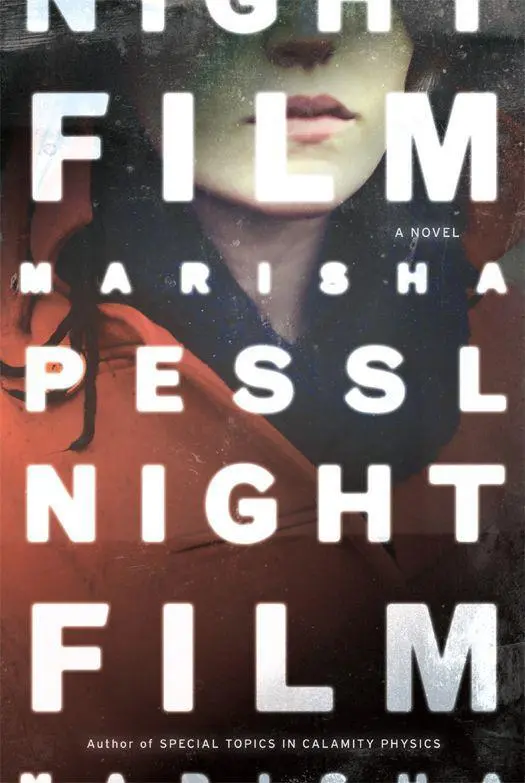
- Название:Night Film
- Автор:
- Издательство:Random House Trade Paperbacks
- Жанр:
- Год:2014
- ISBN:нет данных
- Рейтинг книги:5 / 5. Голосов: 1
-
Избранное:Добавить в избранное
- Отзывы:
-
Ваша оценка:
Night Film: краткое содержание, описание и аннотация
Предлагаем к чтению аннотацию, описание, краткое содержание или предисловие (зависит от того, что написал сам автор книги «Night Film»). Если вы не нашли необходимую информацию о книге — напишите в комментариях, мы постараемся отыскать её.
tells the haunting story of a journalist who becomes obsessed with the mysterious death of a troubled prodigy — the daughter of an iconic, reclusive filmmaker. On a damp October night, beautiful young Ashley Cordova is found dead in an abandoned warehouse in lower Manhattan. Though her death is ruled a suicide, veteran investigative journalist Scott McGrath suspects otherwise. As he probes the strange circumstances surrounding Ashley’s life and death, McGrath comes face-to-face with the legacy of her father: the legendary, reclusive cult-horror-film director Stanislas Cordova — a man who hasn’t been seen in public for more than thirty years.
For McGrath, another death connected to this seemingly cursed family dynasty seems more than just a coincidence. Though much has been written about Cordova’s dark and unsettling films, very little is known about the man himself.
Driven by revenge, curiosity, and a need for the truth, McGrath, with the aid of two strangers, is drawn deeper and deeper into Cordova’s eerie, hypnotic world.
The last time he got close to exposing the director, McGrath lost his marriage and his career. This time he might lose even more.
Night Film
Night Film — читать онлайн бесплатно полную книгу (весь текст) целиком
Ниже представлен текст книги, разбитый по страницам. Система сохранения места последней прочитанной страницы, позволяет с удобством читать онлайн бесплатно книгу «Night Film», без необходимости каждый раз заново искать на чём Вы остановились. Поставьте закладку, и сможете в любой момент перейти на страницу, на которой закончили чтение.
Интервал:
Закладка:
“What’d you think?” asked Hopper, sliding out behind me.
I shrugged. “Young and impressionable. Probably made most of it up.”
“Right. That’s why you looked so bored and nearly tripped over yourself to get your hands on that coat.”
I said nothing, only pulled two twenties from my wallet.
“For one thing,” he said, “she’s got no place to live.” He was staring out the window where Nora Halliday and her many bags were still visible, far across the four-lane street. She was using a building’s mirrored reflection to fix her hair into a ponytail. She then picked up the bags and vanished behind a delivery truck.
With a last hard look at me — clearly indicating he didn’t trust me or particularly like me — Hopper put his phone to his ear.
“Keep those eyes open, Starsky,” he said, heading out.
I held back, waiting for him to duck past the window. I doubted I’d see him again— or Hannah Montana, for that matter. When New York took over, both of them would fall by the wayside.
That was the magnificent thing about the city: It was inherently Machiavellian. One rarely had to worry about follow- throughs, follow- ups, follow the leaders, or any kind of consistency in people due to no machinations of one’s own but the sheer force of living here. New York hit its residents daily like a great debilitating deluge and only the strongest —the ones with Spartacus-styled will —had the strength to stay not just afloat but on course. This pertained to work as much as it did to personal lives. Most people ended up, after only a couple of months, far, far away from where they’d intended to go, stuck in some barbed underbrush of a quagmire when they’d meant to head straight to the ocean. Others outright drowned (became drug addicts) or climbed ashore (moved to Connecticut).
Yet the two of them had been helpful.
All those nights ago, it had been Ashley Cordova. I thought I’d decided on my own to look into her death, and yet incredibly she’d come to me first, wedged herself like a splinter into my subconscious. I’d have to review the timing, but I remembered the Reservoir encounter was a little more than a week before her death. When I saw her it must have been just a few days after she’d escaped from the mental-health clinic, Briarwood Hall.
How had she known I’d be there? No one knew I went to the park to jog in the dead of night except Sam. One evening months ago, while tucking her into bed, she’d announced that I was “far away” and I’d answered I wasn’t, because I went up to her neighborhood to run. With every lap, I could look up to her window and see she was snug in her bed, safe and sound. This was a stretch, of course; I could no more see Cynthia and Bruce’s ritzy apartment on Fifth Avenue than the Eiffel Tower, but the thought had pleased her. She’d closed her eyes, smiling, and fell right to sleep.
The only possible explanation, then, was that Ashley had been following me. She would have known about me after her father’s lawsuit. It was conceivable she’d tracked me down in order to tell me something, something about her father — John’s ominous words immediately came to mind, There’s something he does to the children —but had lost her nerve.
But after what Hopper had told me, shyness didn’t seem an underlying part of Ashley’s personality. Quite the opposite.
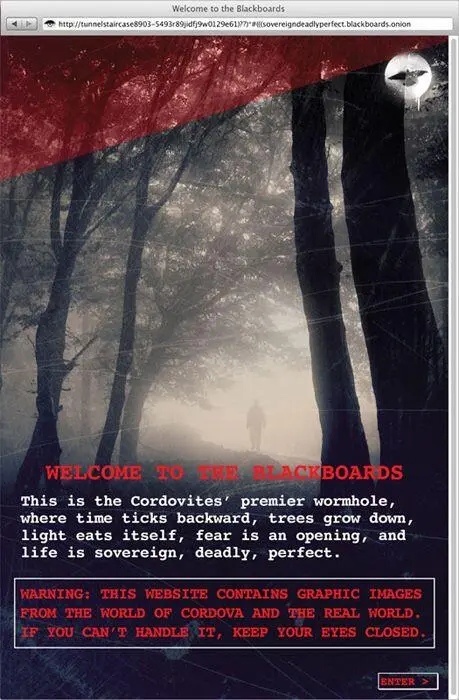
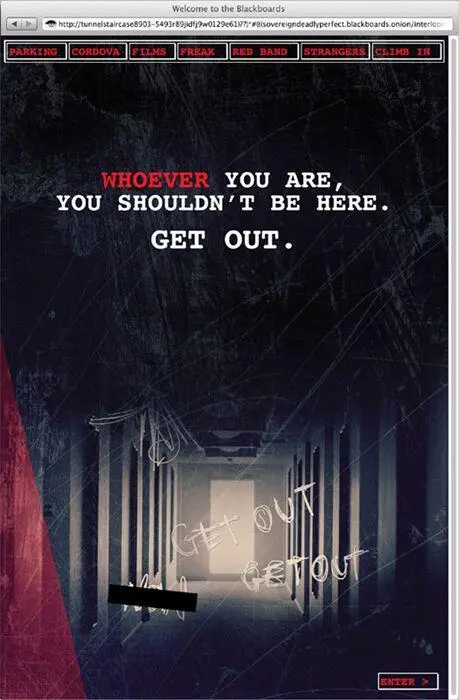
I had to get back to Perry Street: first, to make arrangements to drive upstate to Briarwood so I could learn about Ashley’s stay there. I also wanted to check out the URL of the Blackboards I’d swiped off of Beckman’s computer.
I grabbed the Whole Foods bag, exiting the diner. The sun was out, splattering brash light over the cars speeding down Eleventh Avenue. It did nothing to lighten the unease I felt over the simple, startling fact that the red coat, that blood red stitch in the night from the Reservoir, had appeared one last time in front of me.
It was in my own hands.
~ ~ ~

From: Elizabeth J. Poole  Hide Subject:Re: Tour Date:Oct 25 2011 06:24:44 PM EDT To:Dr. Leon Dean
Dear Dr. Dean:
Thank you for your inquiry.
I would be delighted to give you a guided tour of our state-of-the-art health facility and also to answer any questions you may have. I’ve penciled you in for tomorrow at 11:30 AM.
In the meantime, please browse our website and the attached literature about Briarwood and its esteemed history.
Please call me at your earliest convenience.
Very truly yours,
Elizabeth J. Poole
Director of Admissions
Briarwood Hall Hospital
Restoring Mental Health since 1934
~ ~ ~
14
The following morning, an hour before I was set to leave for the three-hour drive upstate to Briarwood, I was in my kitchen making a fresh pot of coffee when there was a knock on my front door.
I walked into the foyer and checked the peephole.
Nora Halliday was at my door.
I didn’t know how in the hell she’d found out where I lived, but then I remembered: It was on that damn business card I’d given her back at the Four Seasons. Someone must have buzzed her in. I considered pretending I wasn’t at home, but she knocked again and I knew the old wood floors of my apartment squeaked with every step, so she could hear me standing there.
I unlocked the door. She was wearing a tight black wool jacket with a collar of ostrich feathers, black tights, boots, and a zebra-print nylon miniskirt, which looked like a figure-skating costume from the Lillehammer Olympics. She had no shopping bags with her, only that gray leather purse, her long blond hair braided into two cords wrapped around her head.
“Hi,” I said.
“Hi.”
“What are you doing here?”
“I’m ready to work.”
“It’s eight o’clock in the morning.”
She picked at something crusty on the hem of her jacket. “Yeah, well, I thought maybe you could use someone to bounce ideas off of.”
I was about to tell her to come back tomorrow — then obviously I’d have to move or join a Witness Protection Program — but I remembered that observation Hopper had made, that the girl didn’t have a place to live. She did look pale and faintly exhausted.
“You want to come in for a cup of coffee?”
She beamed. “Sure.”
“I’m about to leave for an appointment, so it won’t be long.”
“No problem.”
“What exactly are you wearing?” I asked, leading her through the foyer into the living room. “Your mother doesn’t let you walk around like that, does she?”
“Oh, sure. She lets me do whatever. She’s dead.” She slung her purse beside the couch — it had to contain at least one bowling ball.
“Then that grandmother you mentioned, she doesn’t let you walk around like that.”
“Eli?” She really pronounced the hell out of the name: EEL EYE. “She’s dead, too.”
Читать дальшеИнтервал:
Закладка:
Похожие книги на «Night Film»
Представляем Вашему вниманию похожие книги на «Night Film» списком для выбора. Мы отобрали схожую по названию и смыслу литературу в надежде предоставить читателям больше вариантов отыскать новые, интересные, ещё непрочитанные произведения.







Обсуждение, отзывы о книге «Night Film» и просто собственные мнения читателей. Оставьте ваши комментарии, напишите, что Вы думаете о произведении, его смысле или главных героях. Укажите что конкретно понравилось, а что нет, и почему Вы так считаете.