Karen Bender - Refund - Stories
Здесь есть возможность читать онлайн «Karen Bender - Refund - Stories» весь текст электронной книги совершенно бесплатно (целиком полную версию без сокращений). В некоторых случаях можно слушать аудио, скачать через торрент в формате fb2 и присутствует краткое содержание. Год выпуска: 2015, Издательство: Counterpoint, Жанр: Современная проза, на английском языке. Описание произведения, (предисловие) а так же отзывы посетителей доступны на портале библиотеки ЛибКат.
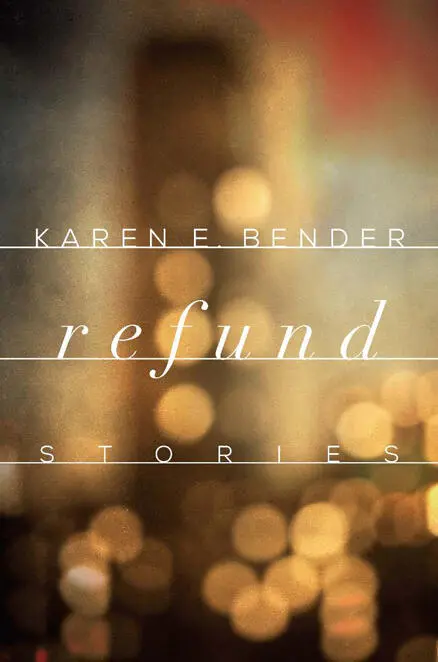
- Название:Refund: Stories
- Автор:
- Издательство:Counterpoint
- Жанр:
- Год:2015
- ISBN:нет данных
- Рейтинг книги:3 / 5. Голосов: 1
-
Избранное:Добавить в избранное
- Отзывы:
-
Ваша оценка:
Refund: Stories: краткое содержание, описание и аннотация
Предлагаем к чтению аннотацию, описание, краткое содержание или предисловие (зависит от того, что написал сам автор книги «Refund: Stories»). Если вы не нашли необходимую информацию о книге — напишите в комментариях, мы постараемся отыскать её.
In Refund, Bender creates an award-winning collection of stories that deeply explore the ways in which money and the estimation of value affect the lives of her characters. The stories in Refund reflect our contemporary world — swindlers, reality show creators, desperate artists, siblings, parents — who try to answer the question: What is the real definition of worth?
In “Theft,” an eighty-year-old swindler, accustomed to tricking people for their money, boards a cruise ship to see if she can find something of true value — a human connection. In “Anything for Money,” the creator of a reality show is thrown into the real world when his estranged granddaughter reenters his life in need of a new heart; and in the title story, young artist parents in downtown Manhattan escape the attack on 9/11 only to face a battle over their subletted apartment with a stranger who might have lost more than only her deposit.
Set in contemporary America, these stories herald a work of singular literary merit by an important writer at the height of her power.
Refund: Stories — читать онлайн бесплатно полную книгу (весь текст) целиком
Ниже представлен текст книги, разбитый по страницам. Система сохранения места последней прочитанной страницы, позволяет с удобством читать онлайн бесплатно книгу «Refund: Stories», без необходимости каждый раз заново искать на чём Вы остановились. Поставьте закладку, и сможете в любой момент перейти на страницу, на которой закончили чтение.
Интервал:
Закладка:
She tightened her arm around Liza’s waist. She knew that her political beliefs were opposite to his. “And how are you going to make the schools better?” she asked.
He heard the blade in her voice; his smile brightened. The pale, clapboard houses behind him seemed to be melting in the heat. “Good question, Diane,” he said, speaking quickly. “We want to bring faith back to our schools. Every child should be allowed to pray. No cost to the taxpayer.” His words sounded a little breathless.
“Pray to what?” she asked.
He blinked. “I’d say Jesus,” he said. She was silent. “But it’s a free country,” he said. He sounded hesitant on that one, she thought. He tapped a rolled-up leaflet against his hand.
“I believe in the separation of church and state,” she said, crisply.
He nodded vigorously, as though by making this movement they would be in agreement. The optimism in the gesture was ridiculous, almost moving. But then he handed her a leaflet. “Some folks may say it’s hard to know whether to choose me or my opponent, Judy Hollis. So I wanted you to know this.”
Did you know that JUDY HOLLIS is a lesbian?
That she is bringing her gay agenda to Raleigh?
Vote for WOODY. FAMILY VALUES .
Diane set Liza down on the floor and slowly stood to face him.
“Diane, our campaign is getting the word out,” he said. “Judy is bad news for our state.”
“Because she’s gay?” she asked.
“Yes,” he said. “We don’t want them coming here. I stand for values, Diane, family values. You know what I mean—”
“No, I don’t,” she said. “I don’t want to hear this bullshit. Stop.”
Woody blinked but did not move. The boy glared at Woody Wilson as though he were an animal the boy wanted to eat. He regarded most men who were tall with brown hair this way — it was the simplest way they could describe their father. The boy lay on the floor and rolled from side to side. Why did they work, the ways he tried to comfort himself? He rolled and screeched and turned; they were strategies that adults found amusing at two but now made them look away. The girl gazed at him. The girl’s love for the boy poured out of her; she could not help herself. She stretched herself on top of him. She screeched and tried to lick his lips. “Stop!” the boy roared, trying to push her off. She clutched his foot as he tried to crawl away from her. Diane plucked the girl off the boy and set her on the couch, where the girl began to scream.
“Please,” Woody Wilson said. “Let me say—” His face went white. Then he toppled forward onto her living room floor.
THE GIRL LET OUT A PIERCING SHRIEK OF DELIGHT, AS THOUGH THE man was entertaining them. The boy jumped back, his hands pressing his ears. “Stop!” he bellowed. He rolled into a ball on the floor.
Woody was lying facedown across Diane’s hardwood floor. His envelope marked CONTRIBUTIONS fell open, and a couple dollars emptied out. He seemed as incongruous as a whale washed up on a beach; she looked down at him, afraid. Diane lightly tapped his shoulder, and then rolled him over. His shoulder was soft as an avocado. He had recently eaten a mint, and his breath was medicinal; she was embarrassed to know this about him.
“What’d he do?” yelled the boy.
She jumped up and grabbed the phone off a side table. Woody’s eyes opened, and he was staring at them.
“I’m calling a doctor,” she said.
“Don’t call anyone. I don’t want them to know.” His presence on billboards made the mundane facts of humanity strange and troubling. His forehead was pink, with creases in it like clay. There was golden hair on the backs of his hands. He touched his eyebrow; a dark bruise was forming. She was afraid of him, which translated into a great and useless pity. She rarely pitied anyone but herself now, so that superiority was somewhat enjoyable.
She left the front door open. Moths flew in. Woody Wilson put a hand on his forehead. “Ow,” he said. He took a deep breath. “Exhaustion. That’s what the doctor said. Nothing wrong at all. He said if it happens, sit down for a few minutes, take some breaths, and keep going. I have to keep going.”
“Okay,” she said, reluctantly. She felt afraid of being blamed.
“I don’t know what happened,” he said. “But when I feel strongly about something, sometimes I see black. I feel my heart churning. Perhaps the Lord is telling me something. Ow,” he said, softly.
What did he mean, the Lord told him things? She sat in her cubicle every day, convincing her students: Evidence. A clear and organized argument. Sometimes, she heard herself ranting about evidence, concrete examples, and she felt herself sweating, pathetically, with her own zealotry. He rubbed the bruise on his forehead. She went to the kitchen and brought him an ice pack. He sat up and pressed it to his face.
“Why are you running for office?” she asked.
“He told me to do this. It is the grace of God. Woody Wilson. I will stand for values. Speak out. The town needs to know your name.”
Through the open front door the clouds were knitting together in a searing, bright sky. She could see the houses on their lawns, each life parceled out into its plot of land, the determined, clipped order of flowers and shrubbery. There were two registered Democrats on her street that she knew of and five Republicans. They went in and out of their houses, shaving their lawns, picking up their newspapers, remarking on the weather. They would all walk into their voting booths, educated and uneducated, intelligent and dumb, and their votes would be worth the same. They sat, diligently filling in bubbles on paper, and, she thought, because of the voters’ impulsive, careless yearnings, wars started, debts soared, the land grew barren, and their great-grandchildren would starve.
The bump on Woody’s head was growing larger and larger. The phone began to ring. Her husband was most lonely around dinner-time. He did not love them but did not know who else to call.
“I’m sorry,” said Woody Wilson. His right foot tapped on the floor like a rabbit’s. “A minute, and I’ll be on my way.” He paused. “Does it look very bad?” he asked.
“I don’t know,” she said. “Maybe you should keep the ice on it.”
The phone rang ten times and then stopped.
“Thank you very much, Diane,” he said. He carefully scooped the dollars on the floor back into his envelope and closed it.
They sat in silence for a moment. He smiled, so his injuries seemed slight.
“Okay,” she said. “While you’re here, I have a question.” She folded her arms, then unfolded them, then folded them again. “Why do you hate so many people? I just want to know—”
“I do not hate them,” he said. “Listen. I am trying to help them from leading lives of so much pain—”
“Why do you assume that people who are not like you are in pain?” she asked.
“I know a lot about pain,” he said. “My mama died when I was eight. My father had to work three jobs. He was always tired. He was so tired we had to forage for dinner ourselves. I got a job working a paper route when I was six. I worked hard. I was angry, I did not know what to do with it, but I said, God, take this anger, and He did. I worked my way up, the good days and the bad. Hard work and faith, that’s what got me to college, law school, to where I am today.”
He recited his litany of pain solemnly, like a prayer. Everyone was competitive in terms of their pain. Did it matter more that Woody’s mother had died when he was young or that Diane’s husband had left the family? Was a troubled, problematic child worse than infertility? What about the fact that Diane’s hours working as a remedial composition instructor had been cut in half, the sudden eczema that spread across her skin, how did that weigh compared to diagnosis with cancer, losing your family in a war, fearing that you might not make love to another person again?
Читать дальшеИнтервал:
Закладка:
Похожие книги на «Refund: Stories»
Представляем Вашему вниманию похожие книги на «Refund: Stories» списком для выбора. Мы отобрали схожую по названию и смыслу литературу в надежде предоставить читателям больше вариантов отыскать новые, интересные, ещё непрочитанные произведения.











Обсуждение, отзывы о книге «Refund: Stories» и просто собственные мнения читателей. Оставьте ваши комментарии, напишите, что Вы думаете о произведении, его смысле или главных героях. Укажите что конкретно понравилось, а что нет, и почему Вы так считаете.