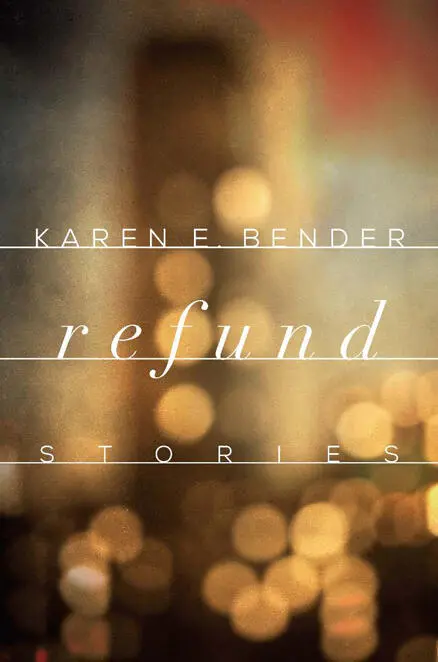
Karen Bender - Refund - Stories
Здесь есть возможность читать онлайн «Karen Bender - Refund - Stories» весь текст электронной книги совершенно бесплатно (целиком полную версию без сокращений). В некоторых случаях можно слушать аудио, скачать через торрент в формате fb2 и присутствует краткое содержание. Год выпуска: 2015, Издательство: Counterpoint, Жанр: Современная проза, на английском языке. Описание произведения, (предисловие) а так же отзывы посетителей доступны на портале библиотеки ЛибКат.
- Название:Refund: Stories
- Автор:
- Издательство:Counterpoint
- Жанр:
- Год:2015
- ISBN:нет данных
- Рейтинг книги:3 / 5. Голосов: 1
-
Избранное:Добавить в избранное
- Отзывы:
-
Ваша оценка:
Refund: Stories: краткое содержание, описание и аннотация
Предлагаем к чтению аннотацию, описание, краткое содержание или предисловие (зависит от того, что написал сам автор книги «Refund: Stories»). Если вы не нашли необходимую информацию о книге — напишите в комментариях, мы постараемся отыскать её.
In Refund, Bender creates an award-winning collection of stories that deeply explore the ways in which money and the estimation of value affect the lives of her characters. The stories in Refund reflect our contemporary world — swindlers, reality show creators, desperate artists, siblings, parents — who try to answer the question: What is the real definition of worth?
In “Theft,” an eighty-year-old swindler, accustomed to tricking people for their money, boards a cruise ship to see if she can find something of true value — a human connection. In “Anything for Money,” the creator of a reality show is thrown into the real world when his estranged granddaughter reenters his life in need of a new heart; and in the title story, young artist parents in downtown Manhattan escape the attack on 9/11 only to face a battle over their subletted apartment with a stranger who might have lost more than only her deposit.
Set in contemporary America, these stories herald a work of singular literary merit by an important writer at the height of her power.
Refund: Stories — читать онлайн бесплатно полную книгу (весь текст) целиком
Ниже представлен текст книги, разбитый по страницам. Система сохранения места последней прочитанной страницы, позволяет с удобством читать онлайн бесплатно книгу «Refund: Stories», без необходимости каждый раз заново искать на чём Вы остановились. Поставьте закладку, и сможете в любой момент перейти на страницу, на которой закончили чтение.
Интервал:
Закладка:
The boys coming up the hill saw me holding Betsy and slowed down. I squeezed my sister, tighter, tighter. I waited for something beautiful to come out of her; I waited for anything at all. Then Betsy started to cough, and we fell, separate, on the sand.
Betsy was still. I took her hand out of the sand. She kept her face down as I shook the sand off. She must have known there was no difference. And, of course, there wasn’t. Because when her hand was out, I could see that it was the same. It was still my sister’s bad hand.
The boys began to rush the hill. And they began calling her by the name she had given them. “Sally.” “Sally.”
When she heard they were still coming, Betsy sat up, yanked her bad hand back.
“Oh, great,” she said. “Give me something.”
“What?”
“Don’t be stupid. Your shirt.”
She snapped up my shirt with her good hand, and then I was on the top of that hill in my bikini top, the wind touching my shoulders. Betsy wrapped my shirt around her bad hand in about half a second, whip-fast after years of practice. The boys were coming for us. They were coming. Betsy pulled me. “Let’s go,” she said. She took my hand with her good one. Her good hand fit into mine perfectly. It had never fit so well.
“Come on,” she said. And we walked off the beach, all the boys calling, “Sally,” “Sally,” the whole beach ringing with my name.
Candidate
Diane Bernstein paid the babysitter, the third one to quit this month, extremely polite when doing so, blaming it on other issues — sorority functions, heavy schoolwork — as though the boy had not unnerved her at all. When Diane walked through the door, Liza, the baby girl, fell into her mother’s arms, weeping so hard she began to choke. The boy, Tommy, was curled up in his bed, rocking himself, for he had scratched the babysitter in a fury (“I wanted to play the radio,” she said, “and he just went insane”), and the young woman had shut him in his room. Why hadn’t Diane found a better babysitter? It was not a question she allowed herself anymore. She had long stopped worrying about forgiveness, of herself or others. When the therapist had told her, again, that it was not her fault, she laughed. Everything was her fault; everything was everyone’s fault. “Even if it was his fault,” she said, meaning her husband, to the therapist, “What would it matter? He’s gone.”
Diane had to figure out whom to comfort first: two-year-old Liza, who clung to her, frantic with love, unwilling to peel herself from her mother after their long day apart, or Tommy, a knot of frustration in his bed. “They’re cute kids,” the babysitter called back, apologetically, pulling her long sleeves over the scratches the boy had given her; clutching her thirty dollars, she got into her Jeep and drove off.
Diane had spent the day working in the remedial writing lab of a private university in the Southeast. She hunched in a dimly lit cubicle with the undergraduates, glossy, overfed children who drove SUVs that were gifts from their parents and who could never correctly use a comma. Their essays were supposed to address the upcoming 2004 presidential election and involved passionate, ungrammatical declarations stating why the Republicans should win. Lazy people should not get my tax mony , they wrote, I don’t want any gay agenda on my family. Marriage is between a man and a woman . That day, Diane sat with a young woman dressed like a prostitute, her pink spandex halter top stretched across her breasts. Her hair was styled, confusingly, in two pigtail braids, like an eight-year-old’s. The girl smelled of the beach, of coconut and salt. She had written a diatribe about how the United States should not only invade Iraq but Saudi Arabia, Egypt, Russia, and Japan, as revenge for Pearl Harbor. It was an extremely long and angry run-on sentence.
“Do you worry about how other countries might respond to this?” asked Diane.
The girl glared at her. “The terrorists want to kill me,” she said.
The girl’s previous paper had recorded her frustrations about her parents’ divorce, the insensitivities of her superiors at Walmart, the cheap gifts her boyfriend had given her. It had been a more interesting paper, though it still lacked any punctuation.
“The terrorists would come to Briar Wood College?” Diane asked, before she could stop herself.
The girl’s eyes narrowed. Then, as though concerned about her grade, she smiled and said, sweetly, “You’re just from the North,” which was true, though “the North” seemed to imply anywhere slanting north or west; Diane had moved here from Seattle.
Diane closed her eyes; the school where she worked had raised tuition too many times, and faculty had been cautioned not to discuss the upcoming election with the mostly conservative students. They lurched about campus, students and teachers, pretending to ignore each other’s pins and T-shirts. She had done what she could: covered her car in bumper stickers and stuck signs in her lawn that were later torn down.
Sometimes, Diane thought it best to unplug the phone. Then she would not have to decide whether or not to answer it. The father, who was now residing in Florida, was not supposed to call at this hour; he was supposed to speak to the children only in the morning, for his voice upset them when it was time for dinner and bed. She carried the girl up to the boy’s room and sat on his bed. Liza put her head on Diane’s leg and closed her eyes, quiet; her breathing became calm. The boy did not like to be touched, but was generally soothed by coloring in squares in black and yellow. She gave him crayons and paper and he sat up, filling each box with extraordinary love.
Diane listened to the silence in the room and envied the girl’s belief that she had been rescued. It was an acute misunderstanding between parents and children, one that sometimes comforted her but also felt like a joke.
SOMEONE KNOCKED AT THE DOOR. DIANE JUMPED UP, HOLDING Liza, and she and Tommy ran for the door. There she found a man in a crisp white shirt and navy pants. His outstretched hand sliced the air in two.
“Hi there,” he said. “Woody Wilson here. Running for state legislature. I want to represent you.”
Before he said his name, he was just an ordinary stranger, standing there, slim, brown-haired — a salesman of encyclopedias or cleaning equipment — with the belligerent, trudging optimism of someone who went door to door. After he declared his name, she hated him. This shift in feeling was so abrupt she felt she had been slapped. His face seemed to glow the way a famous person’s did; perhaps it was an accident that he was walking around on earth. He lived most fully on the newspaper ads and billboards all over town. Woody Wilson, Republican for North Carolina State Senate .
“And what’s your name?”
“Diane,” said the boy.
“Man,” the girl said, looking up at Woody Wilson.
It was late afternoon. The house smelled like a rotten melon. The afternoon was weighted toward night. The golden light already held an undertone of darkness. Diane had read what he stood for, and she hated all of it. It would be so simple, so luxurious, to slam the door on him! But she did not. His eyes were clear and blue as a baby’s.
“Diane, can I have just a moment of your time?” he asked. He kept smiling, but his face was red from the heat. “I can see that you’re a family person.” He stepped back and began to arrange the plastic vehicles scattered across her front porch. He put Big Wheels behind sedans. “I have a family, too. How old are your kids? I have two, eight years old and five.” He laughed, brokenly; it almost sounded like weeping. “I’ve come to ask for your vote, Diane,” he said. “And—” he lifted a manila envelope marked CONTRIBUTIONS — “perhaps a donation to my cause. I am for family. We are what make America great.” He swept his arm toward her in a grand, appropriating gesture; she stepped back from him. “What does your family need? If you want more money in your wallet, I have the answers. If you want better schools, I can answer that, too.”
Читать дальшеИнтервал:
Закладка:
Похожие книги на «Refund: Stories»
Представляем Вашему вниманию похожие книги на «Refund: Stories» списком для выбора. Мы отобрали схожую по названию и смыслу литературу в надежде предоставить читателям больше вариантов отыскать новые, интересные, ещё непрочитанные произведения.












Обсуждение, отзывы о книге «Refund: Stories» и просто собственные мнения читателей. Оставьте ваши комментарии, напишите, что Вы думаете о произведении, его смысле или главных героях. Укажите что конкретно понравилось, а что нет, и почему Вы так считаете.