Larry Bond - Shattered Trident
Здесь есть возможность читать онлайн «Larry Bond - Shattered Trident» весь текст электронной книги совершенно бесплатно (целиком полную версию без сокращений). В некоторых случаях можно слушать аудио, скачать через торрент в формате fb2 и присутствует краткое содержание. Город: New York, Год выпуска: 2013, ISBN: 2013, Издательство: Forge Books, Жанр: prose_military, thriller_techno, на английском языке. Описание произведения, (предисловие) а так же отзывы посетителей доступны на портале библиотеки ЛибКат.
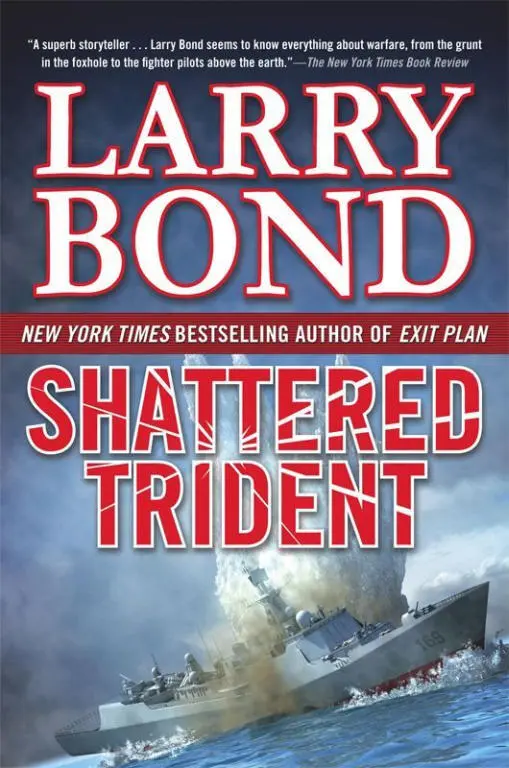
- Название:Shattered Trident
- Автор:
- Издательство:Forge Books
- Жанр:
- Год:2013
- Город:New York
- ISBN:978-0-7653-3147-2
- Рейтинг книги:5 / 5. Голосов: 1
-
Избранное:Добавить в избранное
- Отзывы:
-
Ваша оценка:
Shattered Trident: краткое содержание, описание и аннотация
Предлагаем к чтению аннотацию, описание, краткое содержание или предисловие (зависит от того, что написал сам автор книги «Shattered Trident»). Если вы не нашли необходимую информацию о книге — напишите в комментариях, мы постараемся отыскать её.
is shocked to see the Chinese boat torpedo a Vietnamese merchant ship.
This blatant act of aggression is the opening gambit in a war that has blindsided the U.S. and quickly embroiled all nations in the western Pacific. These nations, bound together in the newly formed Littoral Alliance, have begun a covert submarine campaign aimed at crippling China’s economy before China can set in motion its own plot to dominate the region.
In a desperate attempt to buy the president enough time to resolve the crisis diplomatically, Mitchell’s submarine squadron is ordered to interfere with attacks by both sides. China and the Littoral Alliance are both determined to win, no matter the cost, and as each side increases the level of violence, they approach a dangerous tipping point. In a race against time, the submarines of Mitchell’s squadron must execute their mission before the world witnesses an economic catastrophe—or worse, a nuclear exchange.
Shattered Trident — читать онлайн бесплатно полную книгу (весь текст) целиком
Ниже представлен текст книги, разбитый по страницам. Система сохранения места последней прочитанной страницы, позволяет с удобством читать онлайн бесплатно книгу «Shattered Trident», без необходимости каждый раз заново искать на чём Вы остановились. Поставьте закладку, и сможете в любой момент перейти на страницу, на которой закончили чтение.
Интервал:
Закладка:
“All right, Ray, you’ve made your point,” admonished Myles while gesturing for Lloyd to calm down. “So why don’t we just cut to the chase and have you provide your recommendation. Not that you have a strong opinion on the matter.”
Kirkpatrick chuckled; the president’s light humor successfully dispatched the growing tension amongst his key advisors.
“My apologies, Mr. President. I didn’t mean to preach. But there is one point of agreement between the People’s Republic of China and the Littoral Alliance—neither side wants the United States to become involved in this conflict. Therefore, I recommend we comply with their mutual desire and withdraw our forces from the South and East China Seas. Regardless of which side ultimately prevails, it is in our best interests, long-term interests, to be perceived as neutral.”
Myles leaned back in his chair as he considered Kirkpatrick’s suggestion. The president knew that his national security advisor never took a strong position on anything without first dissecting every fact. And yet, Lloyd and McHenry also had strong arguments. The president loathed situations such as this when he had a diametrically opposed cabinet. It made the job of making a decision far more difficult, as he respected the views and opinions of each of his closest advisors. This time, Myles chose to do something he hated almost as much—he’d kick the can down the road.
“Okay, Ray, I’ll make a deal with you. I’ll postpone a final decision on the spoiler campaign until after Andy and I meet with the Japanese ambassador this evening. After I hear the alliance’s position from the horse’s mouth, then we’ll sit down and hammer it out.”
Kirkpatrick nodded his head, disappointed. But a delay did make some sense, particularly if the Japanese ambassador confirmed his understanding of Komamura’s writings.
Lloyd was equally unhappy, but more vocal. “Mr. President, this will reinforce your opponent’s view that you are a fence-sitter. You’re taking a beating in the polls. The perception is that you are too weak to take a strong stand, or that you don’t know what to do. The election is only two months away; this perception has to be changed, and soon.”
“Andy, I’m being pilloried by both parties for not articulating a firm position—they want me to choose sides,” Myles remarked. “Regardless of what I do, someone will be unhappy with it. If both my own party and the Republicans are upset with my actions, then maybe, just maybe, it’s the right one. I’m going to go with my instinct on this one, Andy. We’ll wait till after our meeting tonight. Then we’ll know where we stand.”
17. EXECUTION
8 September 2016
0800 Local Time
August 1st Building, Ministry of National Defense Compound
Beijing, People’s Republic of China
Chen had agreed to let General Hu present his plan, not because he intended to approve it, but because he was frankly curious. The Second Artillery Corps controlled China’s nuclear ballistic missiles, but it also had an impressive arsenal of conventional weapons. They were already being used against Vietnam with some effect, but Hu wanted a much broader strike against the entire alliance, one with political, as well as military effects.
“The alliance nations have made it easy for us to avoid killing Americans,” Hu argued. “They’ve evacuated the bases they operate jointly with the United States. The only exception is Clark Field in the Philippines, but the CJ-10 cruise missile is accurate enough to attack only areas where the Japanese units are located.”
Hu brought up the last slide. It was a summary, showing arrows reaching out from China toward South Korea, Japan, and the Philippines. Only India was spared, to avoid any possible nuclear misunderstandings.
“We will strike ten targets in three countries, a mix of military and economic targets related to their own energy infrastructure. The plan uses ninety-four missiles, approximately one-fifth of our conventional long-range inventory. It does not call on our standing forces near Taiwan, and does not affect our campaign in Vietnam. With this heavy blow, we will bring the war to the citizens of the Littoral Alliance.” Hu sat down with a pleased expression.
General Shi Peng did not look pleased at all. At Chen’s request, he’d listened to Hu’s plan, but the instant the missile commander was finished, Shi quickly spoke up. “I know you’re eager to bring your forces into the struggle, General, but this ‘heavy blow’ is also an open challenge to the United States. We already have U.S. military units deploying to the Philippines, where before there were almost none, and they’re reinforcing their troops in South Korea.”
Shi turned to General Xi. “Have your intelligence people considered whether the Americans are using these deployments to mask a surprise intervention on the side of the alliance? If they decided to join—”
“They won’t,” Chen interrupted.
“You all read the ambassador’s report,” Shi argued. “I’m alarmed with the level of detail the Americans possessed.”
“I’ll send them my copy of the plan,” Vice Chairman Zhang replied acidly. “It’s old news now. We went over all this when we first received Yang’s report. Even perfect knowledge of the enemy is not enough. One must have the desire to act. They don’t.” Others, including Chen, nodded agreement.
“But you will still not approve my plan,” Hu predicted.
“No,” Chen answered. “A deliberate attack like this might—no, likely would provoke the Americans into action. I understand their reluctance to fight, and I share it. A war between our countries would be a calamity, even if we won. It’s bad enough we have to deal with India, but they only have a limited nuclear strike capability; they’d destroy a few of our cities while we would annihilate their entire country. A nuclear exchange with the U.S. would be profoundly different…” Chen shuddered.
General Su, chief of the General Staff added, “President Chen and I have had many discussions about the Americans. They will not join this war, which leaves us no excuse for not winning. We are developing plans to punish Indonesia for joining the alliance, which will also serve to deter Malaysia and Singapore from making a similar foolish decision. They are not under American protection, and indeed have no military alliances to speak of. General Xi is working with Pakistan to increase pressure on India, and do not forget that phase one of Trident is nearly complete, in spite of our setback at Spratly Island.”
“All we need to do is endure for a little longer,” Chen insisted.
8 September 2016
Littoral Alliance Headquarters
Okutama, Nishitama District
Tokyo, Japan
The television kept distracting him. Like so many others, he simply left it on a news channel all the time. Even with access to the intelligence resources of the alliance, he was afraid of missing something. Things were happening too quickly.
The sound was off, but a map of Russia showed army units moving toward the Chinese border, but so far all the analysts agreed it was precautionary. NATO was arguing about its role, too. The war had nothing to do with European security, but was deeply and adversely affecting Europe’s economy. When did an economic threat require a military solution?
Perhaps his next book would be about the interrelated nature of the world economy. No, that was too obvious. Of course they were interrelated. It took at least two countries to engage in any sort of trade, and there were trade groups, and don’t even get him started about the Common Market…
Читать дальшеИнтервал:
Закладка:
Похожие книги на «Shattered Trident»
Представляем Вашему вниманию похожие книги на «Shattered Trident» списком для выбора. Мы отобрали схожую по названию и смыслу литературу в надежде предоставить читателям больше вариантов отыскать новые, интересные, ещё непрочитанные произведения.
![Никки Сикс - Героиновые дневники. Год из жизни павшей рок-звезды[The Heroin Diaries - A Year in the Life of a Shattered Rock Star]](/books/78612/nikki-siks-geroinovye-dnevniki-god-iz-zhizni-pavshej-rok-zvezdy-the-heroin-diaries-a-yea-thumb.webp)


Обсуждение, отзывы о книге «Shattered Trident» и просто собственные мнения читателей. Оставьте ваши комментарии, напишите, что Вы думаете о произведении, его смысле или главных героях. Укажите что конкретно понравилось, а что нет, и почему Вы так считаете.