Larry Bond - Shattered Trident
Здесь есть возможность читать онлайн «Larry Bond - Shattered Trident» весь текст электронной книги совершенно бесплатно (целиком полную версию без сокращений). В некоторых случаях можно слушать аудио, скачать через торрент в формате fb2 и присутствует краткое содержание. Город: New York, Год выпуска: 2013, ISBN: 2013, Издательство: Forge Books, Жанр: prose_military, thriller_techno, на английском языке. Описание произведения, (предисловие) а так же отзывы посетителей доступны на портале библиотеки ЛибКат.
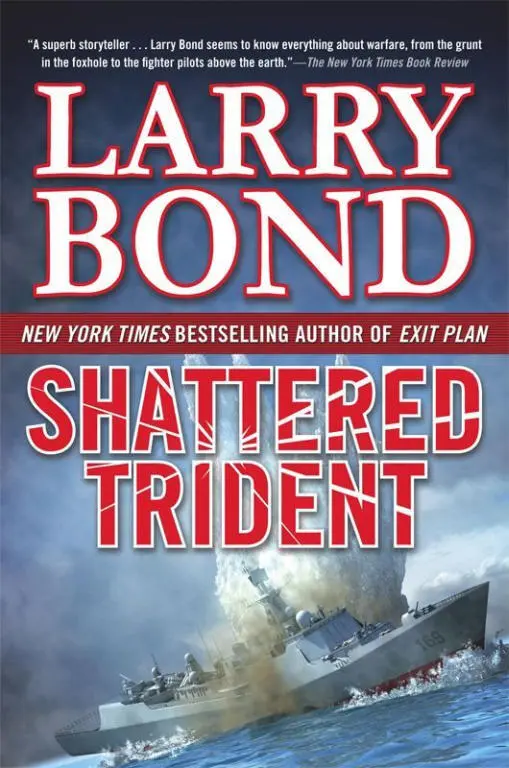
- Название:Shattered Trident
- Автор:
- Издательство:Forge Books
- Жанр:
- Год:2013
- Город:New York
- ISBN:978-0-7653-3147-2
- Рейтинг книги:5 / 5. Голосов: 1
-
Избранное:Добавить в избранное
- Отзывы:
-
Ваша оценка:
Shattered Trident: краткое содержание, описание и аннотация
Предлагаем к чтению аннотацию, описание, краткое содержание или предисловие (зависит от того, что написал сам автор книги «Shattered Trident»). Если вы не нашли необходимую информацию о книге — напишите в комментариях, мы постараемся отыскать её.
is shocked to see the Chinese boat torpedo a Vietnamese merchant ship.
This blatant act of aggression is the opening gambit in a war that has blindsided the U.S. and quickly embroiled all nations in the western Pacific. These nations, bound together in the newly formed Littoral Alliance, have begun a covert submarine campaign aimed at crippling China’s economy before China can set in motion its own plot to dominate the region.
In a desperate attempt to buy the president enough time to resolve the crisis diplomatically, Mitchell’s submarine squadron is ordered to interfere with attacks by both sides. China and the Littoral Alliance are both determined to win, no matter the cost, and as each side increases the level of violence, they approach a dangerous tipping point. In a race against time, the submarines of Mitchell’s squadron must execute their mission before the world witnesses an economic catastrophe—or worse, a nuclear exchange.
Shattered Trident — читать онлайн бесплатно полную книгу (весь текст) целиком
Ниже представлен текст книги, разбитый по страницам. Система сохранения места последней прочитанной страницы, позволяет с удобством читать онлайн бесплатно книгу «Shattered Trident», без необходимости каждый раз заново искать на чём Вы остановились. Поставьте закладку, и сможете в любой момент перейти на страницу, на которой закончили чтение.
Интервал:
Закладка:
Manogar walked over to the helmsman, checking their course and speed for the tenth time in the last hour. It was totally unnecessary; the automatic pilot had them squarely on course for the port of Nagoya at twelve knots. The young mate at the helm smiled. He knew his captain was a compulsive worrier. If there were such a thing as sea monsters, Captain Manogar would fret over them. The war that he feared was far away, near China. The warnings were merely a precautionary measure the Indian government felt compelled to issue. Ever since the 2008 terror attack in south Mumbai, they’d started proclaiming warnings every time they thought something bad might happen. If the government felt the potential risk for severe sunburn was high enough, they’d issue a warning. A bunch of paranoid old men, he thought to himself.
“We’re still steady on course three three zero, speed twelve knots, Captain,” he reaffirmed sarcastically.
“I can read, Helmsman,” Manogar replied tersely. Annoyed by the young man’s flippant report, Manogar marched over to the bridge windows. Staring out into the dark overcast night, it wasn’t even ten seconds before he felt the overwhelming urge to raise his binoculars and conduct a search. It was pure habit, one he had acquired since his time as a junior mate. He doubted he’d ever see a submarine’s periscope, but a stupid fisherman cruising around the ship lanes without his running lights on was another danger that he had to keep in mind.
He’d completed a full forward scan and had turned to look at the bridge’s radar repeater when suddenly the ship shook violently. Both men were knocked off their feet; the helmsman suffered a nasty gash to his head and was bleeding profusely, but he was still conscious. Manogar pulled himself up on the control console and saw the alarm panel had numerous red lights flashing. The audible alarms pierced the quiet night. Through the din, the ship’s internal phone rang. The captain silenced the alarms and grabbed the phone. “Bridge.”
“Captain, Engineer here, we’re taking on water in holds two and three. We’ve also lost the main engine, not sure what the problem is.”
“Engineer,” Manogar spoke quickly, “we’ve been torpedoed. Get your men topside immediately!” He hung up before the engineer could reply.
“Jack, pass the word, prepare to abandon ship!”
The woozy helmsman responded and headed over to the shipwide PA system. Manogar reached over and grabbed the ship’s radio mike and moved the frequency band selector to “16,” the international distress channel.
“Mayday. Mayday. Mayday. This is Motor Vessel Tamilnadu . We’ve been hit by a torpedo, forty-eight nautical miles south-southeast of Irago Suido. Location, latitude, three three degrees, five zero minutes north. Longitude, one three seven degrees, two five minutes east. Repeat. Mayday. Mayday. Mayday. This is Motor Vessel Tamilnadu . We’ve been hit by a torpedo, forty-eight nautical miles—”
The second torpedo exploded aft, right under the ship’s superstructure, abruptly cutting short Captain Manogar’s distress call.
7 September 2016
1300 Local Time
White House Situation Room
Washington, D.C.
Secretary of Commerce Joyce McHenry pulled up the next chart in her brief. The diagram showed a disheartening trend.
“Trade with China has been severely reduced due to the Littoral Alliance submarine campaign. Even though the alliance was only targeting tankers initially, insurance costs have gone through the roof for any ship transiting through a war zone—and Lloyd’s of London includes India in that mix. The bottom line is the number of Chinese ships entering U.S. ports is down to a quarter of the normal level, and many of the ships that get here don’t want to leave. We’ve also seen a decrease in the number of Japanese and South Korean vessels arriving, by about one-third.”
President Myles rubbed his forehead; he dreaded asking the obvious question. “Joyce, what is your best estimate on the damage to the economy?”
McHenry sighed deeply. “Mr. President, China, Japan, and South Korea are in the top ten of our global trading partners. Indian and Taiwan are in the top fifteen. If the merchant traffic doesn’t decrease further, we’re looking at an estimated loss of sixteen billion dollars in exports to the countries directly in the war zone each month. Unfortunately, Europe was still in a weakened condition and it has been bludgeoned by this crisis. Many of the European Union economies have dropped back into recession—resulting in a similar reduction in our exports. An optimistic figure would suggest that we are looking at a fifteen to twenty percent reduction in monthly exports.”
“And the unemployment rate?” groaned Myles.
“Mr. President, we have a ‘just-in-time’ economy,” emphasized McHenry. “It is predicated on an uninterrupted flow of goods, in and out of the country. There is little in the way of stored inventory. Since we produce only a small fraction of the consumer goods sold, particularly in the electronics, appliance, and clothing sectors, you’re looking at two weeks, tops, before many stores will have little or nothing to put on the shelves. Add in the impact of a precipitous drop in exports, and significant job loss is all but inevitable. Initial estimates suggest the unemployment rate will probably exceed twelve percent. Perhaps as high as seventeen percent.”
Myles winced. Many of the other cabinet members sat in shocked silence.
“And that’s an optimistic assessment, correct?” asked Myles hesitantly.
McHenry looked downward, disheartened. “Yes, Mr. President, I’m afraid so,” she answered.
“I see.” The president paused, absorbing the dreadful news. Myles removed his glasses and rubbed his eyes, then clearing his throat said, “All right, Joyce, just skip to the bottom line.”
“Yes, sir. If this war continues for another two or three weeks, the economy will very likely drop into a major recession, with unemployment rates exceeding the historical norms for the last seventy-five years. If the fighting goes on for more than a month, two months at the outside, the possibility of a depression becomes… unpleasantly high.”
“Two months?” cried Geisler in disbelief. “How can our economy be ruined in such a short period of time?”
“As with mechanical systems, Malcolm, economic trends also experience inertia,” explained McHenry. “Even if we could stop this war right now, its aftereffects would still be felt for months, perhaps years. The longer the fighting goes on, the steeper the downturn in our economy becomes, which means a deeper bottoming out further down the road—one that could take us a decade to crawl out of.”
The cabinet meeting abruptly went quiet; everyone’s morale was in shambles, crushed by McHenry’s devastating projection. Uneasy with the depressing silence, Kirkpatrick moved on to the next topic; there was still more ground to cover.
“Mr. President,” he began. “We’ve confirmed that the PLAN was able to secure Spratly Island, and the airfield is largely intact. China did lose a Yuzhao-class amphibious assault ship, an old Jiangwei II-class frigate, and a container ship carrying the garrison’s equipment, so their hold is a bit tenuous.”
Myles nodded. “Casualties?” he asked.
“High, Mr. President. The Chinese probably lost more men because of the amphibious assault ship, but the Vietnamese squadron was all but annihilated. Only a single damaged patrol boat returned to port this morning.” Kirkpatrick saw the pained expression on Myles’s face. “They did stop the Chinese southern thrust,” added the national security advisor.
Читать дальшеИнтервал:
Закладка:
Похожие книги на «Shattered Trident»
Представляем Вашему вниманию похожие книги на «Shattered Trident» списком для выбора. Мы отобрали схожую по названию и смыслу литературу в надежде предоставить читателям больше вариантов отыскать новые, интересные, ещё непрочитанные произведения.
![Никки Сикс - Героиновые дневники. Год из жизни павшей рок-звезды[The Heroin Diaries - A Year in the Life of a Shattered Rock Star]](/books/78612/nikki-siks-geroinovye-dnevniki-god-iz-zhizni-pavshej-rok-zvezdy-the-heroin-diaries-a-yea-thumb.webp)



Обсуждение, отзывы о книге «Shattered Trident» и просто собственные мнения читателей. Оставьте ваши комментарии, напишите, что Вы думаете о произведении, его смысле или главных героях. Укажите что конкретно понравилось, а что нет, и почему Вы так считаете.