Larry Bond - Shattered Trident
Здесь есть возможность читать онлайн «Larry Bond - Shattered Trident» весь текст электронной книги совершенно бесплатно (целиком полную версию без сокращений). В некоторых случаях можно слушать аудио, скачать через торрент в формате fb2 и присутствует краткое содержание. Город: New York, Год выпуска: 2013, ISBN: 2013, Издательство: Forge Books, Жанр: prose_military, thriller_techno, на английском языке. Описание произведения, (предисловие) а так же отзывы посетителей доступны на портале библиотеки ЛибКат.
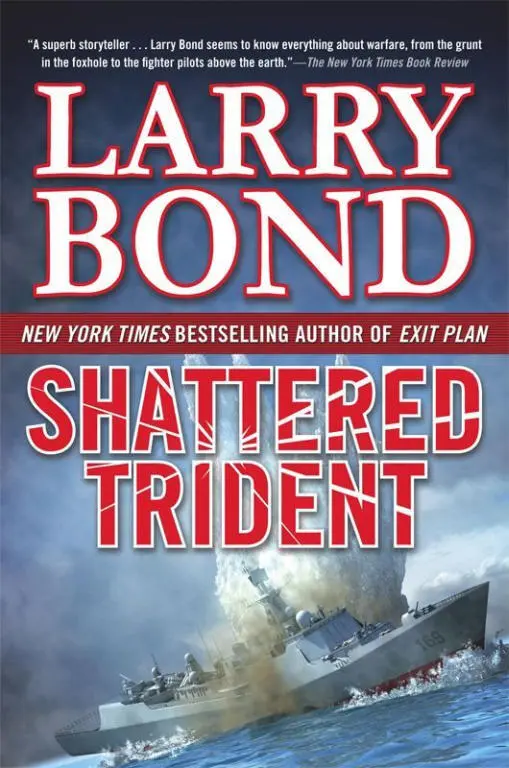
- Название:Shattered Trident
- Автор:
- Издательство:Forge Books
- Жанр:
- Год:2013
- Город:New York
- ISBN:978-0-7653-3147-2
- Рейтинг книги:5 / 5. Голосов: 1
-
Избранное:Добавить в избранное
- Отзывы:
-
Ваша оценка:
Shattered Trident: краткое содержание, описание и аннотация
Предлагаем к чтению аннотацию, описание, краткое содержание или предисловие (зависит от того, что написал сам автор книги «Shattered Trident»). Если вы не нашли необходимую информацию о книге — напишите в комментариях, мы постараемся отыскать её.
is shocked to see the Chinese boat torpedo a Vietnamese merchant ship.
This blatant act of aggression is the opening gambit in a war that has blindsided the U.S. and quickly embroiled all nations in the western Pacific. These nations, bound together in the newly formed Littoral Alliance, have begun a covert submarine campaign aimed at crippling China’s economy before China can set in motion its own plot to dominate the region.
In a desperate attempt to buy the president enough time to resolve the crisis diplomatically, Mitchell’s submarine squadron is ordered to interfere with attacks by both sides. China and the Littoral Alliance are both determined to win, no matter the cost, and as each side increases the level of violence, they approach a dangerous tipping point. In a race against time, the submarines of Mitchell’s squadron must execute their mission before the world witnesses an economic catastrophe—or worse, a nuclear exchange.
Shattered Trident — читать онлайн бесплатно полную книгу (весь текст) целиком
Ниже представлен текст книги, разбитый по страницам. Система сохранения места последней прочитанной страницы, позволяет с удобством читать онлайн бесплатно книгу «Shattered Trident», без необходимости каждый раз заново искать на чём Вы остановились. Поставьте закладку, и сможете в любой момент перейти на страницу, на которой закончили чтение.
Интервал:
Закладка:
Komamura paused. “Please excuse me, I’m complaining to a man with much larger problems. Given time, our plan will work.” He tried to sound confident.
2 September 2016
1300 Local Time
White House Situation Room
Washington, D.C.
Patterson was giving the briefing. Kirkpatrick had given her as much warning as he could, a little less than thirty minutes.
Myles had called for a meeting of the National Security Council as soon as the Littoral Alliance’s “nonanswer” arrived. Everyone had shown up. No deputies this time. The secretaries of state, defense, the chairman and vice chairman of the Joint Chiefs, the director of national intelligence, even the director of Homeland Security sat close to the head of the table, but much of the cabinet had also decided to attend: energy, treasury, commerce, even the attorney general.
The president was late, and he’d sent word to start without him, but the empty chair distracted her. It also meant he wouldn’t hear her opening, but they couldn’t wait any longer. Ray nodded to her, and she stepped up to the podium.
“Ladies and gentlemen, China has mobilized for war, as have most of the nations in the Western Pacific.” She pressed her remote and a map appeared on the screen showing military unit movements from India eastward, all the way to South Korea.
“I am going to summarize the situation in the region. A detailed accounting would take more time than we have. Dr. Kirkpatrick can provide any of you with—”
A rectangle of light appeared to one side, and President Myles came in, hurrying. “Apologies, everyone. My conversation with Prime Minister Keyes went longer than I expected.” He paused, then added, “but the British can add nothing to what we already know.” Settled in his chair, he looked over and said, “Dr. Patterson, please continue.”
She pressed the remote again, and the map zoomed in to frame China. Unit symbols littered Chinese territory, but clustered near the borders. “Of the eighteen group armies that make up their main ground forces, all but two have mobilized, and of those, all but three have left their garrisons. The regional troops in all seven military districts have been put on alert, and this morning President Chen Dao signed an order requiring all reservists to muster with their units.”
Patterson used a light pointer. “Ground and air forces are concentrating in the south, along the Vietnamese border, in the Chengdu and Guangzhou Military Regions. The 13th, 14th, and 41st Group Armies will be in position to attack Vietnam within twenty-four hours. There has been no appreciable concentration across from Taiwan; in fact, elements of the 31st Group Army are heading westward. Some mobile units have been sent to reinforce the northern border, but this seems to be more of a precautionary measure, as they are second-line formations without the latest equipment.
“There are also indications that China has seized several islands and reefs in the Spratly Island archipelago, SIGINT reporting indicates fighting on Namyit and Spratly Islands and Southwest Cay. All three are Vietnamese-claimed islands.
“Every nation in the area, including those in the Littoral Alliance, has gone to a full war footing. In the three Pacific Littoral Alliance countries, U.S. attachés and other U.S. nationals have been barred from military bases ‘for their own safety.’ This has not applied to our joint-use bases in Japan and South Korea. Instead, Japanese and South Korean units are being moved from the joint bases to ones exclusively under national control.”
The map shifted west suddenly, framing India. “Delhi has ordered an alert in the north, ‘because of China’s history of past aggression.’ Indian Army and Air Force units in the area are deploying to defensive positions. Their ballistic missile forces have also begun moving to dispersal sites.”
Patterson brought the map back east, expanding it to include the entire western Pacific. “Merchant ship traffic in the South and East China Seas has dropped by fifty percent in the past four days, with many ships reaching their destination and not leaving, or in some cases, simply heading for the nearest safe harbor. This includes, as of eight o’clock this morning, seventeen U.S.-owned vessels.”
She checked the time. Good, five minutes flat. “Questions?”
General Jason Nagy, the Joint Chiefs vice chairman, raised his hand. “Dr. Patterson, the Vietnamese islands you mentioned, they span the entire length of the Spratlys?”
“Yes, General,” Joanna replied. “Southwest Cay is in the north, Namyit Island is in the center, and Spratly Island proper is in the south.”
“Thank you, ma’am, for makin’ my point,” answered the Marine Corps general with a heavy southern drawl. “That’s a maritime front over two hundred nautical miles long. It would take at least three amphibious assault groups to conduct that many landin’s simultaneously.”
“You’re correct, sir.” She nodded. “Three of China’s Type 071 Yuzhao-class LPDs are in the South China Sea AOR, and the Marine Corps Intelligence Activity has assessed they are the primary units behind the attacks.”
General Nagy smiled broadly. “Yes, ma’am, I’ve talked at length with the boys in MCIA, but doesn’t it strike you as a very fortuitous coincidence that the Chinese have the necessary assets all together and ready to go on a moment’s notice?”
Joanna felt uncertain. What was the general getting at? “Well, General Nagy, they were scheduled to participate in the major exercise, but that is obviously OBE. Since the units were available, the Chinese put them to immediate use attacking islands belonging to at least one of their adversaries.”
Nagy chuckled. “Well, I wouldn’t know about that. But it seems to this dumb grunt that an amphibious campaign of this magnitude would require a helluva lot more time to plan and prepare for than just three or four days.”
The lightbulbs suddenly came on, as everyone present comprehended what the marine general was saying.
President Myles leaned forward, his gaze intense. “General, are you suggesting these invasions were preplanned? How much time would you need to organize such a campaign?”
“Mr. President, all I’m sayin’ is that it would take months to get everythin’ planned and in place, the people trained and properly supplied. Particularly for a navy and a marine corps that hasn’t done anythin’ like this before. Now some pretty smart folks are suggestin’ the Chinese are more flexible and could turn their forces around much quicker than we can. And with all due respect to their considerable credentials, Mr. President, that’s a pile of manure.”
“The ‘imminent Chinese threat,’” Patterson blurted out, referring to the Russian CD. “If the Vietnamese had knowledge of a planned invasion of their holdings in the Spratlys, that would explain the mining of the Chinese carrier—the flagship of the invasion force.”
“My God!” a weary Lloyd exclaimed. “This is the reason why the Littoral Alliance went to war!”
“Hold on, Andy. It only provides an explanation of why Vietnam went to war. It doesn’t do us any good for the other three nations,” retorted Malcolm Geisler, the secretary of defense. He was the newest member of the cabinet, having replaced the ailing James Springfield.
“But it does, Malcolm. Japan and South Korea have similar issues with China in the East China Sea. Remember that tiff over Japanese oil and gas exploration by China near the Senkaku Islands last year? And what about the growing number of incidents between Chinese fishing boats and Japanese and South Korean coast guard ships? Same story, different location,” Lloyd argued.
Читать дальшеИнтервал:
Закладка:
Похожие книги на «Shattered Trident»
Представляем Вашему вниманию похожие книги на «Shattered Trident» списком для выбора. Мы отобрали схожую по названию и смыслу литературу в надежде предоставить читателям больше вариантов отыскать новые, интересные, ещё непрочитанные произведения.
![Никки Сикс - Героиновые дневники. Год из жизни павшей рок-звезды[The Heroin Diaries - A Year in the Life of a Shattered Rock Star]](/books/78612/nikki-siks-geroinovye-dnevniki-god-iz-zhizni-pavshej-rok-zvezdy-the-heroin-diaries-a-yea-thumb.webp)






Обсуждение, отзывы о книге «Shattered Trident» и просто собственные мнения читателей. Оставьте ваши комментарии, напишите, что Вы думаете о произведении, его смысле или главных героях. Укажите что конкретно понравилось, а что нет, и почему Вы так считаете.