Alan Moorehead - Gallipoli
Здесь есть возможность читать онлайн «Alan Moorehead - Gallipoli» весь текст электронной книги совершенно бесплатно (целиком полную версию без сокращений). В некоторых случаях можно слушать аудио, скачать через торрент в формате fb2 и присутствует краткое содержание. Год выпуска: 0101, ISBN: 0101, Издательство: Rockport Publishers, Жанр: prose_military, military_history, на английском языке. Описание произведения, (предисловие) а так же отзывы посетителей доступны на портале библиотеки ЛибКат.
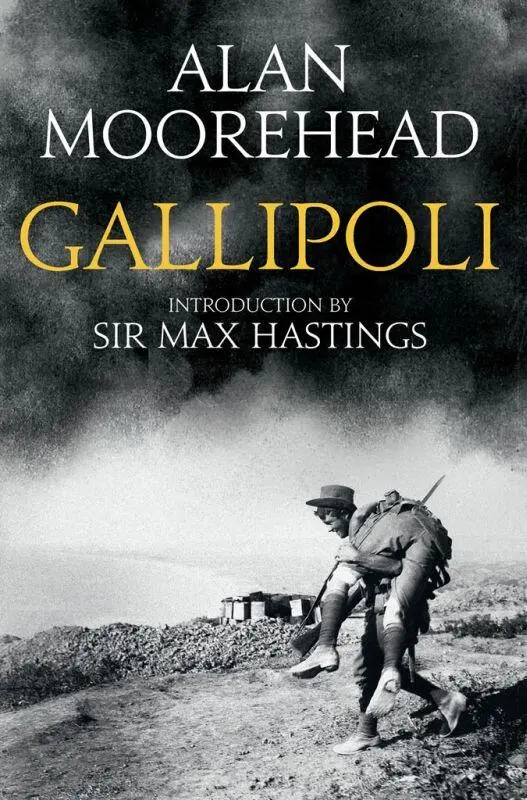
- Название:Gallipoli
- Автор:
- Издательство:Rockport Publishers
- Жанр:
- Год:0101
- ISBN:9781781314852
- Рейтинг книги:5 / 5. Голосов: 1
-
Избранное:Добавить в избранное
- Отзывы:
-
Ваша оценка:
Gallipoli: краткое содержание, описание и аннотация
Предлагаем к чтению аннотацию, описание, краткое содержание или предисловие (зависит от того, что написал сам автор книги «Gallipoli»). Если вы не нашли необходимую информацию о книге — напишите в комментариях, мы постараемся отыскать её.
Gallipoli — читать онлайн бесплатно полную книгу (весь текст) целиком
Ниже представлен текст книги, разбитый по страницам. Система сохранения места последней прочитанной страницы, позволяет с удобством читать онлайн бесплатно книгу «Gallipoli», без необходимости каждый раз заново искать на чём Вы остановились. Поставьте закладку, и сможете в любой момент перейти на страницу, на которой закончили чтение.
Интервал:
Закладка:
‘He looked extraordinarily handsome,’ Hamilton wrote in his diary, ‘quite a knightly presence stretched out there on the sand with the only world that counts at his feet.’
Compton Mackenzie in his Gallipoli Memories relates how he too was caught up in the Gallipoli fever. He was living at Capri at the time, had just published Sinister Street (which had made his name), and was working on the concluding chapters of Guy and Pauline . Directly he heard of the expedition he was in a frenzy of impatience to get to Egypt. Friends in Whitehall found him a job on Hamilton’s staff, and presently he was off down the Mediterranean on the first available boat out of Naples, appalled that as yet he had no uniform, and beset with anxiety that he would not arrive in time.
Almost all these young men — and thousands of others less imaginative but just as ardent — were facing the prospect of battle for the first time, and their letters and diaries reveal how strongly the sense of adventure communicated itself through the Army. For the moment the constricting fear of the unknown was overlaid by the newness and the excitement of the occasion, the feeling that they were isolated together here in this remote place and entirely dependent upon one another. They were determined to be brave. They were convinced that they were committed to something which was larger and grander than life itself, perhaps even a kind of purification, a release from the pettiness of things.
‘Once in a generation,’ Hamilton wrote in his diary, ‘a mysterious wish for war passes through the people. Their instinct tells them that there is no other way of progress and of escape from habits that no longer fit them. Whole generations of statesmen will fumble over reforms for a lifetime which are put into full-blooded execution within a week of a declaration of war. There is no other way . Only by intense sufferings can the nations grow, just as a snake once a year must with anguish slough off the once beautiful coat which has now become a strait jacket.’
In the long tradition of British poet-generals Hamilton remains an exception of an extremely elusive kind. One knows everything and nothing about him. Whether one is dealing with the poet or the general at any given point it is almost impossible to tell. Somewhere about this time — April 1915—there was a remarkable photograph taken of the General on board the Triad , and this perhaps reveals him more intimately than all the diaries and the opinions of his friends. One recognizes the other figures in the group at once. Admiral de Robeck stands with his feet firmly planted on the deck, his arms clasped behind his back, and his steady, carved, admiral’s face belongs to gales at sea. Keyes at his side, is exactly as he ought to be: a slim, angular figure, alas not a beautiful face with those big ears, but most engaging. Braithwaite, the Chief of Staff, is the handsome professional; he fills his uniform like a soldier and he knows where he is. But it is upon Hamilton that one inevitably fixes one’s eye. Everything about him is wrong. He has adopted an almost mincing attitude, his shoulders half-turned in embarrassment towards the camera, one hand resting on a stanchion in a curiously feminine way and the other grasping what appears to be a scarf or a piece of material at his side. The fingers are long, shapely and intensely sensitive, the face quite firm and patrician but somehow nervous and ill-at-ease. His uniform does not fit him — or rather he gives the impression that he ought not to be in uniform at all. His cap is a disaster. Braithwaite has the right kind of cap and it suits him; Hamilton’s perches like a pancake on his head, his tunic is bus-conductorish, his breeches too tight for his wilting bow legs. Physically he is the last possible man one can imagine as a commander-in-chief. He simply does not inspire confidence.
And yet it is clear beyond any doubt from this photograph that here is an exceptionally intelligent man — much more intelligent than any of the others. One looks again and finds oneself hoping that this intelligence, this sensitivity and bird-like quickness, also contains a germ of resolution, perhaps some special sort of refined courage which we had missed before; and still one remains uncertain.
It is left to his record to reassure us. The General was sixty-two when this picture was taken. He was born in the Mediterranean on the island of Corfu, and had spent the whole of his adult life in the Army — indeed, he had seen more active service than almost any other senior general. He had fought the tribesmen on the north-west frontier of India, had served throughout the Boer War, and had been with the Japanese in Manchuria in the Russo-Japanese war. In recent years he had held the appointments of commander-in-chief in the Mediterranean and Inspector-General of Overseas Forces. According to his contemporaries, Hamilton was one of those unusual men who apparently are quite indifferent to danger. His left hand had been shattered early in his career, and more than once he had been recommended for the Victoria Cross.
There was one other thing that set him apart, and that was his exceptional talent as a writer. He read and wrote much poetry and he loved to keep diaries in a kind of French shorthand which he had invented himself; these jottings, he said, cleared his mind and put events into perspective when he was in command in the field. As a staff officer he had been full of ideas. His Staff Officer’s Scrapbook , for example, had foretold the disappearance of cavalry in favour of trench warfare.
There is a theme running through this life, and that is Lord Kitchener. Kitchener was Hamilton’s star. Fifteen years before Hamilton had served as the Field Marshal’s chief-of-staff in South Africa, and the intimacy that had grown up between them was a good deal more than the relationship of the admiring junior to his chief; there was a strength in Kitchener, a massiveness, which appears to have deeply satisfied something which was wanting in Hamilton’s own life. He was quite shrewd enough to see Kitchener’s weaknesses, and in his diaries he occasionally permitted himself to fret about them as a woman will fret about her husband. But Kitchener had only to speak out and Hamilton dissolved at once. Old K. In the end he was bigger than them all. One had to protect him from the fools and the critics. Never for an instant does Hamilton challenge his chief’s authority. Never does he fail to pause before taking a major decision and ask himself, ‘What would K. have done?’ And Kitchener on his side promotes his follower, occasionally favours him with his confidence, and now sends him off to Constantinople.
Henry Nevinson, the war correspondent, has an interesting note on Hamilton’s character: ‘From a mingled Highland and Scottish descent he had inherited the so-called Celtic qualities which are regarded by thorough Englishmen with varying admiration and dislike. His blood gave him so conspicuous a physical courage that after the battles of Caesar’s Camp and Diamond Hill the present writer, who knew him there, regarded him as an example of the rare type which not merely conceals fear with success, but does not feel it. Undoubtedly he was deeply tinged with the “Celtic charm”—that glamour of mind and courtesy of behaviour which create suspicion among people endowed with neither.’
After the war Hamilton was criticized for being so much under Kitchener’s thumb, for being a weak commander, a commentator on battles instead of a man of action. But it is only fair to remember that he was respected and liked by Winston Churchill and a great many other demanding people in London. At Gallipoli none of his senior contemporaries speak against him — not Keyes nor any of the Admirals, not any of the French. The one man who attacks him is a corps commander whom Hamilton dismissed. Under Hamilton’s command there is never any dispute between the Army and the Navy, and all the Allied contingents serve with him the utmost loyalty.
Читать дальшеИнтервал:
Закладка:
Похожие книги на «Gallipoli»
Представляем Вашему вниманию похожие книги на «Gallipoli» списком для выбора. Мы отобрали схожую по названию и смыслу литературу в надежде предоставить читателям больше вариантов отыскать новые, интересные, ещё непрочитанные произведения.








Обсуждение, отзывы о книге «Gallipoli» и просто собственные мнения читателей. Оставьте ваши комментарии, напишите, что Вы думаете о произведении, его смысле или главных героях. Укажите что конкретно понравилось, а что нет, и почему Вы так считаете.