William Gerhardie - The Polyglots
Здесь есть возможность читать онлайн «William Gerhardie - The Polyglots» весь текст электронной книги совершенно бесплатно (целиком полную версию без сокращений). В некоторых случаях можно слушать аудио, скачать через торрент в формате fb2 и присутствует краткое содержание. Год выпуска: 2013, Издательство: Melville House, Жанр: Классическая проза, на английском языке. Описание произведения, (предисловие) а так же отзывы посетителей доступны на портале библиотеки ЛибКат.
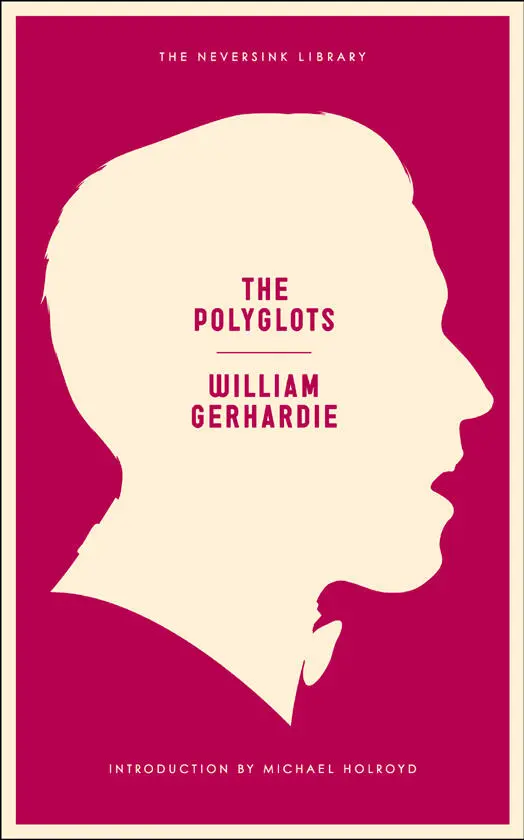
- Название:The Polyglots
- Автор:
- Издательство:Melville House
- Жанр:
- Год:2013
- ISBN:нет данных
- Рейтинг книги:5 / 5. Голосов: 1
-
Избранное:Добавить в избранное
- Отзывы:
-
Ваша оценка:
The Polyglots: краткое содержание, описание и аннотация
Предлагаем к чтению аннотацию, описание, краткое содержание или предисловие (зависит от того, что написал сам автор книги «The Polyglots»). Если вы не нашли необходимую информацию о книге — напишите в комментариях, мы постараемся отыскать её.
The Polyglots — читать онлайн бесплатно полную книгу (весь текст) целиком
Ниже представлен текст книги, разбитый по страницам. Система сохранения места последней прочитанной страницы, позволяет с удобством читать онлайн бесплатно книгу «The Polyglots», без необходимости каждый раз заново искать на чём Вы остановились. Поставьте закладку, и сможете в любой момент перейти на страницу, на которой закончили чтение.
Интервал:
Закладка:
And here at last Dr. Murgatroyd stepped in. The value of education weighed in the balance and found wanting, the utility of self-government reduced to a becoming level, and the worth of either played off against the other till one effectively disposed of both, the field was clear for his pet theory, the exposition of which he felt was now peculiarly appropriate.
His pet theory was the union of the Orthodox and the Anglican Churches. It was a fixed idea with him, the essence and the purpose of his life. For thirty years or more he had accosted archbishops, bishops, patriarchs, archimandrites, metropolitans, and such-like holy fathers in both countries with this obsolete idea. Dr. Murgatroyd was a singularly untidy, unkempt, dishevelled individual, and, no doubt, to advertise his liaison with that country he wore a costume after the style of the Russian moujik . He had been described by his enemies as ‘the only Englishman who never washed’, and he was persistent to a degree scarcely credible even in a correspondent. He had no conscience, no shame. He confronted kings and emperors, prime ministers and ambassadors and commanders-in-chief and every kind of religious enthusiast, and preached to them the union of the Orthodox and the Anglican Churches. Many seemed quite hopeful, and others were polite about it, but he thought it the crowning factor in world politics, the keystone of the Russian situation, the crux of the whole thing. If anything was to bring the two countries together, or avert wars, or promote trade, or kill Bolshevism, or save the world from every kind of evil, it was, he said, with certainty, the union of the Orthodox and the Anglican Churches. In his absent-mindedness it had somehow not occurred to him that the big idea of political domination through the medium of religion had died for ever with the temporal power of the Pope, and that whatever his concern for the Anglican Church at home the ordinary modern Englishman cared no more about the Orthodox faith than the ordinary Russian bothered his mind about the Church of England, should he have ever heard of its existence. But Dr. Murgatroyd was absent-minded to a degree only pardonable in professors. If you had told him at any hour of the day that he had already had his dinner, he would knit his brows and think hard for a moment and then say: ‘Yes, perhaps you are right. Yes, you are right. Yes, I must have had my dinner. Yes, I have had my dinner. Yes, yes, yes, yes.’ But he never kept regular hours for meals. He scarcely ever had any regular meals, or, in fact, any meals at all. He simply felt no need for food. He said: ‘All I want is a little tobacco.’ He was one of that class of people who never have any money; for even if he had had any money, he would not know where he had put it. Similarly all his teeth had gone from wear and tear and lack of all care. But there he lived on without teeth, not that their absence did not cause him to suffer pain and discomfort (for his digestion, as in fact everything else in his constitution, had gone to pieces), but it had simply never occurred to him that something had to be done in the matter. His mind was continually occupied with other things.
‘The most formidable weapon against Bolshevism,’ said Dr. Murgatroyd, ‘is religion. Here it is that we can truly help. Russia’s salvation lies in the union of the Orthodox and the Anglican Churches. When I was in Moscow and Kiev many years ago I saw Archimandrite Theodosy, Metropolitans Theophanes and Hermogenes and Father Nikon, and they asked me to convey their warmest sentiments to our archbishops.’
‘M’yes,’ said the General. ‘M’yes — of course — the Union of the Churches. But why is it that this Captain Negodyaev is so long in coming?’
He pressed the button in a prolonged, determined manner.
The aide-de-camp stood in the doorway.
‘Well?’
‘We’ve sent for the mechanic, your Excellency.’
‘What a long time,’ said the General apologetically to Aunt Teresa. ‘Yes — of course — the Union of the Churches. But we must have propaganda for that.’
‘Ah, yes, propaganda,’ said Dr. Murgatroyd, and before we could stop him he had launched out on propaganda. This was his other craze.
He spoke with increasing speed.
‘Propaganda is everything; it is almost as important as religion, but the most effective propaganda is propaganda conducted through the medium of the Churches — the union of the two Churches. We must develop a huge organization to counteract the insidious, lying propaganda of the Bolsheviks. The religious note must be struck. This is all-important. The people must be urged to stand fast and not let the Bolshevik forces of Antichrist prevail. In the defence of Christianity, we will argue, the Churches of Russia and England must combine their forces: this will lead us to the union of the Orthodox and the Anglican Churches. But we will not stop at that. This organization — this colossal organization — with headquarters at Vladivostok and London respectively, will be split into two groups: the first for the enlightenment of the Russians concerning their British Ally, the other for the enlightenment of the British concerning things Russian. It is imperative that an exceptionally capable man with an excellent knowledge of the language and conditions be given charge of the entire Association in order to co-ordinate and generally direct the work of this organization. Well, with your approval I am prepared to undertake the task. I have innumerable friends in both countries. I will get the bishops and the archimandrites to work together. Each group will be in uninterrupted communication with the other, acquire all available information on the spot, and pass it on to the people on the other side — and keep the pot boiling. We will buy up all newspapers, periodicals, printing presses in both countries, and so guide public opinion by issuing dailies, weeklies, hourly bulletins, leaflets, pamphlets, magazines, articles, books of every description, printed in large quantities, translated into all languages; some light books, some of them more serious works, some full of pictures, others of maps and diagrams and charts — but one and all directed against Bolshevism. We will mobilize all the best authors, artists, scientists, priests, and other people who know their subjects — sound and vigorous writers — and get them to condemn Bolshevism from the point of view of the peasant, the workman, the co-operator, the Church, the merchant, the schoolmaster, the professor. In a short while I hope a new literature will spring into being. We will then set up numerous libraries comprising all sorts of books on every kind of topic: philosophy, science, psychology, botany, gardening, poultry, mathematics, farming, sport, economics — all and sundry directed against Bolshevism: Bolshevism as a brutal and inhuman science; Bolshevism as a criminal psychology; Bolshevism as a ruinous economic system. Ugly gardening, hopeless botany, impracticable farming, immoral sport, misleading mathematics, impossible poultry — all as the result of the Bolshevik communist system. There is really no limit to which we cannot go! In addition special picture-books can be printed to preserve the coming generation from the insidious penetration of Bolshevik ideas. We will scatter throughout the country a host of photographers to collect scenes of Bolshevik atrocities. We will engage famous artists to paint pictures of rape, murder, pillage and outrage committed by communists. On the other hand, we will praise the courage and loyalty and discipline and devotion of the forces of law and order, and send them constant urgings to be of good cheer and courage.’
‘M’yes,’ said the General stroking his chin. ‘M’yes. But why is this Captain Negodyaev not coming?’
He pressed the electric bell-button.
Читать дальшеИнтервал:
Закладка:
Похожие книги на «The Polyglots»
Представляем Вашему вниманию похожие книги на «The Polyglots» списком для выбора. Мы отобрали схожую по названию и смыслу литературу в надежде предоставить читателям больше вариантов отыскать новые, интересные, ещё непрочитанные произведения.


Обсуждение, отзывы о книге «The Polyglots» и просто собственные мнения читателей. Оставьте ваши комментарии, напишите, что Вы думаете о произведении, его смысле или главных героях. Укажите что конкретно понравилось, а что нет, и почему Вы так считаете.