Jan Slauerhoff - The Forbidden Kingdom
Здесь есть возможность читать онлайн «Jan Slauerhoff - The Forbidden Kingdom» весь текст электронной книги совершенно бесплатно (целиком полную версию без сокращений). В некоторых случаях можно слушать аудио, скачать через торрент в формате fb2 и присутствует краткое содержание. Год выпуска: 2013, Издательство: Pushkin Press, Жанр: Классическая проза, на английском языке. Описание произведения, (предисловие) а так же отзывы посетителей доступны на портале библиотеки ЛибКат.
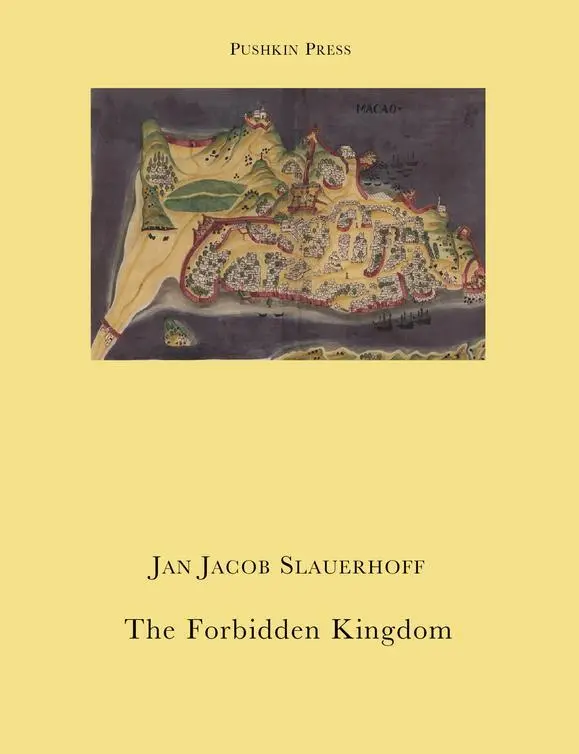
- Название:The Forbidden Kingdom
- Автор:
- Издательство:Pushkin Press
- Жанр:
- Год:2013
- ISBN:нет данных
- Рейтинг книги:5 / 5. Голосов: 1
-
Избранное:Добавить в избранное
- Отзывы:
-
Ваша оценка:
The Forbidden Kingdom: краткое содержание, описание и аннотация
Предлагаем к чтению аннотацию, описание, краткое содержание или предисловие (зависит от того, что написал сам автор книги «The Forbidden Kingdom»). Если вы не нашли необходимую информацию о книге — напишите в комментариях, мы постараемся отыскать её.
brings together the seemingly unrelated lives of a twentieth-century ship's radio operator and the sixteenth-century Portuguese poet-in-exile Luis Camoes.
Jacob Slauerhoff draws his reader into a dazzling world of exoticism, betrayal, and exile, where past and present merge and the possibility of death is never far away.
Born in The Netherlands in 1898, upon graduating from university
signed up as a ship's surgeon with the Dutch East India Company. He was at sea throughout his life, voyaging to the Far East, Latin America, and Africa.
The Forbidden Kingdom — читать онлайн бесплатно полную книгу (весь текст) целиком
Ниже представлен текст книги, разбитый по страницам. Система сохранения места последней прочитанной страницы, позволяет с удобством читать онлайн бесплатно книгу «The Forbidden Kingdom», без необходимости каждый раз заново искать на чём Вы остановились. Поставьте закладку, и сможете в любой момент перейти на страницу, на которой закончили чтение.
Интервал:
Закладка:
“Not a white woman hiding anywhere? A young lady of high birth has gone missing for the last three weeks; it’s as though she has been abducted by the Chinese. If you can tell us anything it will be to your advantage.”
Camões shook his head.
“You don’t know anything? You must know. Otherwise you’ll be tortured together with the Dominicans.”
Camões pointed out the impossibility of a shipwrecked sailor in the great unknown country having met a captive of his own race. On the contrary, if the Chinese had abducted her they would certainly have kept her hidden from him. But Campos was not susceptible to reason, seemed to have inherited a sixth sense from the Inquisition, or to have been warned by an instinct that Camões had been in contact with the fugitive. Had his face given anything away? Had something of her remained clinging to him? He had not touched her, but felt himself anyway. He now envied the Chinese their impassive features, not knowing that as a result of all his suffering his own features had acquired almost the same immobility. He feared torture, but knew that he was brave in war and had stayed calm during an earthquake in Lisbon. He had actually revelled in the hurricane that sank the São Bento , but squirmed with revulsion at the thought of having to undergo torture bound and helpless. He imagined what he would do if he really knew nothing. Probably tell some story when he first felt pain; he was inventive. But now he did know… Should he indicate a place as far as possible from the real one? No, now, he knew, he must be silent. He tried to muster his resistance by standing stock-still against a wall, rather than tiring himself out with excessive muscular movements, but his weak body could not take it, and the narrowness of the cell did not permit it either.
When the guard came in, he was lying half dazed in a corner. He leapt up, thinking that he was already being fetched, but the guard, an old Kwantung Chinese, stood in front of him and handed him some brown powder on a willow leaf. Camões stared, not understanding at first that this was a powder that made one insensible to all pain. It finally dawned on him, and he asked to whom he owed this. The guard made it clear to him that he thought it was just to torture child murderers but not a shipwrecked sailor, who was under the jurisdiction of the goddess Amah, who pacifies storms and rescues fishermen and whose priest he had been. No more information could be got out of him. Camões took some of the powder. Very soon he felt himself drifting calmly and languidly into a great feeling of comfort. Suddenly a jolt of mistrust went through his body. Had Pilar heard of his imprisonment and smuggled this poison to the guard through her duenha , with instructions to silence him? Why else would this old Mongol be so sympathetic, contrary to the nature of the Chinese, who see torture as a work of art? Was Pilar so fearful of her safety that she had him calmly murdered in his dungeon? Sorrow turned to hatred, but subsided just as suddenly. For wasn’t she doing him a favour, even by killing him now? Camões stretched out, the stone floor became as soft as velvet, the low, cobweb-covered roof became a heaven sprinkled with stars, with her eyes glittering among them, and everything merged into a light distance. He allowed himself to drift off to sleep, or to death — time would tell.
II
THIS WAS A LARGER and lighter chamber than Camões had entered for as long as he could remember. The instruments of torture had been assembled in the centre of the room. He did not understand the function of many of them. The torturer and his assistants stood there in an attitude of fearful tension, as if they had to guard the instruments and were frightened that they would be dragged away at the last moment.
There stood the Dominicans, shackled together in a corner, still calmer. As always, they wore their rough cassocks and sandals and were talking quietly but animatedly, as if involved in a theological conversation. Most of them were cross-eyed and squinted at each other, as if they only half trusted each other. This was so out of keeping with the situation, in which they could expect support, only moral that is, from no one but each other, that Camões at first did not understand and was sure that they would betray each other when first put to the question. In addition one of them had a shrill voice, which kept breaking amid all the hoarse whispering. It was only later that he noticed their inner peace. One of the judges called out, “Quiet!” And once the captain, who was also present, said, “You’ll be singing a different tune soon!”
The judges were sitting under the light that entered through low barred windows at ceiling level. Through those windows Camões saw countless feet passing: the soft felt shoes of the Chinese, the goats’ hooves of their wives; far less often the leather shoes of soldiers, and two or three times fawn-coloured boots with long silver spurs. Never before had he seen so many of the inhabitants of Macao. It lasted perhaps a few moments, while the judges arranged court documents and seemed to be making bets. Scarcely any attention was paid to him.
Then Campos gave the signal to the torturer. The assistants went over to the Dominicans, but they had fallen on their knees. The prior spoke a forceful prayer, and as yet not an assistant laid a finger on them. Camões wondered what would be more effective against torture — his powder, or that prayer. Campos ordered them to say amen, and make a start, and soon they were swinging from the ceiling with heavy weights attached to their toes.
There was no room left for Camões to hang and to pass the time he was put in the thumbscrews, and his ankles were put in sharp irons. It remained deathly still, apart from the weights that occasionally collided with a dull metallic thud, and Campos’s regular cry of “Confess, confess!”
Finally a young monk started groaning faintly.
“Confess,” cried Campos. “Speak the truth and free yourself from these pains and those ten times worse that are still to come. Confess.”
The scribes held their pens poised above the paper. But the prior admonished him, speaking of the Church fathers, who endured much worse, and conjured him not to forfeit immortal salvation because of a few hours of earthly pain and not to betray their innocence.
However, the young monk, under increasingly severe torture, broke down, and admitted that Lou Yat’s children had been lured into the monastery. But he did not know what had happened to them.
“But you heard their groans? You saw them burying something in the courtyard?”
“Yes, yes,” cried the victim. “Untie me, I saw it, they buried them. Untie me.”
“He’s lying,” cried the prior. “We had no part in it. Torture me till I die, no lie will escape from my mouth. He’s a coward who wants to save his skin.”
“No, he’s sensible. The evidence is overwhelming; denials won’t help. Do you wish to recant?”
“No, no; untie me, now I’ve said it!”
They were all released. A statement was read out, but most of them were no longer aware of anything, and leant against the wall, or had collapsed onto the floor. And Camões had almost been forgotten, since he had made no sound. Campos went over to him.
“And you confess too, then we have all the information we need.”
But Camões smiled, shook his head and gave no reply. The blood was dripping from his thumbs.
He was awakened by a strange warm feeling on his face. He could not understand what it was and did not move, frightened to open his eyes. At the same time he could feel a dull pain in his thumbs and ankles. Finally he opened his eyes with a great effort. He was lying on a bed in a large, bright room. A chair and a table stood by a window. He crossed to it and in the distance saw the sea and a few islands on the horizon. He could not see any ground beneath the window. Again he was far from the earth, no longer in the darkness beneath it, but in the light above it.
Читать дальшеИнтервал:
Закладка:
Похожие книги на «The Forbidden Kingdom»
Представляем Вашему вниманию похожие книги на «The Forbidden Kingdom» списком для выбора. Мы отобрали схожую по названию и смыслу литературу в надежде предоставить читателям больше вариантов отыскать новые, интересные, ещё непрочитанные произведения.










Обсуждение, отзывы о книге «The Forbidden Kingdom» и просто собственные мнения читателей. Оставьте ваши комментарии, напишите, что Вы думаете о произведении, его смысле или главных героях. Укажите что конкретно понравилось, а что нет, и почему Вы так считаете.