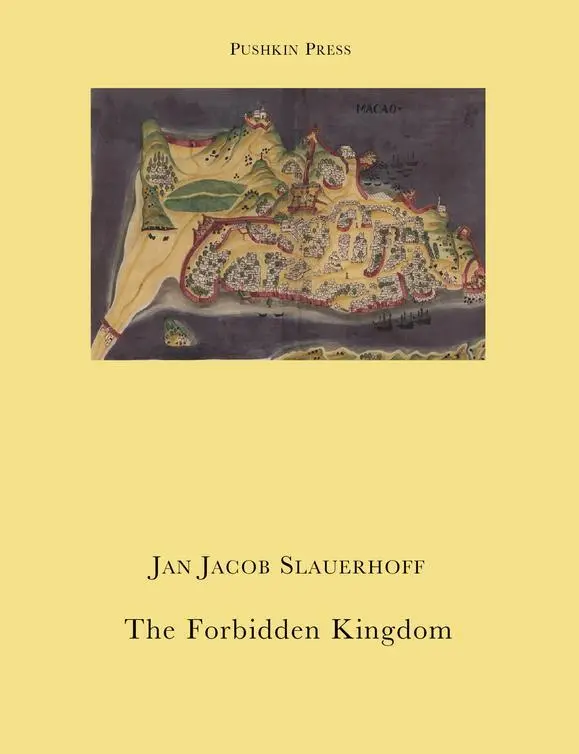
Jan Slauerhoff - The Forbidden Kingdom
Здесь есть возможность читать онлайн «Jan Slauerhoff - The Forbidden Kingdom» весь текст электронной книги совершенно бесплатно (целиком полную версию без сокращений). В некоторых случаях можно слушать аудио, скачать через торрент в формате fb2 и присутствует краткое содержание. Год выпуска: 2013, Издательство: Pushkin Press, Жанр: Классическая проза, на английском языке. Описание произведения, (предисловие) а так же отзывы посетителей доступны на портале библиотеки ЛибКат.
- Название:The Forbidden Kingdom
- Автор:
- Издательство:Pushkin Press
- Жанр:
- Год:2013
- ISBN:нет данных
- Рейтинг книги:5 / 5. Голосов: 1
-
Избранное:Добавить в избранное
- Отзывы:
-
Ваша оценка:
The Forbidden Kingdom: краткое содержание, описание и аннотация
Предлагаем к чтению аннотацию, описание, краткое содержание или предисловие (зависит от того, что написал сам автор книги «The Forbidden Kingdom»). Если вы не нашли необходимую информацию о книге — напишите в комментариях, мы постараемся отыскать её.
brings together the seemingly unrelated lives of a twentieth-century ship's radio operator and the sixteenth-century Portuguese poet-in-exile Luis Camoes.
Jacob Slauerhoff draws his reader into a dazzling world of exoticism, betrayal, and exile, where past and present merge and the possibility of death is never far away.
Born in The Netherlands in 1898, upon graduating from university
signed up as a ship's surgeon with the Dutch East India Company. He was at sea throughout his life, voyaging to the Far East, Latin America, and Africa.
The Forbidden Kingdom — читать онлайн бесплатно полную книгу (весь текст) целиком
Ниже представлен текст книги, разбитый по страницам. Система сохранения места последней прочитанной страницы, позволяет с удобством читать онлайн бесплатно книгу «The Forbidden Kingdom», без необходимости каждый раз заново искать на чём Вы остановились. Поставьте закладку, и сможете в любой момент перейти на страницу, на которой закончили чтение.
Интервал:
Закладка:
I had, though, stolen a bottle of brown liquid from the sick bay; whenever the emptiness of the life I was living made me dizzy, I took a few drops, and was filled with a dull sense of well-being. I was perfectly capable of doing my work. It was as if I were surrounded by a wall of wool, which only the sounds I had to hear could penetrate.
I envied the steerage passengers who inhaled the same pleasure in ethereal smoke; while I sank into dulled consciousness, their lightness made them float. I could tell from their blissful faces and the indifference with which they died when they had contracted cholera or dysentery.
In the evenings I sometimes saw the whole ship lying open before me like a beehive with the top taken off. On the bridge the third helmsman hanging round in a corner smoking; the captain in his cabin with his elbows on the table and a glass in front of him. On the right the helmsmen’s cabins, the first sleeping, the second lying on his bunk, with a pornographic book dancing over his head. On the left the engineers’ cabins: the first engineer reading the Bible, with his glasses on the tip of his nose, the second knitting stockings or weaving mats, unaware that in so doing he was revealing the feminine nature he was so good at concealing, the third engineer on watch deep in the ship, with a smoking light and the stench of oil, constantly wiping the sweat from his already balding head with a duster. Forward, the sailors packed closely together. Aft, the tally clerks gathered, playing mah-jong at a long low table. In the dark area between decks was a squashed mass of people, lying on their cases and baskets full of cabbage and birdcages, their limbs intertwined, relieving themselves where they lay, almost choked by their own stench. Beneath them the dark areas where the sacks of sugar and beans lie, the rats run to and fro, the cockroaches gnaw and scuttle against the wall; outside was the sea, inhabited by fish and molluscs. The hulls of ships like clouds and their lights like constellations low in the sky — and, enclosing everything, night and the firmament. What does a ship in the night have to do with the world? Even the thoughts of those on board no longer focus on it.
And in that time of desolate freedom, when I was apart from the earth, as completely as I had wanted to be in the past, no, more so, I began to long for some attachment, a different life, since my own was no longer sufficient to satisfy my soul. It had nothing to nurture, entertain or affirm it; my origin uncertain, my parents indifferent, my country hostile. I had also lost the friendship of the sea, which had once been so good to me; once I had heard its roar as an encouragement, now it was a dirge.
Certainly my egotism had been satisfied over the years, and I had freed myself from the few things that held me back. Now I was beginning to yearn for a power that would take possession of me; there was little hope of a woman: where was I to see her? In the past there had been on the promenade deck, when a slim hand passed me a telegram and I saw part of a sweet face, an eye, a pretty ear, a lock of hair, through the small hatch. Now there was nothing but women with black jackets, long indigo-coloured trousers and coarse grins.
Not a woman then! What then? A mind in this state, open to outside influences, becomes an easy target for demons eager to prey on a living being like parasites. But at sea there are no spirits, at least so I firmly believed. That absence, or that belief, saved me for a long time; when I yearned to be freed from my emptiness, I would not have excluded even the most malevolent of them. The sea saved me, it’s true. But I wasn’t grateful to the sea.
CHAPTER 7
I
THE DUNGEON was far below ground, as he had been brought down countless steps. He saw neither sun nor moon, the night was black, the day an ashen twilight. Every twenty-four hours, at some point during the morning, the guard would bring him food and a jug of water which, after standing for a few hours, would become turbid and undrinkable, so that after a few times he drank it up at once. His calculation of time was based on the visit of the guard: a scratch on the beams that he could later feel. When there was already a long ladder he asked the guard when it would be his turn. The guard shook his head. When? First the child murderers, and then the deserters.
Then he begged for more light. He still had a gold coin and offered that. But the guard refused and left. He lay down with his face to the wall, ashamed and weary of life. When he looked up many hours later, a narrow beam of light struck his face — a jet of cool spring water could not have been more refreshing. Where did the light come from? Had the guard rolled away a stone up above, so that that the light found its way through a straight, narrow opening? Or had the sun or the moon reached a point in the heavens where the light could shine in through half-collapsed passageways? He suspected the latter. That meant that the light would soon disappear again. He wanted to enjoy every minute of it, drink it in. But the light roused another desire in him and he started writing, half reluctantly at first, perhaps so as to be able to know later, to feel tentatively what these light hours had meant to him, perhaps also so as to stay awake, for as long as it lasted. Then again he reproached himself for not deriving pure enjoyment from the light, instead of using it to write. And he sat and gazed into it and thought of it without moving. But a big cockroach ran across his foot; now it was light, he was able to grab it and kill it; he was seized by a great urge to clean out his cell. He began hunting for them, but there were too many. More and more kept appearing from the corners of the cell. And suddenly it was dark. He blamed himself for having abused the divine light, and resolved, if it came back, to do nothing but worship it. But the following day too poetry and hunting for vermin alternated.
Twelve days after his incarceration, he had to climb back up the steps and stood blindfolded in a room that was anyway in semi-darkness and where black judges sat at a green table. Campos himself conducted the interrogation.
He stated that he had been shipwrecked, and had received a head injury, that he could not remember his name or rank, and had walked from a remote part of the coast to Macao, the light of which he could see at night. No more could be got out of him and he was soon led away again. He hoped that he would be incorporated in the colony’s troops as a private soldier, and that he would have an opportunity to desert and get back to the island. But Fate had decided otherwise. Again he was led up the steps, thrust into the courtroom and he stared into the face of the captain whom he had never expected to see again in this world, sitting next to Campos.
“Do you know who you are now?” the latter asked him.
“I know who I was, Luís Vaz de Camões, but through ill will or resentment I am now a man without a name.”
“No, through the will of the King. A danger to the state and guilty of lese-majesty . You must remain in prison.”
“Stop,” said Campos. “The laws are applied rather differently here. Here every man is of some use. He will be given employment.”
“He’s a deserter.”
Goaded by the captain, Camões became quick-witted.
“Is it desertion if after being washed up on a remote stretch of coast, I walked to Macao with my last remaining strength?”
But he got not further; Campos had him taken away. In the evening he visited the cell. A lantern was put in a corner and shed red light on Camões. Campos himself remained in darkness.
“What did you see over there across the water?”
“Chinese, their houses and their graves. Mainly the latter!”
Читать дальшеИнтервал:
Закладка:
Похожие книги на «The Forbidden Kingdom»
Представляем Вашему вниманию похожие книги на «The Forbidden Kingdom» списком для выбора. Мы отобрали схожую по названию и смыслу литературу в надежде предоставить читателям больше вариантов отыскать новые, интересные, ещё непрочитанные произведения.








Обсуждение, отзывы о книге «The Forbidden Kingdom» и просто собственные мнения читателей. Оставьте ваши комментарии, напишите, что Вы думаете о произведении, его смысле или главных героях. Укажите что конкретно понравилось, а что нет, и почему Вы так считаете.