Jack London - Burning Daylight
Здесь есть возможность читать онлайн «Jack London - Burning Daylight» весь текст электронной книги совершенно бесплатно (целиком полную версию без сокращений). В некоторых случаях можно слушать аудио, скачать через торрент в формате fb2 и присутствует краткое содержание. Год выпуска: 1910, Жанр: Классическая проза, Природа и животные, Путешествия и география, на английском языке. Описание произведения, (предисловие) а так же отзывы посетителей доступны на портале библиотеки ЛибКат.
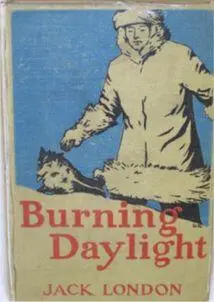
- Название:Burning Daylight
- Автор:
- Жанр:
- Год:1910
- ISBN:нет данных
- Рейтинг книги:5 / 5. Голосов: 1
-
Избранное:Добавить в избранное
- Отзывы:
-
Ваша оценка:
Burning Daylight: краткое содержание, описание и аннотация
Предлагаем к чтению аннотацию, описание, краткое содержание или предисловие (зависит от того, что написал сам автор книги «Burning Daylight»). Если вы не нашли необходимую информацию о книге — напишите в комментариях, мы постараемся отыскать её.
Burning Daylight — читать онлайн бесплатно полную книгу (весь текст) целиком
Ниже представлен текст книги, разбитый по страницам. Система сохранения места последней прочитанной страницы, позволяет с удобством читать онлайн бесплатно книгу «Burning Daylight», без необходимости каждый раз заново искать на чём Вы остановились. Поставьте закладку, и сможете в любой момент перейти на страницу, на которой закончили чтение.
Интервал:
Закладка:
She shook her head.
"Do you like me—the littlest bit?"
This time she nodded, at the same time allowing the smile of amusement to play on her lips. But it was amusement without contempt. The humorous side of a situation rarely appealed in vain to her.
"Well, that's something to go on," he announced. "You've got to make a start to get started. I just liked you at first, and look what it's grown into. You recollect, you said you didn't like my way of life. Well, I've changed it a heap. I ain't gambling like I used to. I've gone into what you called the legitimate, making two minutes grow where one grew before, three hundred thousand folks where only a hundred thousand grew before. And this time next year there'll be two million eucalyptus growing on the hills. Say do you like me more than the littlest bit?"
She raised her eyes from her work and looked at him as she answered:
"I like you a great deal, but—"
He waited a moment for her to complete the sentence, failing which, he went on himself.
"I haven't an exaggerated opinion of myself, so I know I ain't bragging when I say I'll make a pretty good husband. You'd find I was no hand at nagging and fault-finding. I can guess what it must be for a woman like you to be independent. Well, you'd be independent as my wife. No strings on you. You could follow your own sweet will, and nothing would be too good for you. I'd give you everything your heart desired—"
"Except yourself," she interrupted suddenly, almost sharply.
Daylight's astonishment was momentary.
"I don't know about that. I'd be straight and square, and live true. I don't hanker after divided affections."
"I don't mean that," she said. "Instead of giving yourself to your wife, you would give yourself to the three hundred thousand people of Oakland, to your street railways and ferry-routes, to the two million trees on the hills to everything business—and—and to all that that means."
"I'd see that I didn't," he declared stoutly. "I'd be yours to command."
"You think so, but it would turn out differently." She suddenly became nervous. "We must stop this talk. It is too much like attempting to drive a bargain. 'How much will you give?' 'I'll give so much.' 'I want more,' and all that. I like you, but not enough to marry you, and I'll never like you enough to marry you."
"How do you know that?" he demanded.
"Because I like you less and less."
Daylight sat dumfounded. The hurt showed itself plainly in his face.
"Oh, you don't understand," she cried wildly, beginning to lose self-control—"It's not that way I mean. I do like you; the more I've known you the more I've liked you. And at the same time the more I've known you the less would I care to marry you."
This enigmatic utterance completed Daylight's perplexity.
"Don't you see?" she hurried on. "I could have far easier married the Elam Harnish fresh from Klondike, when I first laid eyes on him long ago, than marry you sitting before me now."
He shook his head slowly. "That's one too many for me. The more you know and like a man the less you want to marry him. Familiarity breeds contempt—I guess that's what you mean."
"No, no," she cried, but before she could continue, a knock came on the door.
"The ten minutes is up," Daylight said.
His eyes, quick with observation like an Indian's, darted about the room while she was out. The impression of warmth and comfort and beauty predominated, though he was unable to analyze it; while the simplicity delighted him—expensive simplicity, he decided, and most of it leftovers from the time her father went broke and died. He had never before appreciated a plain hardwood floor with a couple of wolfskins; it sure beat all the carpets in creation. He stared solemnly at a bookcase containing a couple of hundred books. There was mystery. He could not understand what people found so much to write about.
Writing things and reading things were not the same as doing things, and himself primarily a man of action, doing things was alone comprehensible.
His gaze passed on from the Crouched Venus to a little tea-table with all its fragile and exquisite accessories, and to a shining copper kettle and copper chafing-dish. Chafing dishes were not unknown to him, and he wondered if she concocted suppers on this one for some of those University young men he had heard whispers about. One or two water-colors on the wall made him conjecture that she had painted them herself. There were photographs of horses and of old masters, and the trailing purple of a Burial of Christ held him for a time. But ever his gaze returned to that Crouched Venus on the piano. To his homely, frontier-trained mind, it seemed curious that a nice young woman should have such a bold, if not sinful, object on display in her own room. But he reconciled himself to it by an act of faith. Since it was Dede, it must be eminently all right. Evidently such things went along with culture. Larry Hegan had similar casts and photographs in his book-cluttered quarters. But then, Larry Hegan was different. There was that hint of unhealth about him that Daylight invariably sensed in his presence, while Dede, on the contrary, seemed always so robustly wholesome, radiating an atmosphere compounded of the sun and wind and dust of the open road. And yet, if such a clean, healthy woman as she went in for naked women crouching on her piano, it must be all right. Dede made it all right. She could come pretty close to making anything all right. Besides, he didn't understand culture anyway.
She reentered the room, and as she crossed it to her chair, he admired the way she walked, while the bronze slippers were maddening.
"I'd like to ask you several questions," he began immediately "Are you thinking of marrying somebody?"
She laughed merrily and shook her head.
"Do you like anybody else more than you like me?—that man at the 'phone just now, for instance?"
"There isn't anybody else. I don't know anybody I like well enough to marry. For that matter, I don't think I am a marrying woman. Office work seems to spoil one for that."
Daylight ran his eyes over her, from her face to the tip of a bronze slipper, in a way that made the color mantle in her cheeks. At the same time he shook his head sceptically.
"It strikes me that you're the most marryingest woman that ever made a man sit up and take notice. And now another question. You see, I've just got to locate the lay of the land. Is there anybody you like as much as you like me?"
But Dede had herself well in hand.
"That's unfair," she said. "And if you stop and consider, you will find that you are doing the very thing you disclaimed—namely, nagging. I refuse to answer any more of your questions. Let us talk about other things. How is Bob?"
Half an hour later, whirling along through the rain on Telegraph Avenue toward Oakland, Daylight smoked one of his brown-paper cigarettes and reviewed what had taken place. It was not at all bad, was his summing up, though there was much about it that was baffling. There was that liking him the more she knew him and at the same time wanting to marry him less. That was a puzzler.
But the fact that she had refused him carried with it a certain elation. In refusing him she had refused his thirty million dollars. That was going some for a ninety dollar-a-month stenographer who had known better ties. She wasn't after money, that was patent. Every woman he had encountered had seemed willing to swallow him down for the sake of his money. Why, he had doubled his fortune, made fifteen millions, since the day she first came to work for him, and behold, any willingness to marry him she might have possessed had diminished as his money had increased.
"Gosh!" he muttered. "If I clean up a hundred million on this land deal she won't even be on speaking terms with me."
Читать дальшеИнтервал:
Закладка:
Похожие книги на «Burning Daylight»
Представляем Вашему вниманию похожие книги на «Burning Daylight» списком для выбора. Мы отобрали схожую по названию и смыслу литературу в надежде предоставить читателям больше вариантов отыскать новые, интересные, ещё непрочитанные произведения.








Обсуждение, отзывы о книге «Burning Daylight» и просто собственные мнения читателей. Оставьте ваши комментарии, напишите, что Вы думаете о произведении, его смысле или главных героях. Укажите что конкретно понравилось, а что нет, и почему Вы так считаете.