Jack London - Burning Daylight
Здесь есть возможность читать онлайн «Jack London - Burning Daylight» весь текст электронной книги совершенно бесплатно (целиком полную версию без сокращений). В некоторых случаях можно слушать аудио, скачать через торрент в формате fb2 и присутствует краткое содержание. Год выпуска: 1910, Жанр: Классическая проза, Природа и животные, Путешествия и география, на английском языке. Описание произведения, (предисловие) а так же отзывы посетителей доступны на портале библиотеки ЛибКат.
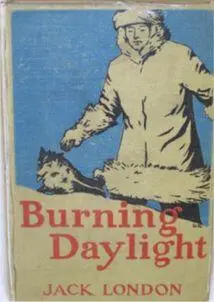
- Название:Burning Daylight
- Автор:
- Жанр:
- Год:1910
- ISBN:нет данных
- Рейтинг книги:5 / 5. Голосов: 1
-
Избранное:Добавить в избранное
- Отзывы:
-
Ваша оценка:
Burning Daylight: краткое содержание, описание и аннотация
Предлагаем к чтению аннотацию, описание, краткое содержание или предисловие (зависит от того, что написал сам автор книги «Burning Daylight»). Если вы не нашли необходимую информацию о книге — напишите в комментариях, мы постараемся отыскать её.
Burning Daylight — читать онлайн бесплатно полную книгу (весь текст) целиком
Ниже представлен текст книги, разбитый по страницам. Система сохранения места последней прочитанной страницы, позволяет с удобством читать онлайн бесплатно книгу «Burning Daylight», без необходимости каждый раз заново искать на чём Вы остановились. Поставьте закладку, и сможете в любой момент перейти на страницу, на которой закончили чтение.
Интервал:
Закладка:
This was love-making of a sort beyond Dede's experience. Nor had she ever heard of anything like it. Furthermore, its lack of ardor carried with it a shock which she could overcome only by remembering the way his hand had trembled in the past, and by remembering the passion she had seen that very day and every day in his eyes, or heard in his voice. Then, too, she recollected what he had said to her weeks before: "Maybe you don't know what patience is," he had said, and thereat told her of shooting squirrels with a big rifle the time he and Elijah Davis had starved on the Stewart River.
"So you see," he urged, "just for a square deal we've got to see some more of each other this winter. Most likely your mind ain't made up yet—"
"But it is," she interrupted. "I wouldn't dare permit myself to care for you. Happiness, for me, would not lie that way. I like you, Mr. Harnish, and all that, but it can never be more than that."
"It's because you don't like my way of living," he charged, thinking in his own mind of the sensational joyrides and general profligacy with which the newspapers had credited him—thinking this, and wondering whether or not, in maiden modesty, she would disclaim knowledge of it.
To his surprise, her answer was flat and uncompromising.
"No; I don't."
"I know I've been brash on some of those rides that got into the papers," he began his defense, "and that I've been travelling with a lively crowd."
"I don't mean that," she said, "though I know about it too, and can't say that I like it. But it is your life in general, your business. There are women in the world who could marry a man like you and be happy, but I couldn't. And the more I cared for such a man, the more unhappy I should be. You see, my unhappiness, in turn, would tend to make him unhappy. I should make a mistake, and he would make an equal mistake, though his would not be so hard on him because he would still have his business."
"Business!" Daylight gasped. "What's wrong with my business? I play fair and square. There's nothing under hand about it, which can't be said of most businesses, whether of the big corporations or of the cheating, lying, little corner-grocerymen. I play the straight rules of the game, and I don't have to lie or cheat or break my word."
Dede hailed with relief the change in the conversation and at the same time the opportunity to speak her mind.
"In ancient Greece," she began pedantically, "a man was judged a good citizen who built houses, planted trees—" She did not complete the quotation, but drew the conclusion hurriedly. "How many houses have you built? How many trees have you planted?"
He shook his head noncommittally, for he had not grasped the drift of the argument.
"Well," she went on, "two winters ago you cornered coal—"
"Just locally," he grinned reminiscently, "just locally. And I took advantage of the car shortage and the strike in British Columbia."
"But you didn't dig any of that coal yourself. Yet you forced it up four dollars a ton and made a lot of money. That was your business. You made the poor people pay more for their coal. You played fair, as you said, but you put your hands down into all their pockets and took their money away from them. I know. I burn a grate fire in my sitting-room at Berkeley. And instead of eleven dollars a ton for Rock Wells, I paid fifteen dollars that winter. You robbed me of four dollars. I could stand it. But there were thousands of the very poor who could not stand it. You might call it legal gambling, but to me it was downright robbery."
Daylight was not abashed. This was no revelation to him. He remembered the old woman who made wine in the Sonoma hills and the millions like her who were made to be robbed.
"Now look here, Miss Mason, you've got me there slightly, I grant. But you've seen me in business a long time now, and you know I don't make a practice of raiding the poor people. I go after the big fellows. They're my meat. They rob the poor, and I rob them. That coal deal was an accident. I wasn't after the poor people in that, but after the big fellows, and I got them, too. The poor people happened to get in the way and got hurt, that was all.
"Don't you see," he went on, "the whole game is a gamble. Everybody gambles in one way or another. The farmer gambles against the weather and the market on his crops. So does the United States Steel Corporation. The business of lots of men is straight robbery of the poor people. But I've never made that my business. You know that. I've always gone after the robbers."
"I missed my point," she admitted. "Wait a minute."
And for a space they rode in silence.
"I see it more clearly than I can state it, but it's something like this. There is legitimate work, and there's work that—well, that isn't legitimate. The farmer works the soil and produces grain. He's making something that is good for humanity. He actually, in a way, creates something, the grain that will fill the mouths of the hungry."
"And then the railroads and market-riggers and the rest proceed to rob him of that same grain,"—Daylight broke in Dede smiled and held up her hand.
"Wait a minute. You'll make me lose my point. It doesn't hurt if they rob him of all of it so that he starves to death. The point is that the wheat he grew is still in the world. It exists. Don't you see? The farmer created something, say ten tons of wheat, and those ten tons exist. The railroads haul the wheat to market, to the mouths that will eat it. This also is legitimate. It's like some one bringing you a glass of water, or taking a cinder out of your eye. Something has been done, in a way been created, just like the wheat."
"But the railroads rob like Sam Scratch," Daylight objected.
"Then the work they do is partly legitimate and partly not. Now we come to you. You don't create anything. Nothing new exists when you're done with your business. Just like the coal. You didn't dig it. You didn't haul it to market. You didn't deliver it. Don't you see? that's what I meant by planting the trees and building the houses. You haven't planted one tree nor built a single house."
"I never guessed there was a woman in the world who could talk business like that," he murmured admiringly. "And you've got me on that point. But there's a lot to be said on my side just the same. Now you listen to me. I'm going to talk under three heads. Number one: We live a short time, the best of us, and we're a long time dead. Life is a big gambling game. Some are born lucky and some are born unlucky. Everybody sits in at the table, and everybody tries to rob everybody else. Most of them get robbed. They're born suckers.
"Fellow like me comes along and sizes up the proposition. I've got two choices. I can herd with the suckers, or I can herd with the robbers. As a sucker, I win nothing. Even the crusts of bread are snatched out of my mouth by the robbers. I work hard all my days, and die working. And I ain't never had a flutter. I've had nothing but work, work, work. They talk about the dignity of labor. I tell you there ain't no dignity in that sort of labor. My other choice is to herd with the robbers, and I herd with them. I play that choice wide open to win. I get the automobiles, and the porterhouse steaks, and the soft beds.
"Number two: There ain't much difference between playing halfway robber like the railroad hauling that farmer's wheat to market, and playing all robber and robbing the robbers like I do. And, besides, halfway robbery is too slow a game for me to sit in. You don't win quick enough for me."
"But what do you want to win for?" Dede demanded. "You have millions and millions, already. You can't ride in more than one automobile at a time, sleep in more than one bed at a time."
"Number three answers that," he said, "and here it is: Men and things are so made that they have different likes. A rabbit likes a vegetarian diet. A lynx likes meat. Ducks swim; chickens are scairt of water. One man collects postage stamps, another man collects butterflies. This man goes in for paintings, that man goes in for yachts, and some other fellow for hunting big game. One man thinks horse-racing is It, with a big I, and another man finds the biggest satisfaction in actresses. They can't help these likes. They have them, and what are they going to do about it? Now I like gambling. I like to play the game. I want to play it big and play it quick. I'm just made that way. And I play it."
Читать дальшеИнтервал:
Закладка:
Похожие книги на «Burning Daylight»
Представляем Вашему вниманию похожие книги на «Burning Daylight» списком для выбора. Мы отобрали схожую по названию и смыслу литературу в надежде предоставить читателям больше вариантов отыскать новые, интересные, ещё непрочитанные произведения.








Обсуждение, отзывы о книге «Burning Daylight» и просто собственные мнения читателей. Оставьте ваши комментарии, напишите, что Вы думаете о произведении, его смысле или главных героях. Укажите что конкретно понравилось, а что нет, и почему Вы так считаете.