Jack London - Burning Daylight
Здесь есть возможность читать онлайн «Jack London - Burning Daylight» весь текст электронной книги совершенно бесплатно (целиком полную версию без сокращений). В некоторых случаях можно слушать аудио, скачать через торрент в формате fb2 и присутствует краткое содержание. Год выпуска: 1910, Жанр: Классическая проза, Природа и животные, Путешествия и география, на английском языке. Описание произведения, (предисловие) а так же отзывы посетителей доступны на портале библиотеки ЛибКат.
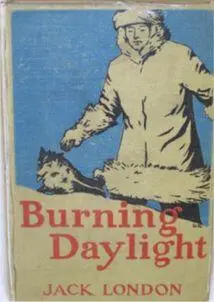
- Название:Burning Daylight
- Автор:
- Жанр:
- Год:1910
- ISBN:нет данных
- Рейтинг книги:5 / 5. Голосов: 1
-
Избранное:Добавить в избранное
- Отзывы:
-
Ваша оценка:
Burning Daylight: краткое содержание, описание и аннотация
Предлагаем к чтению аннотацию, описание, краткое содержание или предисловие (зависит от того, что написал сам автор книги «Burning Daylight»). Если вы не нашли необходимую информацию о книге — напишите в комментариях, мы постараемся отыскать её.
Burning Daylight — читать онлайн бесплатно полную книгу (весь текст) целиком
Ниже представлен текст книги, разбитый по страницам. Система сохранения места последней прочитанной страницы, позволяет с удобством читать онлайн бесплатно книгу «Burning Daylight», без необходимости каждый раз заново искать на чём Вы остановились. Поставьте закладку, и сможете в любой момент перейти на страницу, на которой закончили чтение.
Интервал:
Закладка:
And then she was so natural. He had been prepared to find her a most difficult young woman to get acquainted with. Yet here it was proving so simple. There was nothing highfalutin about her company manners—it was by this homely phrase that he differentiated this Dede on horseback from the Dede with the office manners whom he had always known. And yet, while he was delighted with the smoothness with which everything was going, and with the fact that they had found plenty to talk about, he was aware of an irk under it all. After all, this talk was empty and idle. He was a man of action, and he wanted her, Dede Mason, the woman; he wanted her to love him and to be loved by him; and he wanted all this glorious consummation then and there. Used to forcing issues used to gripping men and things and bending them to his will, he felt, now, the same compulsive prod of mastery. He wanted to tell her that he loved her and that there was nothing else for her to do but marry him. And yet he did not obey the prod. Women were fluttery creatures, and here mere mastery would prove a bungle. He remembered all his hunting guile, the long patience of shooting meat in famine when a hit or a miss meant life or death. Truly, though this girl did not yet mean quite that, nevertheless she meant much to him—more, now, than ever, as he rode beside her, glancing at her as often as he dared, she in her corduroy riding-habit, so bravely manlike, yet so essentially and revealingly woman, smiling, laughing, talking, her eyes sparkling, the flush of a day of sun and summer breeze warm in her cheeks.
CHAPTER XIII
Another Sunday man and horse and dog roved the Piedmont hills. And again Daylight and Dede rode together. But this time her surprise at meeting him was tinctured with suspicion; or rather, her surprise was of another order. The previous Sunday had been quite accidental, but his appearing a second time among her favorite haunts hinted of more than the fortuitous. Daylight was made to feel that she suspected him, and he, remembering that he had seen a big rock quarry near Blair Park, stated offhand that he was thinking of buying it. His one-time investment in a brickyard had put the idea into his head—an idea that he decided was a good one, for it enabled him to suggest that she ride along with him to inspect the quarry.
So several hours he spent in her company, in which she was much the same girl as before, natural, unaffected, lighthearted, smiling and laughing, a good fellow, talking horses with unflagging enthusiasm, making friends with the crusty-tempered Wolf, and expressing the desire to ride Bob, whom she declared she was more in love with than ever. At this last Daylight demurred. Bob was full of dangerous tricks, and he wouldn't trust any one on him except his worst enemy.
"You think, because I'm a girl, that I don't know anything about horses," she flashed back. "But I've been thrown off and bucked off enough not to be over-confident. And I'm not a fool. I wouldn't get on a bucking horse. I've learned better. And I'm not afraid of any other kind. And you say yourself that Bob doesn't buck."
"But you've never seen him cutting up didoes," Daylight said.
"But you must remember I've seen a few others, and I've been on several of them myself. I brought Mab here to electric cars, locomotives, and automobiles. She was a raw range colt when she came to me. Broken to saddle that was all. Besides, I won't hurt your horse."
Against his better judgment, Daylight gave in, and, on an unfrequented stretch of road, changed saddles and bridles.
"Remember, he's greased lightning," he warned, as he helped her to mount.
She nodded, while Bob pricked up his ears to the knowledge that he had a strange rider on his back. The fun came quickly enough—too quickly for Dede, who found herself against Bob's neck as he pivoted around and bolted the other way. Daylight followed on her horse and watched. He saw her check the animal quickly to a standstill, and immediately, with rein across neck and a decisive prod of the left spur, whirl him back the way he had come and almost as swiftly.
"Get ready to give him the quirt on the nose," Daylight called.
But, too quickly for her, Bob whirled again, though this time, by a severe effort, she saved herself from the undignified position against his neck. His bolt was more determined, but she pulled him into a prancing walk, and turned him roughly back with her spurred heel. There was nothing feminine in the way she handled him; her method was imperative and masculine. Had this not been so, Daylight would have expected her to say she had had enough. But that little preliminary exhibition had taught him something of Dede's quality. And if it had not, a glance at her gray eyes, just perceptibly angry with herself, and at her firm-set mouth, would have told him the same thing. Daylight did not suggest anything, while he hung almost gleefully upon her actions in anticipation of what the fractious Bob was going to get. And Bob got it, on his next whirl, or attempt, rather, for he was no more than halfway around when the quirt met him smack on his tender nose. There and then, in his bewilderment, surprise, and pain, his fore feet, just skimming above the road, dropped down.
"Great!" Daylight applauded. "A couple more will fix him. He's too smart not to know when he's beaten."
Again Bob tried. But this time he was barely quarter around when the doubled quirt on his nose compelled him to drop his fore feet to the road. Then, with neither rein nor spur, but by the mere threat of the quirt, she straightened him out.
Dede looked triumphantly at Daylight.
"Let me give him a run?" she asked.
Daylight nodded, and she shot down the road. He watched her out of sight around the bend, and watched till she came into sight returning. She certainly could sit her horse, was his thought, and she was a sure enough hummer. God, she was the wife for a man! Made most of them look pretty slim. And to think of her hammering all week at a typewriter. That was no place for her. She should be a man's wife, taking it easy, with silks and satins and diamonds (his frontier notion of what befitted a wife beloved), and dogs, and horses, and such things—"And we'll see, Mr. Burning Daylight, what you and me can do about it," he murmured to himself! and aloud to her:—
"You'll do, Miss Mason; you'll do. There's nothing too good in horseflesh you don't deserve, a woman who can ride like that. No; stay with him, and we'll jog along to the quarry." He chuckled. "Say, he actually gave just the least mite of a groan that last time you fetched him. Did you hear it? And did you see the way he dropped his feet to the road—just like he'd struck a stone wall. And he's got savvee enough to know from now on that that same stone wall will be always there ready for him to lam into."
When he parted from her that afternoon, at the gate of the road that led to Berkeley, he drew off to the edge of the intervening clump of trees, where, unobserved, he watched her out of sight. Then, turning to ride back into Oakland, a thought came to him that made him grin ruefully as he muttered: "And now it's up to me to make good and buy that blamed quarry. Nothing less than that can give me an excuse for snooping around these hills."
But the quarry was doomed to pass out of his plans for a time, for on the following Sunday he rode alone. No Dede on a chestnut sorrel came across the back-road from Berkeley that day, nor the day a week later. Daylight was beside himself with impatience and apprehension, though in the office he contained himself. He noted no change in her, and strove to let none show in himself. The same old monotonous routine went on, though now it was irritating and maddening. Daylight found a big quarrel on his hands with a world that wouldn't let a man behave toward his stenographer after the way of all men and women. What was the good of owning millions anyway? he demanded one day of the desk-calendar, as she passed out after receiving his dictation.
Читать дальшеИнтервал:
Закладка:
Похожие книги на «Burning Daylight»
Представляем Вашему вниманию похожие книги на «Burning Daylight» списком для выбора. Мы отобрали схожую по названию и смыслу литературу в надежде предоставить читателям больше вариантов отыскать новые, интересные, ещё непрочитанные произведения.







Обсуждение, отзывы о книге «Burning Daylight» и просто собственные мнения читателей. Оставьте ваши комментарии, напишите, что Вы думаете о произведении, его смысле или главных героях. Укажите что конкретно понравилось, а что нет, и почему Вы так считаете.