Jack London - Burning Daylight
Здесь есть возможность читать онлайн «Jack London - Burning Daylight» весь текст электронной книги совершенно бесплатно (целиком полную версию без сокращений). В некоторых случаях можно слушать аудио, скачать через торрент в формате fb2 и присутствует краткое содержание. Год выпуска: 1910, Жанр: Классическая проза, Природа и животные, Путешествия и география, на английском языке. Описание произведения, (предисловие) а так же отзывы посетителей доступны на портале библиотеки ЛибКат.
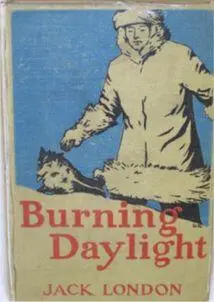
- Название:Burning Daylight
- Автор:
- Жанр:
- Год:1910
- ISBN:нет данных
- Рейтинг книги:5 / 5. Голосов: 1
-
Избранное:Добавить в избранное
- Отзывы:
-
Ваша оценка:
Burning Daylight: краткое содержание, описание и аннотация
Предлагаем к чтению аннотацию, описание, краткое содержание или предисловие (зависит от того, что написал сам автор книги «Burning Daylight»). Если вы не нашли необходимую информацию о книге — напишите в комментариях, мы постараемся отыскать её.
Burning Daylight — читать онлайн бесплатно полную книгу (весь текст) целиком
Ниже представлен текст книги, разбитый по страницам. Система сохранения места последней прочитанной страницы, позволяет с удобством читать онлайн бесплатно книгу «Burning Daylight», без необходимости каждый раз заново искать на чём Вы остановились. Поставьте закладку, и сможете в любой момент перейти на страницу, на которой закончили чтение.
Интервал:
Закладка:
"How old are you, daddy?" he queried.
"Eighty-four," was the reply. "Yes, sirree, eighty-four, and spryer than most."
"You must a' taken good care of yourself," Daylight suggested.
"I don't know about that. I ain't loafed none. I walked across the Plains with an ox-team and fit Injuns in '51, and I was a family man then with seven youngsters. I reckon I was as old then as you are now, or pretty nigh on to it."
"Don't you find it lonely here?"
The old man shifted the pail of milk and reflected. "That all depends," he said oracularly. "I ain't never been lonely except when the old wife died. Some fellers are lonely in a crowd, and I'm one of them. That's the only time I'm lonely, is when I go to 'Frisco. But I don't go no more, thank you 'most to death. This is good enough for me. I've ben right here in this valley since '54—one of the first settlers after the Spaniards."
Daylight started his horse, saying:—
"Well, good night, daddy. Stick with it. You got all the young bloods skinned, and I guess you've sure buried a mighty sight of them."
The old man chuckled, and Daylight rode on, singularly at peace with himself and all the world. It seemed that the old contentment of trail and camp he had known on the Yukon had come back to him. He could not shake from his eyes the picture of the old pioneer coming up the trail through the sunset light. He was certainly going some for eighty-four. The thought of following his example entered Daylight's mind, but the big game of San Francisco vetoed the idea.
"Well, anyway," he decided, "when I get old and quit the game, I'll settle down in a place something like this, and the city can go to hell."
CHAPTER IX
Instead of returning to the city on Monday, Daylight rented the butcher's horse for another day and crossed the bed of the valley to its eastern hills to look at the mine. It was dryer and rockier here than where he had been the day before, and the ascending slopes supported mainly chaparral, scrubby and dense and impossible to penetrate on horseback. But in the canyons water was plentiful and also a luxuriant forest growth. The mine was an abandoned affair, but he enjoyed the half-hour's scramble around. He had had experience in quartz-mining before he went to Alaska, and he enjoyed the recrudescence of his old wisdom in such matters. The story was simple to him: good prospects that warranted the starting of the tunnel into the sidehill; the three months' work and the getting short of money; the lay-off while the men went away and got jobs; then the return and a new stretch of work, with the "pay" ever luring and ever receding into the mountain, until, after years of hope, the men had given up and vanished. Most likely they were dead by now, Daylight thought, as he turned in the saddle and looked back across the canyon at the ancient dump and dark mouth of the tunnel.
As on the previous day, just for the joy of it, he followed cattle-trails at haphazard and worked his way up toward the summits. Coming out on a wagon road that led upward, he followed it for several miles, emerging in a small, mountain-encircled valley, where half a dozen poor ranchers farmed the wine-grapes on the steep slopes. Beyond, the road pitched upward. Dense chaparral covered the exposed hillsides but in the creases of the canons huge spruce trees grew, and wild oats and flowers.
Half an hour later, sheltering under the summits themselves, he came out on a clearing. Here and there, in irregular patches where the steep and the soil favored, wine grapes were growing. Daylight could see that it had been a stiff struggle, and that wild nature showed fresh signs of winning—chaparral that had invaded the clearings; patches and parts of patches of vineyard, unpruned, grassgrown, and abandoned; and everywhere old stake-and-rider fences vainly striving to remain intact. Here, at a small farm-house surrounded by large outbuildings, the road ended. Beyond, the chaparral blocked the way.
He came upon an old woman forking manure in the barnyard, and reined in by the fence.
"Hello, mother," was his greeting; "ain't you got any men-folk around to do that for you?"
She leaned on her pitchfork, hitched her skirt in at the waist, and regarded him cheerfully. He saw that her toil-worn, weather-exposed hands were like a man's, callused, large-knuckled, and gnarled, and that her stockingless feet were thrust into heavy man's brogans.
"Nary a man," she answered. "And where be you from, and all the way up here? Won't you stop and hitch and have a glass of wine?"
Striding clumsily but efficiently, like a laboring-man, she led him into the largest building, where Daylight saw a hand-press and all the paraphernalia on a small scale for the making of wine. It was too far and too bad a road to haul the grapes to the valley wineries, she explained, and so they were compelled to do it themselves. "They," he learned, were she and her daughter, the latter a widow of forty-odd. It had been easier before the grandson died and before he went away to fight savages in the Philippines. He had died out there in battle.
Daylight drank a full tumbler of excellent Riesling, talked a few minutes, and accounted for a second tumbler. Yes, they just managed not to starve. Her husband and she had taken up this government land in '57 and cleared it and farmed it ever since, until he died, when she had carried it on. It actually didn't pay for the toil, but what were they to do? There was the wine trust, and wine was down. That Riesling? She delivered it to the railroad down in the valley for twenty-two cents a gallon. And it was a long haul. It took a day for the round trip. Her daughter was gone now with a load.
Daylight knew that in the hotels, Riesling, not quite so good even, was charged for at from a dollar and a half to two dollars a quart. And she got twenty-two cents a gallon. That was the game. She was one of the stupid lowly, she and her people before her—the ones that did the work, drove their oxen across the Plains, cleared and broke the virgin land, toiled all days and all hours, paid their taxes, and sent their sons and grandsons out to fight and die for the flag that gave them such ample protection that they were able to sell their wine for twenty-two cents. The same wine was served to him at the St. Francis for two dollars a quart, or eight dollars a short gallon. That was it.
Between her and her hand-press on the mountain clearing and him ordering his wine in the hotel was a difference of seven dollars and seventy-eight cents. A clique of sleek men in the city got between her and him to just about that amount. And, besides them, there was a horde of others that took their whack. They called it railroading, high finance, banking, wholesaling, real estate, and such things, but the point was that they got it, while she got what was left,—twenty-two cents. Oh, well, a sucker was born every minute, he sighed to himself, and nobody was to blame; it was all a game, and only a few could win, but it was damned hard on the suckers.
"How old are you, mother?" he asked.
"Seventy-nine come next January."
"Worked pretty hard, I suppose?"
"Sense I was seven. I was bound out in Michigan state until I was woman-grown. Then I married, and I reckon the work got harder and harder."
"When are you going to take a rest?"
She looked at him, as though she chose to think his question facetious, and did not reply.
"Do you believe in God?"
She nodded her head.
"Then you get it all back," he assured her; but in his heart he was wondering about God, that allowed so many suckers to be born and that did not break up the gambling game by which they were robbed from the cradle to the grave.
"How much of that Riesling you got?"
She ran her eyes over the casks and calculated. "Just short of eight hundred gallons."
Читать дальшеИнтервал:
Закладка:
Похожие книги на «Burning Daylight»
Представляем Вашему вниманию похожие книги на «Burning Daylight» списком для выбора. Мы отобрали схожую по названию и смыслу литературу в надежде предоставить читателям больше вариантов отыскать новые, интересные, ещё непрочитанные произведения.








Обсуждение, отзывы о книге «Burning Daylight» и просто собственные мнения читателей. Оставьте ваши комментарии, напишите, что Вы думаете о произведении, его смысле или главных героях. Укажите что конкретно понравилось, а что нет, и почему Вы так считаете.