Jack London - Burning Daylight
Здесь есть возможность читать онлайн «Jack London - Burning Daylight» весь текст электронной книги совершенно бесплатно (целиком полную версию без сокращений). В некоторых случаях можно слушать аудио, скачать через торрент в формате fb2 и присутствует краткое содержание. Год выпуска: 1910, Жанр: Классическая проза, Природа и животные, Путешествия и география, на английском языке. Описание произведения, (предисловие) а так же отзывы посетителей доступны на портале библиотеки ЛибКат.
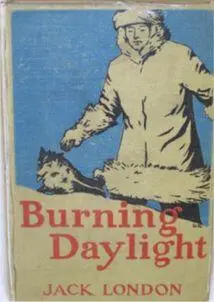
- Название:Burning Daylight
- Автор:
- Жанр:
- Год:1910
- ISBN:нет данных
- Рейтинг книги:5 / 5. Голосов: 1
-
Избранное:Добавить в избранное
- Отзывы:
-
Ваша оценка:
Burning Daylight: краткое содержание, описание и аннотация
Предлагаем к чтению аннотацию, описание, краткое содержание или предисловие (зависит от того, что написал сам автор книги «Burning Daylight»). Если вы не нашли необходимую информацию о книге — напишите в комментариях, мы постараемся отыскать её.
Burning Daylight — читать онлайн бесплатно полную книгу (весь текст) целиком
Ниже представлен текст книги, разбитый по страницам. Система сохранения места последней прочитанной страницы, позволяет с удобством читать онлайн бесплатно книгу «Burning Daylight», без необходимости каждый раз заново искать на чём Вы остановились. Поставьте закладку, и сможете в любой момент перейти на страницу, на которой закончили чтение.
Интервал:
Закладка:
"But I sure get something out of that. It's business, and it's different. I get money out of it. What do you get out of books?"
"Points of view, new ideas, life."
"Not worth a cent cash."
"But life's worth more than cash," she argued.
"Oh, well," he said, with easy masculine tolerance, "so long as you enjoy it. That's what counts, I suppose; and there's no accounting for taste."
Despite his own superior point of view, he had an idea that she knew a lot, and he experienced a fleeting feeling like that of a barbarian face to face with the evidence of some tremendous culture. To Daylight culture was a worthless thing, and yet, somehow, he was vaguely troubled by a sense that there was more in culture than he imagined.
Again, on her desk, in passing, he noticed a book with which he was familiar. This time he did not stop, for he had recognized the cover. It was a magazine correspondent's book on the Klondike, and he knew that he and his photograph figured in it and he knew, also, of a certain sensational chapter concerned with a woman's suicide, and with one "Too much Daylight."
After that he did not talk with her again about books. He imagined what erroneous conclusions she had drawn from that particular chapter, and it stung him the more in that they were undeserved. Of all unlikely things, to have the reputation of being a lady-killer,—he, Burning Daylight,—and to have a woman kill herself out of love for him. He felt that he was a most unfortunate man and wondered by what luck that one book of all the thousands of books should have fallen into his stenographer's hands. For some days afterward he had an uncomfortable sensation of guiltiness whenever he was in Miss Mason's presence; and once he was positive that he caught her looking at him with a curious, intent gaze, as if studying what manner of man he was.
He pumped Morrison, the clerk, who had first to vent his personal grievance against Miss Mason before he could tell what little he knew of her.
"She comes from Siskiyou County. She's very nice to work with in the office, of course, but she's rather stuck on herself—exclusive, you know."
"How do you make that out?" Daylight queried.
"Well, she thinks too much of herself to associate with those she works with, in the office here, for instance. She won't have anything to do with a fellow, you see. I've asked her out repeatedly, to the theatre and the chutes and such things. But nothing doing. Says she likes plenty of sleep, and can't stay up late, and has to go all the way to Berkeley—that's where she lives."
This phase of the report gave Daylight a distinct satisfaction. She was a bit above the ordinary, and no doubt about it. But Morrison's next words carried a hurt.
"But that's all hot air. She's running with the University boys, that's what she's doing. She needs lots of sleep and can't go to the theatre with me, but she can dance all hours with them. I've heard it pretty straight that she goes to all their hops and such things. Rather stylish and high-toned for a stenographer, I'd say. And she keeps a horse, too. She rides astride all over those hills out there. I saw her one Sunday myself. Oh, she's a high-flyer, and I wonder how she does it. Sixty-five a month don't go far. Then she has a sick brother, too."
"Live with her people?" Daylight asked.
"No; hasn't got any. They were well to do, I've heard. They must have been, or that brother of hers couldn't have gone to the University of California. Her father had a big cattle-ranch, but he got to fooling with mines or something, and went broke before he died. Her mother died long before that. Her brother must cost a lot of money. He was a husky once, played football, was great on hunting and being out in the mountains and such things. He got his accident breaking horses, and then rheumatism or something got into him. One leg is shorter than the other and withered up some. He has to walk on crutches. I saw her out with him once—crossing the ferry. The doctors have been experimenting on him for years, and he's in the French Hospital now, I think."
All of which side-lights on Miss Mason went to increase Daylight's interest in her. Yet, much as he desired, he failed to get acquainted with her. He had thoughts of asking her to luncheon, but his was the innate chivalry of the frontiersman, and the thoughts never came to anything. He knew a self-respecting, square-dealing man was not supposed to take his stenographer to luncheon. Such things did happen, he knew, for he heard the chaffing gossip of the club; but he did not think much of such men and felt sorry for the girls. He had a strange notion that a man had less rights over those he employed than over mere acquaintances or strangers. Thus, had Miss Mason not been his employee, he was confident that he would have had her to luncheon or the theatre in no time. But he felt that it was an imposition for an employer, because he bought the time of an employee in working hours, to presume in any way upon any of the rest of that employee's time. To do so was to act like a bully. The situation was unfair. It was taking advantage of the fact that the employee was dependent on one for a livelihood. The employee might permit the imposition through fear of angering the employer and not through any personal inclination at all.
In his own case he felt that such an imposition would be peculiarly obnoxious, for had she not read that cursed Klondike correspondent's book? A pretty idea she must have of him, a girl that was too high-toned to have anything to do with a good-looking, gentlemanly fellow like Morrison. Also, and down under all his other reasons, Daylight was timid. The only thing he had ever been afraid of in his life was woman, and he had been afraid all his life. Nor was that timidity to be put easily to flight now that he felt the first glimmering need and desire for woman. The specter of the apron-string still haunted him, and helped him to find excuses for getting on no forwarder with Dede Mason.
CHAPTER VII
Not being favored by chance in getting acquainted with Dede Mason, Daylight's interest in her slowly waned. This was but natural, for he was plunged deep in hazardous operations, and the fascinations of the game and the magnitude of it accounted for all the energy that even his magnificent organism could generate.
Such was his absorption that the pretty stenographer slowly and imperceptibly faded from the forefront of his consciousness. Thus, the first faint spur, in the best sense, of his need for woman ceased to prod. So far as Dede Mason was concerned, he possessed no more than a complacent feeling of satisfaction in that he had a very nice stenographer. And, completely to put the quietus on any last lingering hopes he might have had of her, he was in the thick of his spectacular and intensely bitter fight with the Coastwise Steam Navigation Company, and the Hawaiian, Nicaraguan, and Pacific-Mexican Steamship-Company. He stirred up a bigger muss than he had anticipated, and even he was astounded at the wide ramifications of the struggle and at the unexpected and incongruous interests that were drawn into it. Every newspaper in San Francisco turned upon him. It was true, one or two of them had first intimated that they were open to subsidization, but Daylight's judgment was that the situation did not warrant such expenditure. Up to this time the press had been amusingly tolerant and good-naturedly sensational about him, but now he was to learn what virulent scrupulousness an antagonized press was capable of. Every episode of his life was resurrected to serve as foundations for malicious fabrications. Daylight was frankly amazed at the new interpretation put upon all he had accomplished and the deeds he had done. From an Alaskan hero he was metamorphosed into an Alaskan bully, liar, desperado, and all around "bad Man." Not content with this, lies upon lies, out of whole cloth, were manufactured about him. He never replied, though once he went to the extent of disburdening his mind to half a dozen reporters. "Do your damnedest," he told them. "Burning Daylight's bucked bigger things than your dirty, lying sheets. And I don't blame you, boys... that is, not much. You can't help it. You've got to live. There's a mighty lot of women in this world that make their living in similar fashion to yours, because they're not able to do anything better. Somebody's got to do the dirty work, and it might as well be you. You're paid for it, and you ain't got the backbone to rustle cleaner jobs."
Читать дальшеИнтервал:
Закладка:
Похожие книги на «Burning Daylight»
Представляем Вашему вниманию похожие книги на «Burning Daylight» списком для выбора. Мы отобрали схожую по названию и смыслу литературу в надежде предоставить читателям больше вариантов отыскать новые, интересные, ещё непрочитанные произведения.






Обсуждение, отзывы о книге «Burning Daylight» и просто собственные мнения читателей. Оставьте ваши комментарии, напишите, что Вы думаете о произведении, его смысле или главных героях. Укажите что конкретно понравилось, а что нет, и почему Вы так считаете.