Герман Мелвилл - Typee
Здесь есть возможность читать онлайн «Герман Мелвилл - Typee» весь текст электронной книги совершенно бесплатно (целиком полную версию без сокращений). В некоторых случаях можно слушать аудио, скачать через торрент в формате fb2 и присутствует краткое содержание. Год выпуска: 2014, Издательство: epubBooks Classics, Жанр: Классическая проза, на английском языке. Описание произведения, (предисловие) а так же отзывы посетителей доступны на портале библиотеки ЛибКат.
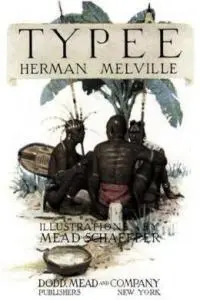
- Название:Typee
- Автор:
- Издательство:epubBooks Classics
- Жанр:
- Год:2014
- ISBN:нет данных
- Рейтинг книги:4 / 5. Голосов: 1
-
Избранное:Добавить в избранное
- Отзывы:
-
Ваша оценка:
Typee: краткое содержание, описание и аннотация
Предлагаем к чтению аннотацию, описание, краткое содержание или предисловие (зависит от того, что написал сам автор книги «Typee»). Если вы не нашли необходимую информацию о книге — напишите в комментариях, мы постараемся отыскать её.
Typee — читать онлайн бесплатно полную книгу (весь текст) целиком
Ниже представлен текст книги, разбитый по страницам. Система сохранения места последней прочитанной страницы, позволяет с удобством читать онлайн бесплатно книгу «Typee», без необходимости каждый раз заново искать на чём Вы остановились. Поставьте закладку, и сможете в любой момент перейти на страницу, на которой закончили чтение.
Интервал:
Закладка:
After having made this discovery I could not avoid congratulating myself that Mehevi had from the first taken me as it were under his royal protection, and that he still continued to entertain for me the warmest regard, as far at least as I was enabled to judge from appearances. For the future I determined to pay most assiduous court to him, hoping that eventually through his kindness I might obtain my liberty.
Chapter XXV
King Mehevi—conduct of Marheyo and Mehevi in Certain Delicate Matters—peculiar System of Marriage—number of Population—uniformity—embalming—places of Sepulture—funeral Obsequies at Nukuheva—number of Inhabitants in Typee—location of the Dwellings—happiness Enjoyed in the Valley.
King Mehevi!—A goodly sounding title!—and why should I not bestow it upon the foremost man in the valley? All hail, therefore, Mehevi, king over all the Typees! and long life and prosperity to his tropical majesty! But to be sober again after this loyal burst.
Previously to seeing the Dancing Widows I had little idea that there were any matrimonial relations subsisting in Typee, and I should as soon have thought of a Platonic affection being cultivated between the sexes, as of the solemn connexion of man and wife. To be sure, there were old Marheyo and Tinor, who seemed to live together quite sociably; but for all that, I had sometimes observed a comical–looking old gentleman, dressed in a suit of shabby tattooing, who appeared to be equally at home. This behaviour, until subsequent discoveries enlightened me, puzzled me more than anything else I witnessed in Typee.
As for Mehevi, I had supposed him a confirmed bachelor, as well as most of the principal chiefs. At any rate, if they had wives and families, they ought to have been ashamed of themselves; for sure I am, they never troubled themselves about any domestic affairs. In truth, Mehevi seemed to be the president of a club of hearty fellows who kept “Bachelor’s Hall” in fine style at the Ti. I had no doubt but that they regarded children as odious incumbrances; and their ideas of domestic felicity were sufficiently shown in the fact, that they allowed no meddlesome housekeepers to turn topsy–turvy those snug little arrangements they had made in their comfortable dwelling. I strongly suspected, however, that some of those jolly bachelors were carrying on love intrigues with the maidens of the tribe, although they did not appear publicly to acknowledge them. I happened to pop upon Mehevi three or four times when he was romping—in a most undignified manner for a warrior king—with one of the prettiest little witches in the valley. She lived with an old woman and a young man, in a house near Marheyo’s; and although in appearance a mere child herself, had a noble boy about a year old, who bore a marvellous resemblance to Mehevi, whom I should certainly have believed to have been the father, were it not that the little fellow had no triangle on his face. Mehevi, however, was not the only person upon whom the damsel Moonoony smiled—the young fellow of fifteen, who permanently resided in the house with her, was decidedly in her good graces. This too was a mystery which, with others of the same kind, was afterwards satisfactorily explained.
During the second day of the Feast of Calabashes, Kory–Kory—being determined that I should have some understanding on these matters—had, in the course of his explanations, directed my attention to a peculiarity I had frequently marked among many of the females,—principally those of a mature age and rather matronly appearance. This consisted in having the right hand and the left foot most elaborately tattooed; while the rest of the body was wholly free from the operation of the art, with the exception of the minutely dotted lips and slight marks on the shoulders, to which I have previously referred as comprising the sole tattooing exhibited by Fayaway, in common with other young girls of her age. The hand and foot thus embellished, were, according to Kory–Kory, the distinguishing badge of wedlock, so far as that social and highly commendable institution is known among these people. It answers, indeed, the same purpose as the plain gold ring worn by our fairer spouses.
After Kory–Kory’s explanation of the subject, I was for some time studiously respectful in the presence of all females thus distinguished, and never ventured to indulge in the slightest approach to flirtation with any of their number.
A further insight, however, into the peculiar domestic customs of the inmates of the valley did away in a measure with the severity of my scruples, and convinced me that I was deceived in some at least of my conclusions. A regular system of polygamy exists among the islanders, but of a most extraordinary nature,—a plurality of husbands, instead of wives; and this solitary fact speaks volumes for the gentle disposition of the male population.
I was not able to learn what particular ceremony was observed in forming the marriage contract, but am inclined to think that it must have been of a very simple nature. Perhaps the mere “popping the question,” as it is termed with us, might have been followed by an immediate nuptial alliance. At any rate, tedious courtships are unknown in the valley of Typee.
The males considerably outnumber the females. This holds true of many of the islands of Polynesia, although the reverse of what is the case in most civilized countries. The girls are first wooed and won, at a very tender age, by some stripling in the household in which they reside. This, however, is a mere frolic of the affections, and no formal engagement is contracted. By the time this first love has a little subsided, a second suitor presents himself, of graver years, and carries both boy and girl away to his own habitation. This disinterested and generous–hearted fellow now weds the young couple—marrying damsel and lover at the same time—and all three thenceforth live together as harmoniously as so many turtles. I have heard of some men who in civilized countries rashly marry large families with their wives, but had no idea that there was any place where people married supplementary husbands with them. Infidelity on either side is very rare. No man has more than one wife, and no wife of mature years has less than two husbands,—sometimes she has three, but such instances are not frequent. The marriage tie, whatever it may be, does not appear to be indissoluble; for separations occasionally happen. These, however, when they do take place, produce no unhappiness, and are preceded by no bickerings: for the simple reason, that an ill–used wife or a hen–pecked husband is not obliged to file a bill in chancery to obtain a divorce. As nothing stands in the way of a separation, the matrimonial yoke sits easily and lightly, and a Typee wife lives on very pleasant and sociable terms with her husbands. On the whole, wedlock, as known among these Typees, seems to be of a more distinct and enduring nature than is usually the case with barbarous people.
But, notwithstanding its existence among them, the scriptural injunction to increase and multiply seems to be but indifferently attended to. I never saw any of those large families, in arithmetical or step–ladder progression, which one often meets with at home. I never knew of more than two youngsters living together in the same home, and but seldom even that number. As for the women, it was very plain that the anxieties of the nursery but seldom disturbed the serenity of their souls; and they were never seen going about the valley with half a score of little ones tagging at their apron–strings, or rather at the bread–fruit leaf they usually wore in the rear.
I have before had occasion to remark that I never saw any of the ordinary signs of a place of sepulture in the valley, a circumstance which I attributed, at the time, to my living in a particular part of it, and being forbidden to extend my ramble to any considerable distance towards the sea. I have since thought it probable, however, that the Typees, either desirous of removing from their sight the evidences of mortality, or prompted by a taste for rural beauty, may have some charming cemetery situated in the shadowy recesses along the base of the mountains. At Nukuheva, two or three large quadrangular “pi–pis,” heavily flagged, enclosed with regular stone walls, and shaded over and almost hidden from view by the interlacing branches of enormous trees, were pointed out to me as burial–places. The bodies, I understood, were deposited in rude vaults beneath the flagging, and were suffered to remain there without being disinterred. Although nothing could be more strange and gloomy than the aspect of these places, where the lofty trees threw their dark shadows over rude blocks of stone, a stranger looking at them would have discerned none of the ordinary evidences of a place of sepulture.
Читать дальшеИнтервал:
Закладка:
Похожие книги на «Typee»
Представляем Вашему вниманию похожие книги на «Typee» списком для выбора. Мы отобрали схожую по названию и смыслу литературу в надежде предоставить читателям больше вариантов отыскать новые, интересные, ещё непрочитанные произведения.





Обсуждение, отзывы о книге «Typee» и просто собственные мнения читателей. Оставьте ваши комментарии, напишите, что Вы думаете о произведении, его смысле или главных героях. Укажите что конкретно понравилось, а что нет, и почему Вы так считаете.