Герман Мелвилл - Typee
Здесь есть возможность читать онлайн «Герман Мелвилл - Typee» весь текст электронной книги совершенно бесплатно (целиком полную версию без сокращений). В некоторых случаях можно слушать аудио, скачать через торрент в формате fb2 и присутствует краткое содержание. Год выпуска: 2014, Издательство: epubBooks Classics, Жанр: Классическая проза, на английском языке. Описание произведения, (предисловие) а так же отзывы посетителей доступны на портале библиотеки ЛибКат.
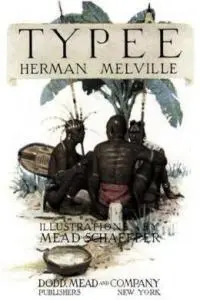
- Название:Typee
- Автор:
- Издательство:epubBooks Classics
- Жанр:
- Год:2014
- ISBN:нет данных
- Рейтинг книги:4 / 5. Голосов: 1
-
Избранное:Добавить в избранное
- Отзывы:
-
Ваша оценка:
Typee: краткое содержание, описание и аннотация
Предлагаем к чтению аннотацию, описание, краткое содержание или предисловие (зависит от того, что написал сам автор книги «Typee»). Если вы не нашли необходимую информацию о книге — напишите в комментариях, мы постараемся отыскать её.
Typee — читать онлайн бесплатно полную книгу (весь текст) целиком
Ниже представлен текст книги, разбитый по страницам. Система сохранения места последней прочитанной страницы, позволяет с удобством читать онлайн бесплатно книгу «Typee», без необходимости каждый раз заново искать на чём Вы остановились. Поставьте закладку, и сможете в любой момент перейти на страницу, на которой закончили чтение.
Интервал:
Закладка:
When I first visited this singular place with Kory–Kory, he told me—or, at least, I so understood him—that the chief was paddling his way to the realms of bliss and bread–fruit—the Polynesian heaven—where every moment the bread–fruit trees dropped their ripened spheres to the ground, and where there was no end to the cocoa–nuts and bananas; there they reposed through the live–long eternity upon mats much finer than those of Typee; and every day bathed their glowing limbs in rivers of cocoa–nut oil. In that happy land there were plenty of plumes and feathers, and boars’–tusks and sperm–whale teeth, far preferable to all the shining trinkets and gay tappa of the white men; and, best of all, women, far lovelier than the daughters of earth, were there in abundance. “A very pleasant place,” Kory–Kory said it was; “but, after all, not much pleasanter, he thought, than Typee.” “Did he not, then,” I asked him, “wish to accompany the warrior?” “Oh, no; he was very happy where he was; but supposed that some time or other he would go in his own canoe.”
Thus far, I think, I clearly comprehended Kory–Kory. But there was a singular expression he made use of at the time, enforced by as singular a gesture, the meaning of which I would have given much to penetrate. I am inclined to believe it must have been a proverb he uttered; for I afterwards heard him repeat the same words several times, and in what appeared to me to be a somewhat similar sense. Indeed, Kory–Kory had a great variety of short, smart–sounding sentences, with which he frequently enlivened his discourse; and he introduced them with an air which plainly intimated, that, in his opinion, they settled the matter in question, whatever it might be.
Could it have been, then, that when I asked him whether he desired to go to this heaven of bread–fruit, cocoa–nuts, and young ladies, which he had been describing, he answered by saying something equivalent to our old adage—“A bird in the hand is worth two in the bush!”—if he did, Kory–Kory was a discreet and sensible fellow, and I cannot sufficiently admire his shrewdness.
Whenever, in the course of my rambles through the valley, I happened to be near the chief’s mausoleum, I always turned aside to visit it. The place had a peculiar charm for me; I hardly know why, but so it was. As I leaned over the railing and gazed upon the strange effigy, and watched the play of the feathery head–dress, stirred by the same breeze which in low tones breathed amidst the lofty palm trees, I loved to yield myself up to the fanciful superstition of the islanders, and could almost believe that the grim warrior was bound heavenward. In this mood, when I turned to depart, I bade him, “God speed, and a pleasant voyage.” Ay, paddle away, brave chieftain, to the land of spirits! To the material eye thou makest but little progress, but, with the eye of faith, I see thy canoe cleaving the bright waves, which die away on those dimly looming shores of Paradise.
This strange superstition affords another evidence of the fact, that however ignorant man may be, he still feels within him his immortal spirit yearning after the unknown future.
Although the religious theories of the islands were a complete mystery to me, their practical every–day operation could not be concealed. I frequently passed the little temples reposing in the shadows of the Taboo Groves, and beheld the offerings—mouldy fruit spread out upon a rude altar, or hanging in half–decayed baskets around some uncouth, jolly–looking images. I was present during the continuance of the festival. I daily beheld the grinning idols marshalled rank and file in the Hoolah Hoolah ground, and was often in the habit of meeting those whom I supposed to be the priests. But the temples seemed to be abandoned to solitude; the festival had been nothing more than a jovial mingling of the tribe; the idols were quite as harmless as any other logs of wood; and the priests were the merriest dogs in the valley.
In fact, religious affairs in Typee were at a very low ebb. All such matters sat very lightly upon the thoughtless inhabitants; and, in the celebration of many of their strange rites, they appeared merely to seek a sort of childish amusement.
A curious evidence of this was given in a remarkable ceremony, in which I frequently saw Mehevi and several other chiefs and warriors of note take part; but never a single female.
Among those whom I looked upon as forming the priesthood of the valley, there was one in particular who often attracted my notice, and whom I could not help regarding as the head of the order. He was a noble–looking man, in the prime of his life, and of a most benignant aspect. The authority this man, whose name was Kolory, seemed to exercise over the rest, the episcopal part he took in the Feast of Calabashes, his sleek and complacent appearance, the mystic characters which were tattooed upon his chest, and, above all, the mitre he frequently wore, in the shape of a towering head–dress, consisting of part of a cocoa–nut branch, the stalk planted uprightly on his brow, and the leaflets gathered together and passed round the temples and behind the ears, all these pointed him out as Lord Primate of Typee. Kolory was a sort of Knight Templar—a soldier–priest; for he often wore the dress of a Marquesan warrior, and always carried a long spear, which, instead of terminating in a paddle at the lower end, after the general fashion of these weapons, was curved into a heathenish–looking little image. This instrument, however, might perhaps have been emblematic of his double functions. With one end, in carnal combat he tranfixed the enemies of his tribe; and with the other, as a pastoral crook, he kept in order his spiritual flock. But this is not all I have to about Kolory. His martial grace very often carried about with him what seemed to me the half of a broken war–club. It was swathed round with ragged bits of white tappa, and the upper part, which was intended to represent a human head, was embellished with a strip of scarlet cloth of European manufacture. It required little observation to discover that this strange object was revered as a god. By the side of the big and lusty images standing sentinel over the altars of the Hoolah Hoolah ground, it seemed a mere pigmy in tatters. But appearances all the world over are deceptive. Little men are sometimes very potent, and rags sometimes cover very extensive pretensions. In fact, this funny little image was the “crack” god of the island; lording it over all the wooden lubbers who looked so grim and dreadful; its name was Moa Artua. [4] The word “Artua,” although having some other significations, is in nearly all the Polynesian dialects used as the general designation of the gods.
And it was in honour of Moa Artua, and for the entertainment of those who believe in him, that the curious ceremony I am about to describe was observed.
Mehevi and the chieftains of the Ti have just risen from their noontide slumbers. There are no affairs of state to dispose of; and having eaten two or three breakfasts in the course of the morning, the magnates of the valley feel no appetite as yet for dinner. How are their leisure moments to be occupied? They smoke, they chat, and at last one of their number makes a proposition to the rest, who joyfully acquiescing, he darts out of the house, leaps from the pi–pi, and disappears in the grove. Soon you see him returning with Kolory, who bears the god Moa Artua in his arms, and carries in one hand a small trough, hollowed out in the likeness of a canoe. The priest comes along dangling his charge as if it were a lachrymose infant he was endeavouring to put into a good humour. Presently, entering the Ti, he seats himself on the mats as composedly as a juggler about to perform his sleight–of–hand tricks; and, with the chiefs disposed in a circle around him, commences his ceremony.
Читать дальшеИнтервал:
Закладка:
Похожие книги на «Typee»
Представляем Вашему вниманию похожие книги на «Typee» списком для выбора. Мы отобрали схожую по названию и смыслу литературу в надежде предоставить читателям больше вариантов отыскать новые, интересные, ещё непрочитанные произведения.





Обсуждение, отзывы о книге «Typee» и просто собственные мнения читателей. Оставьте ваши комментарии, напишите, что Вы думаете о произведении, его смысле или главных героях. Укажите что конкретно понравилось, а что нет, и почему Вы так считаете.