Герман Мелвилл - Typee
Здесь есть возможность читать онлайн «Герман Мелвилл - Typee» весь текст электронной книги совершенно бесплатно (целиком полную версию без сокращений). В некоторых случаях можно слушать аудио, скачать через торрент в формате fb2 и присутствует краткое содержание. Год выпуска: 2014, Издательство: epubBooks Classics, Жанр: Классическая проза, на английском языке. Описание произведения, (предисловие) а так же отзывы посетителей доступны на портале библиотеки ЛибКат.
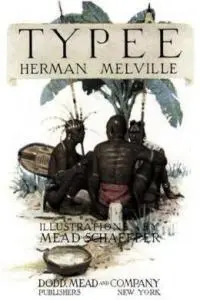
- Название:Typee
- Автор:
- Издательство:epubBooks Classics
- Жанр:
- Год:2014
- ISBN:нет данных
- Рейтинг книги:4 / 5. Голосов: 1
-
Избранное:Добавить в избранное
- Отзывы:
-
Ваша оценка:
Typee: краткое содержание, описание и аннотация
Предлагаем к чтению аннотацию, описание, краткое содержание или предисловие (зависит от того, что написал сам автор книги «Typee»). Если вы не нашли необходимую информацию о книге — напишите в комментариях, мы постараемся отыскать её.
Typee — читать онлайн бесплатно полную книгу (весь текст) целиком
Ниже представлен текст книги, разбитый по страницам. Система сохранения места последней прочитанной страницы, позволяет с удобством читать онлайн бесплатно книгу «Typee», без необходимости каждый раз заново искать на чём Вы остановились. Поставьте закладку, и сможете в любой момент перейти на страницу, на которой закончили чтение.
Интервал:
Закладка:
Leaving these afflicted females, we passed on to the Hoolah Hoolah ground. Within the spacious quadrangle, the whole population of the valley seemed to be assembled, and the sight presented was truly remarkable. Beneath the sheds of bamboo which opened towards the interior of the square, reclined the principal chiefs and warriors, while a miscellaneous throng lay at their ease under the enormous trees, which spread a majestic canopy overhead. Upon the terraces of the gigantic altars, at either end, were deposited green bread–fruit in baskets of cocoa–nut leaves, large rolls of tappa, bunches of white bananas, clusters of mammee–apples, the golden–hued fruit of the artu tree, and baked hogs, laid out in large wooden trenchers, fancifully decorated with freshly–plucked leaves, whilst a variety of rude implements of war were piled in confused heaps before the ranks of hideous idols. Fruits of various kinds were likewise suspended in leafen baskets, from the tops of poles planted uprightly, and at regular intervals, along the lower terraces of both altars. At their base were arranged two parallel rows of cumbersome drums, standing at least fifteen feet in height, and formed from the hollow trunks of large trees. Their heads were covered with shark skins, and their barrels were elaborately carved with various quaint figures and devices. At regular intervals, they were bound round by a species of sinnate of various colours, and strips of native cloth flattened upon them here and there. Behind these instruments were built slight platforms, upon which stood a number of young men, who, beating violently with the palms of their hands upon the drum–heads, produced those outrageous sounds which had awakened me in the morning. Every few minutes these musical performers hopped down from their elevation into the crowd below, and their places were immediately supplied by fresh recruits. Thus an incessant din was kept up that might have startled Pandemonium.
Precisely in the middle of the quadrangle were placed perpendicularly in the ground a hundred or more slender, fresh–cut poles, stripped of their bark, and decorated at the end with a floating pennon of white tappa, the whole being fenced about with a little picket of canes. For what purpose these singular ornaments were intended, I in vain endeavoured to discover.
Another most striking feature of the performance was exhibited by a score of old men, who sat cross–legged in the little pulpits, which encircled the trunks of the immense trees growing in the middle of the enclosure. These venerable gentlemen, who I presume were the priests, kept up an uninterrupted monotonous chant, which was nearly drowned in the roar of drums. In the right hand they held a finely–woven grass fan, with a heavy black wooden handle, curiously chased: these fans they kept in continual motion.
But no attention whatever seemed to be paid to the drummers or to the old priests, the individuals who composed the vast crowd present being entirely taken up in chatting and laughing with one another, smoking, drinking arva, and eating. For all the observation it attracted, or the good it achieved, the whole savage orchestra might, with great advantage to its own members and the company in general, have ceased the prodigious uproar they were making.
In vain I questioned Kory–Kory and others of the natives, as to the meaning of the strange things that were going on; all their explanations were conveyed in such a mass of outlandish gibberish and gesticulation that I gave up the attempt in despair. All that day the drums resounded, the priests chanted, and the multitude feasted and roared till sunset, when the throng dispersed, and the Taboo Groves were again abandoned to quiet and repose. The next day the same scene was repeated until night, when this singular festival terminated.
Chapter XXIII
Ideas Suggested by the Feast of Calabashes—effigy of a Dead Warrior—a Singular Superstition—the Priest Kolory and the God Moa Artua—amazing Religious Observance—a Dilapidated Shrine—kory-kory and the Idol—an Inference.
Although I had been baffled in my attempts to learn the origin of the Feast of Calabashes, yet it seemed very plain to me that it was principally, if not wholly, of a religious character.
Yet, notwithstanding all I observed on this occasion, I am free to confess my almost entire inability to gratify any curiosity that may be felt with regard to the theology of the valley. I doubt whether the inhabitants themselves could do so. They are either too lazy or too sensible to worry themselves about abstract points of religious belief. While I was among them, they never held any synods or councils to settle the principles of their faith by agitating them. An unbounded liberty of conscience seemed to prevail. Those who pleased to do so were allowed to repose implicit faith in an ill–favoured god, with a large bottle–nose, and fat shapeless arms crossed upon his breast; whilst others worshipped an image which, having no likeness either in heaven or on earth, could hardly be called an idol. As the islanders always maintained a discreet reserve with regard to my own peculiar views on religion, I thought it would be excessively ill–bred in me to pry into theirs.
But, although my knowledge of the religious faith of the Typees was unavoidably limited, one of their superstitious observances with which I became acquainted interested me greatly.
In one of the most secluded portions of the valley, within a stone’s cast of Fayaway’s lake—for so I christened the scene of our island yachting—and hard by a growth of palms, which stood ranged in order along both banks of the stream, waving their green arms as if to do honour to its passage, was the mausoleum of a deceased warrior–chief. Like all the other edifices of any note, it was raised upon a small pi–pi of stones, which, being of unusual height, was a conspicuous object from a distance. A light thatching of bleached palmetto–leaves hung over it like a self–supported canopy; for it was not until you came very near that you saw it was supported by four slender columns of bamboo, rising at each corner to a little more than the height of a man. A clear area of a few yards surrounded the pi–pi, and was enclosed by four trunks of cocoa–nut trees, resting at the angles on massive blocks of stone. The place was sacred. The sign of the inscrutable Taboo was seen, in the shape of a mystic roll of white tappa, suspended by a twisted cord of the same material from the top of a slight pole planted within the enclosure. [3] White appears to be the sacred colour among the Marquesans.
The sanctity of the spot appeared never to have been violated. The stillness of the grave was there, and the calm solitude around was beautiful and touching. The soft shadows of those lofty palm trees—I can see them now—hanging over the little temple, as if to keep out the intrusive sun.
On all sides, as you approached this silent spot, you caught sight of the dead chief’s effigy, seated in the stern of a canoe, which was raised on a light frame a few inches above the level of the pi–pi. The canoe was about seven feet in length; of a rich, dark–coloured wood, handsomely carved, and adorned in many places with variegated bindings of stained sinnate, into which were ingeniously wrought a number of sparkling sea–shells, and a belt of the same shells ran all round it. The body of the figure—of whatever material it might have been made—was effectually concealed in a heavy robe of brown tappa, revealing only the hands and head; the latter skilfully carved in wood, and surmounted by a superb arch of plumes. These plumes, in the subdued and gentle gales which found access to this sequestered spot, were never for one moment at rest, but kept nodding and waving over the chief’s brow. The long leaves of the palmetto dropped over the eaves, and through them you saw the warrior, holding his paddle with both hands in the act of rowing, leaning forward and inclining his head, as if eager to hurry on his voyage. Glaring at him for ever, and face to face, was a polished human skull, which crowned the prow of the canoe. The spectral figure–head, reversed in its position, glancing backwards, seemed to mock the impatient attitude of the warrior.
Читать дальшеИнтервал:
Закладка:
Похожие книги на «Typee»
Представляем Вашему вниманию похожие книги на «Typee» списком для выбора. Мы отобрали схожую по названию и смыслу литературу в надежде предоставить читателям больше вариантов отыскать новые, интересные, ещё непрочитанные произведения.






Обсуждение, отзывы о книге «Typee» и просто собственные мнения читателей. Оставьте ваши комментарии, напишите, что Вы думаете о произведении, его смысле или главных героях. Укажите что конкретно понравилось, а что нет, и почему Вы так считаете.