Irwin Shaw - Rich Man, Poor Man
Здесь есть возможность читать онлайн «Irwin Shaw - Rich Man, Poor Man» весь текст электронной книги совершенно бесплатно (целиком полную версию без сокращений). В некоторых случаях можно слушать аудио, скачать через торрент в формате fb2 и присутствует краткое содержание. Год выпуска: 1970, ISBN: 1970, Издательство: Delacorte Press, NY, Жанр: Классическая проза, на английском языке. Описание произведения, (предисловие) а так же отзывы посетителей доступны на портале библиотеки ЛибКат.
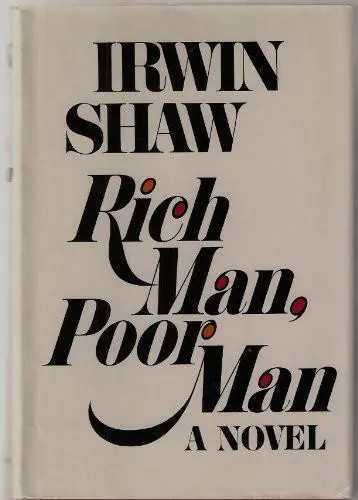
- Название:Rich Man, Poor Man
- Автор:
- Издательство:Delacorte Press, NY
- Жанр:
- Год:1970
- ISBN:9780385288583
- Рейтинг книги:5 / 5. Голосов: 1
-
Избранное:Добавить в избранное
- Отзывы:
-
Ваша оценка:
Rich Man, Poor Man: краткое содержание, описание и аннотация
Предлагаем к чтению аннотацию, описание, краткое содержание или предисловие (зависит от того, что написал сам автор книги «Rich Man, Poor Man»). Если вы не нашли необходимую информацию о книге — напишите в комментариях, мы постараемся отыскать её.
Rich Man, Poor Man — читать онлайн бесплатно полную книгу (весь текст) целиком
Ниже представлен текст книги, разбитый по страницам. Система сохранения места последней прочитанной страницы, позволяет с удобством читать онлайн бесплатно книгу «Rich Man, Poor Man», без необходимости каждый раз заново искать на чём Вы остановились. Поставьте закладку, и сможете в любой момент перейти на страницу, на которой закончили чтение.
Интервал:
Закладка:
If Rudolph was an ordinary man, the cabinet member was certainly speaking for him. Now that he had heard some of the stories about the war in bull sessions around the campus he no longer envied the generation before his which had stood on Guadalcanal and the sandy ridges of Tunisia and at the Rapido River.
The fine, intelligent, educated voice sang on in the sunny quadrangle of red-brick Colonial buildings. Inevitably, there was the salute to America, land of opportunity. Half the young men listening had had the opportunity to be killed for America, but the speaker was looking forward this afternoon, not towards the past, and the opportunities he mentioned were those of scientific research, public service, aid to those nations throughout the world who were not as fortunate as we. He was a good man, the cabinet member, and Rudolph was glad that such a man was near the seat of power in Washington, but his view of opportunity in 1950 was a bit lofty, evangelical, Washingtonian; all very well for a commencement exercise, but not likely to coincide with the down-to-earth views of the three hundred or so poor men’s sons who sat before him in black robes waiting to receive their degrees from a small, underfinanced school known, if it was known at all, for its agricultural department, and wondering how they were going to start earning a living the next day.
Up front, in the section reserved for professors, Rudolph saw Professor Denton, the head of the History and Economics Departments, squirming in his seat and turning to whisper to Professor Lloyd, of the English Department, sitting on his right. Rudolph smiled, guessing what Professor Denton’s comments would be on the cabinet members’ ritualistic pronouncements. Denton, a small, fierce greying man, disappointed because by now he realised he would rise no higher in the academic world, was also a kind of outdated Midwestern Populist, who spent a good deal of his time in the classroom ranting about what he considered the betrayal of the American economic and political system, dating back to the Civil War, by Big Money and Big Business. The American economy,’ he said in class, ‘is a rigged crap table, with loaded dice. The laws are carefully arranged to that the Rich throw only sevens and everybody else throws only snake-eyes.’
At least once a term he made a point of referring to the fact that in 1932, by his own admission before a congressional committee, J. P. Morgan had not paid a cent in income tax. ‘I want you gentlemen to keep this in mind,’ Professor Denton would declaim bitterly, ‘while also keeping in mind that in the same year, on a mere tutor’s salary, I paid five hundred and twenty seven dollars and thirty cents in tax to the Federal Government.’
The effect on the class, as far as Rudolph could discern, was not the one Denton sought Rather than firing the students up with indignation and a burning desire to rally forth to do
battle for reform, most of the students, Rudolph included, dreamed of the time when they themselves could reach the heights of wealth and power, so that they, too, like J. P. Morgan, could be exempt from what Denton called the legal enslavement of the electorate body.
And when Denton, pouncing upon some bit of news in the Wall Street Journal describing some new wily tax-saving amalgamation or oil jobbing that kept millions of dollars immune from the Federal treasury, Rudolph listened carefully, admiring the techniques that Denton lovingly dissected, and putting everything carefully down in his notebooks, against the blessed day when he perhaps might be faced with similar opportunities.
Anxious for good marks, not so much for themselves as for the possible advantages later, Rudolph did not let on that his close attention to Denton’s tirades were not those of a disciple, but rather those of a spy in enemy territory. His three courses with Denton had been rewarded with three As and Denton had offered him a teaching fellowship in the History department for the next year.
Despite his secret disagreement with what he thought were Denton’s naive positions, Denton was the one instructor Rudolph had come to like in all the time he had been in the college, and the one man he considered had taught him anything useful.
He had kept this opinion, as he had kept almost all his other opinions, strictly to himself, and he was highly regarded as a serious student and a well-behaved young man by the faculty members.
The speaker was finishing, with a mention of God in his last sentence. There was applause. Then the graduates were called up to receive their degrees, one by one. The President beamed as he bestowed the rolls of paper bedecked with ribbon. He had scored a coup getting the cabinet member to his ceremony. He had not read Boylan’s letter about an agricultural school.
A hymn was sung, a decorous march played. The black robes filed down through rows of parents and relatives. The robes dispersed under the summer foliage, of oak trees, mixing with the bright colours of women’s dresses, making the graduates look like a flock of crows feeding in a field of flowers.
Rudolph limited himself to a few handshakes. He had a busy day and night ahead of him. Denton sought him out, shook his hand, a small, almost hunchbacked man with thick, silver-rimmed glasses. ‘Jordache,’ he said, his hand enthusiastic, ‘you will think it over won’t you?’
‘Yes, sir,’ Rudolph said. ‘It’s very kind of you.’ Respect your elders. The academic life, serene, underpaid. A master’s in a year, a PhD a few years later, a chair perhaps at the age of forty-five. ‘I am certainly tempted, sir.’ He was not tempted at all.
He and Brad broke away to turn in their robes and go, as prearranged, to the parking lot. Brad had a pre-war Chevy convertible, and his bags, already packed were in the trunk. Brad was ready to take off for Oklahoma, that overflowing country.
They were the first ones out of the parking lot. They did not look back. Alma Mater disappeared around a bend in the road. Four years. Be sentimental later. Twenty years from now. ‘Let’s go by the store for a minute,’ Rudolph said. ‘I promised Calderwood I’d look in.’
‘Yes, sir,’ Brad said, at the wheel. ‘Do I sound like an educated man?’
The ruling class,’ Rudolph said.
‘My time has not been wasted,’ Brad said. ‘How much do you think a cabinet member makes a year?’ ‘Fifteen, sixteen thousand,’ Rudolph hazarded. ‘Chickenfeed,’ Brad said. ‘Plus honour.’
That’s another thirty bucks a year at least,’ Brad said. Tax free. You think he wrote that speech himself?’ ‘Probably.’
“He’s overpaid.’ Brad began to hum the tune of ‘Everything’s Up-to-date in Kansas City’. Will there be broads there tonight?’
Gretchen had invited them both to her place for a party to mark the occasion. Julie was to come, too, if she could shake her parents.
‘Probably,’ Rudolph said. There’re usually one or two girls hanging around.’
‘I read all that stuff in the papers,’ Brad said querulously, about how modern youth is going to the dogs and how morality has broken down since the war and all, but I’m not getting any of that little old broken-down morality, that’s for sure, The next time I go to college it’s going to be coed. You’re looking at a pure-bred, sex-starved Bachelor of Arts, and I ain’t just talking.’ He hummed gaily. They drove through the town. Since the war there had been a
lot of new construction, small factories and lawns and flowerbeds pretending to be places of recreation and gracious living, shop-fronts redone to look as though they were on 18th century village streets in the English counties, a white clapboard building that had once been the town hall and was now a summer theatre. People from New York had begun buying farmhouses in the adjoining countryside and came up for weekends and holidays. Whitby, in the four years that Rudolph had spent there, had grown visibly more prosperous with nine new holes added to the golf-course and an optimistic real-estate development called Greenwood Estates, where you had to buy at least two acres of land if you wanted to build a house. There was even a small artists’ colony and when the President of the university attempted to lure staff away from other institutions, he always pointed out that Whitby was situated in an up-and-coming town, improving in quality as well as size, and that it had a cultural atmosphere.
Читать дальшеИнтервал:
Закладка:
Похожие книги на «Rich Man, Poor Man»
Представляем Вашему вниманию похожие книги на «Rich Man, Poor Man» списком для выбора. Мы отобрали схожую по названию и смыслу литературу в надежде предоставить читателям больше вариантов отыскать новые, интересные, ещё непрочитанные произведения.





Обсуждение, отзывы о книге «Rich Man, Poor Man» и просто собственные мнения читателей. Оставьте ваши комментарии, напишите, что Вы думаете о произведении, его смысле или главных героях. Укажите что конкретно понравилось, а что нет, и почему Вы так считаете.