Irwin Shaw - Rich Man, Poor Man
Здесь есть возможность читать онлайн «Irwin Shaw - Rich Man, Poor Man» весь текст электронной книги совершенно бесплатно (целиком полную версию без сокращений). В некоторых случаях можно слушать аудио, скачать через торрент в формате fb2 и присутствует краткое содержание. Год выпуска: 1970, ISBN: 1970, Издательство: Delacorte Press, NY, Жанр: Классическая проза, на английском языке. Описание произведения, (предисловие) а так же отзывы посетителей доступны на портале библиотеки ЛибКат.
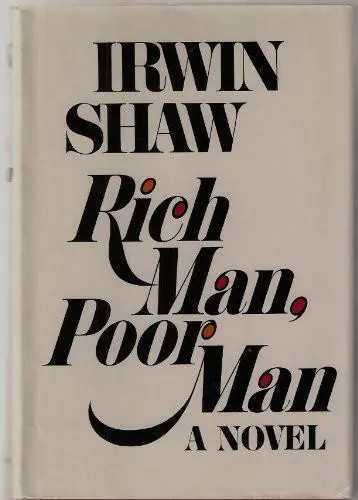
- Название:Rich Man, Poor Man
- Автор:
- Издательство:Delacorte Press, NY
- Жанр:
- Год:1970
- ISBN:9780385288583
- Рейтинг книги:5 / 5. Голосов: 1
-
Избранное:Добавить в избранное
- Отзывы:
-
Ваша оценка:
Rich Man, Poor Man: краткое содержание, описание и аннотация
Предлагаем к чтению аннотацию, описание, краткое содержание или предисловие (зависит от того, что написал сам автор книги «Rich Man, Poor Man»). Если вы не нашли необходимую информацию о книге — напишите в комментариях, мы постараемся отыскать её.
Rich Man, Poor Man — читать онлайн бесплатно полную книгу (весь текст) целиком
Ниже представлен текст книги, разбитый по страницам. Система сохранения места последней прочитанной страницы, позволяет с удобством читать онлайн бесплатно книгу «Rich Man, Poor Man», без необходимости каждый раз заново искать на чём Вы остановились. Поставьте закладку, и сможете в любой момент перейти на страницу, на которой закончили чтение.
Интервал:
Закладка:
‘I know he’s your friend,’ Calderwood said, ‘and he’s smart as a fox and you’ve known him a long time and you had enough confidence in him to bring him here and give him a big load of responsibility, but there’s something about him - ‘ Calderwood shook his big, sallow, death-marked head. ‘He drinks, he’s a whoremonger - don’t contradict me, Rudy, I know what I know - he gambles, he comes from Olkahoma…’
Rudolph chuckled.
‘I know,’ Calderwood said. ‘I’m an old man and I have my prejudices. But there they are. I guess I’ve been spoiled by you, Rudy. I never dealt with a man in my whole life I knew I could trust the way I trust you. Even when you talked me into acting against my better judgement - and you’d be surprised how many times that’s happened -I knew you’d never do anything that you thought was against my interests or was underhanded or would reflect against my reputation.’
Thank you, Mr Calderwood,’ Rudolph said.
‘Mr Calderwood, Mr Calderwood,’ the old man said peevishly. ‘Are you still going to be calling me Mr Calderwood on my death bed?’
Thank you, Duncan.’ It was an effort to say Duncan.
To turn the whole damn shebang over to that man.’ There was a cranky, aged complaint in Calderwood’s voice. ‘Even if it’s after I die. I don’t feel like doing it. But if you say so …’ He trailed off unhappily.
Rudolph sighed. There is always someone to betray, he thought. ‘I don’t say so,’ he said quietly. There’s a young lawyer in our legal department by the name of Mathers … ‘
‘I know him,’ Calderwood said. ‘Light-complected fellow with glasses and two kids. From Philadelphia.’
‘He has a degree from the Wharton School of Business that he took before he went to Havard Law. He’s been with us more than four years. He knows every department. He asks all the right questions. He’s been in and out of my office. He could earn a lot more than he does here in any one of a dozen law firms in New York, but he likes living here.
‘Okay,’ Calderwood said. Tell him tomorrow.’
‘I would prefer it if you told him, Duncan.’ Second Duncan in his life. ‘As usual,’ Calderwood said. ‘I don’t like to do what you’re telling me to do, and I know you’re right. I’ll tell him. Now let’s go back and drink some more of that champagne. I paid enough for it, God knows, I might as well drink it’
The new appointment was announced the day before the newlyweds were due back from the honeymoon.
Brad took it calmly, like a gentleman, and never queried Rudolph about who made the decision. But three months later he quit his job and he and Virginia went out to Tulsa, where Brad’s father had made a place for him in his oil business. On Enid’s first birthday, he sent a cheque for five hundred dollars to be deposited in Enid’s savings account.
Brad wrote regularly, jovial, breezy, friendly letters. He was doing very well, he wrote, and was making more money than he ever had before. He liked Tulsa, where the golf bets were on a generous Western scale and on three successive Saturdays he had won more than a thousand dollars a round. Virginia was liked by everyone and had made dozens of friends. She had taken up golf. Brad invited Rudolph to invest with him - ‘It’s like picking money off a tree,’ was the way he put it. He said he wanted somehow to pay back all that Rudolph had done for him, and this was one way of doing it.
Out of sense of guilt - he could not forget the moment on the steps of the Country Club with Duncan Calderwood -Rudolph started taking shares in wells that Brad prospected, drilled and managed. Besides, as Johnny Heath pointed out, for a man in bis income bracket, considering the twenty-seven-percent depletion tax allowance that the oil industry enjoyed, it was more than worth the gamble. Johnny checked on the credit rating of Peter Knight and Son, found it was A-one, then matched Rudolph’s investments dollar for dollar.
1965
Thomas squatted on the forward deck, whistling tunelessly, polishing the bronze spool of the anchor winch. Although it was only early June, it was already warm and he worked barefooted and stripped to the waist. His torso was dark brown from the sun, as dark as the skin of the swarthiest Greeks or Italians on any of the ships in the harbour of Antibes. His body wasn’t as hard as it had been when he was fighting. The muscles didn’t stand out in ridges as they had then, but were smoother, not as heavy. When he was wearing something to cover his small bald spot, as he was now, he looked younger than he had two years ago. He tilted the white American gob’s hat, which he wore with the rim turned down all round, over his eyes, to protect him from the glare of the sun off the water.
From the engine-room below there was the sound of hammering. Pinky Kimball was down there with Dwyer working on a pump. The first charter of the year began tomorrow and the port engine had overheated on a trial run. Pinky, who was the engineer on the Vega, the biggest ship in the harbour, had volunteered to come over and look at it. Dwyer and Thomas could handle simple repairs themselves, but when it came to anything really complicated they had to ask for help. Luckily Thomas had struck up a friendship with Kimball during the winter and Kimball had given them a hand on various things as they got the Clothilde into shape for the summer. Thomas had not explained to Dwyer why he had decided to call the ship Clothilde when they had changed it from the Penelope at Porto Santo Stefano. To himself, he had said, a ship had to be called by a woman’s name, why not Clothilde? He certainly wasn’t going to call it Teresa.
He was happy on the Clothilde, although even in bis own eyes it wasn’t one of the smartest craft on the Mediterranean. He knew its superstructure was a little topheavy and presented too much surface to the wind and its top speed was only twelve knots, cruising speed ten knots, and it rolled alarmingly in
certain seas. But everything that two determined men, working month after month, could do to make a craft snug and seaworthy, had been done to the peeling hulk they had bought at Porto Santo Stefano two and a half years before. They had had two good seasons, and while neither of them had got rich off the boat, they both had some money in the bank, in case of trouble. The season coming up looked as though it was going to be even better than the first two and Thomas felt a calm pleasure as he burnished the bronze spool and saw it reflect the sun from its surface. Before taking to the sea he would never have thought that a simple, brainless act like polishing a piece of metal could give him pleasure.
It was the same with everything on the ship. He loved to stroll from bow to stern and back again, touching the hand rails, pleased to see the lines curled into perfect spiral patterns on the caulked, pale, teak deck, admiring the polished brass handles on the old-fashioned wheel in the deck house and the perfectly arranged charts in their slots and the signal flags tightly rolled in their pigeonholes. He, who had never washed a dish in his life, spent long hours in the galley scrubbing pans until they shone and making sure that the icebox was immaculate and fresh smelling, the range and oven scrubbed. When there was a charter on board he and Dwyer and whoever they signed on as a cook dressed in tan drill shorts and immaculate white cotton T-shirts with Clothilde printed across the chest in blue. In the evenings, or in cold weather, they wore identical heavy navy-blue sailors’ sweaters.
He had learned to mix all sorts of drinks and serve them frosty and cold in good glasses, and there was one party, Americans, who swore they only took the ship for his Bloody Marys. A pleasure craft on the Mediterranean going between one country and another could be a cheap holiday for a drunkard, because you could take on case after case of dutyfree liquor and you could buy gin and whisky for about a dollar and a half a bottle. He rarely drank anything himself, except for a little pastis and an occasional beer. When charters came aboard he wore a peaked captain’s cap, with the gilt anchor and chain. It made his clients’ holidays more seagoing, he felt.
Читать дальшеИнтервал:
Закладка:
Похожие книги на «Rich Man, Poor Man»
Представляем Вашему вниманию похожие книги на «Rich Man, Poor Man» списком для выбора. Мы отобрали схожую по названию и смыслу литературу в надежде предоставить читателям больше вариантов отыскать новые, интересные, ещё непрочитанные произведения.





Обсуждение, отзывы о книге «Rich Man, Poor Man» и просто собственные мнения читателей. Оставьте ваши комментарии, напишите, что Вы думаете о произведении, его смысле или главных героях. Укажите что конкретно понравилось, а что нет, и почему Вы так считаете.