Irwin Shaw - Rich Man, Poor Man
Здесь есть возможность читать онлайн «Irwin Shaw - Rich Man, Poor Man» весь текст электронной книги совершенно бесплатно (целиком полную версию без сокращений). В некоторых случаях можно слушать аудио, скачать через торрент в формате fb2 и присутствует краткое содержание. Год выпуска: 1970, ISBN: 1970, Издательство: Delacorte Press, NY, Жанр: Классическая проза, на английском языке. Описание произведения, (предисловие) а так же отзывы посетителей доступны на портале библиотеки ЛибКат.
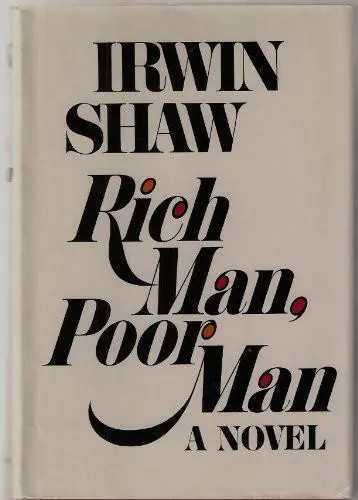
- Название:Rich Man, Poor Man
- Автор:
- Издательство:Delacorte Press, NY
- Жанр:
- Год:1970
- ISBN:9780385288583
- Рейтинг книги:5 / 5. Голосов: 1
-
Избранное:Добавить в избранное
- Отзывы:
-
Ваша оценка:
Rich Man, Poor Man: краткое содержание, описание и аннотация
Предлагаем к чтению аннотацию, описание, краткое содержание или предисловие (зависит от того, что написал сам автор книги «Rich Man, Poor Man»). Если вы не нашли необходимую информацию о книге — напишите в комментариях, мы постараемся отыскать её.
Rich Man, Poor Man — читать онлайн бесплатно полную книгу (весь текст) целиком
Ниже представлен текст книги, разбитый по страницам. Система сохранения места последней прочитанной страницы, позволяет с удобством читать онлайн бесплатно книгу «Rich Man, Poor Man», без необходимости каждый раз заново искать на чём Вы остановились. Поставьте закладку, и сможете в любой момент перейти на страницу, на которой закончили чтение.
Интервал:
Закладка:
‘Ill tell him,’ Rudolph said. Thank you. Thank you both for everything.’
Fairweather escorted him back along the hallway, opened the door into the turmoil of boys, didn’t smile as he shook Rudolph’s hand and closed the door behind him.
As Rudolph drove away from the school, Billy, in the front
seat beside him. said, ‘I never want to see this place again.’ He didn’t ask where they were going.
It was half-past five when they got to Whitby and the street lights were on in the wintry darkness. Billy had slept a good deal of the way. Rudolph dreaded the moment when he would have to introduce his mother to her grandson. ‘Spawn of the harlot,’ might not be beyond the powers of his mother’s rhetoric. But he had the appointment with Calderwood after the Calderwood Sunday supper, which would be over by seven, and it would have been impossible to take Billy back to New York and then arrive in Whitby on time. And even if he had had the time to drive the boy down to the city, to whom could he have turned him over? Willie Abbott? Gretchen had asked him to bypass Willie in the matter and he had done so and there was no having it both ways. And after what Billy had said about his father at lunch, being put in Willie’s alcoholic care could hardly have seemed like much of an improvement over staying in school.
Briefly, Rudolph had considered putting Billy in a hotel, but had discarded the idea as too cold-blooded. This was no night for the boy to spend alone in a hotel. Also, it would have been .cowardly. He would have to face the old lady down.
Still, when he awakened the boy as he stopped the car in front of the house, and led him through the door, he was relieved to see that his mother was not in the livingroom. He looked down the hallway and saw that her door was closed. That meant she had probably had a fight with Martha and was sulking. He could confront her alone and prepare her for her first meeting with her grandson.
He went into the kitchen with Billy. Martha was sitting at the table reading a newspaper and there was a smell of something cooking coming from the oven. Martha was not fat, as his mother spitefully described her, but in fact was an angular, virginal, gaunt woman of fifty, sure of the world’s displeasure, anxious to give back as good as she got.
‘Martha,’ he said, ‘this is my nephew, Billy. He’s going to stay with us for a few days. He’s tired and he needs a bath and some hot food. Do you think you can give him a hand? He’ll sleep in the guest room, next to mine.’
Martha smoothed out the newspaper on the kitchen table.
‘Your mother said you weren’t going to be in for dinner.’
‘I’m not. I’m going out again.’ ‘Then there’ll be enough for him,’ Martha said. “She - ‘
with a savage gesture of the head towards the part of the house inhabited by his mother -‘ she didn’t say nothing about no nephews.’
‘She doesn’t know yet,’ Rudolph said, trying to make his voice sound cheery, for Billy’s sake.
That’ll make her day,’ Martha said. ‘Finding out about nephews.’
Billy stood quietly to one side, testing the atmosphere, not liking it
Martha stood up, her face no more disapproving, really, than usual, but how could Billy know that? ‘Come on, young man,’ Martha said. ‘I guess we can make room for a skinny little thing like you.’
Rudolph was surprised at what was, in Martha’s vocabulary, practically a tender invitation.
‘Go ahead, Billy,’ he said. ‘I’ll be up to see you in a little while.’
Billy followed Martha out of the kitchen, hesitantly. Attached now to his uncle, any separation was full of risk.
Rudolph heard their footsteps going up the stairs. His mother would be alerted that someone strange was in the house. She recognised his tread and invariably called out to him when he was on his way to his room.
He got some ice out of the refrigerator. He needed a drink after the almost teetotalling day and before the meeting with his mother. He carried the ice out into the livingroom and was pleased to find that the livingroom was warm. Brad must have sent over an engineer yesterday for the furnace. His mother’s tongue would at least not be honed by cold.
He made himself a bourbon and water, with plenty of ice, sank into a chair, put his feet up, and sipped at his drink, enjoying it He was pleased with the room, not too heavily furnished, with modern, leather chairs, globular glass lamps, Danish wood tables and simple, neutral-coloured curtains, all of it making a carefully thought-out contrast with the low-beamed ceiling and the small eighteenth-century, square-paned windows. His mother complained that it looked like a dentist’s waiting room.
He finished his drink slowly, in no hurry for the scene ahead of him. Finally, he pushed himself up out of the chair, went down the hallway, and knocked on the door. His mother’s bedroom was on the ground floor so that she wouldn’t have to manage the stairs. Although, now, since the two operations,
one for phlebitis, the second for cataracts, she got around fairly well. Complainingly, but well,
‘Who is it?’ The voice was sharp behind the closed door.
‘It’s me. Mom,’ Rudolph said, ‘You asleep?’
‘Not any more,’ she said.
He pushed me door open.
‘Not with people tramping up and down like elephants all over the house,’ she said from the bed. She was propped up against lacy pillows, wearing a pink bed jacket that was trimmed with what seemed to be some kind of pinkish fur. She was wearing the thick glasses that the doctor had prescribed for her after the operation. They permitted her to read, watch television, and go to the movies, but they gave a wild, blank, soulless stare to her hugely magnified eyes.
Doctors had done wonders for her since they had moved to the new house. Before that, when they were still living over the store, although Rudolph had pleaded with his mother to undergo the various operations he was sure she needed, she had adamantly refused. ‘I will be nobody’s charity patient,’ she had said, ‘being experimented on by interns who shouldn’t be allowed to put a knife to a dog.’ Rudolph’s protestations had fallen then on deaf ears. While they lived in the poor apartment nothing could convince her that she was not poor and doomed to suffer the fate of the poor once confided to the cold care of an institution. But once they had made the move and Martha read the write-ups in the newspapers about Rudy’s successes to her and she had ridden in the new car that Rudy had bought, she then went boldly into surgery, after ascertaining that the men who treated her were the best and most expensive available.
She had been literally rejuvenated, resuscitated, brought back from the lip of the grave, by her belief in money. Rudy had thought that decent medical care would make his mother’s last years a little more comfortable. Instead, they had almost made her young. With Martha glooming at the wheel, she now went out in Rudy’s car whenever it was free; she frequented beauty parlours (her hair was almost blue and waved); patronised the town’s movie houses; called for taxis; attended Mass; played bridge with newly found church acquaintances twice a week; fed priests on nights when Rudy was not at home; had bought a new copy of Gone With the Wind, as well as all the novels of Frances Parkinson Keyes.
A wide variety of clothes and hats for all occasions were stored in the wardrobe in her room, which was as full of
furniture as a small antique shop, gilt desks, a chaise lonque, a dressing table with ten different flasks of French perfume on it. For the first time in her life her lips were heavily rouged. She looked ghastly, Rudolph thought, with her painted face and gaudy dresses, but she was infinitely more alive than before. If this was the way she was making up for the dreadful years of her childhood and the long agony of her marriage, it was not up to him to deprive her of her toys.
Читать дальшеИнтервал:
Закладка:
Похожие книги на «Rich Man, Poor Man»
Представляем Вашему вниманию похожие книги на «Rich Man, Poor Man» списком для выбора. Мы отобрали схожую по названию и смыслу литературу в надежде предоставить читателям больше вариантов отыскать новые, интересные, ещё непрочитанные произведения.





Обсуждение, отзывы о книге «Rich Man, Poor Man» и просто собственные мнения читателей. Оставьте ваши комментарии, напишите, что Вы думаете о произведении, его смысле или главных героях. Укажите что конкретно понравилось, а что нет, и почему Вы так считаете.