Irwin Shaw - Rich Man, Poor Man
Здесь есть возможность читать онлайн «Irwin Shaw - Rich Man, Poor Man» весь текст электронной книги совершенно бесплатно (целиком полную версию без сокращений). В некоторых случаях можно слушать аудио, скачать через торрент в формате fb2 и присутствует краткое содержание. Год выпуска: 1970, ISBN: 1970, Издательство: Delacorte Press, NY, Жанр: Классическая проза, на английском языке. Описание произведения, (предисловие) а так же отзывы посетителей доступны на портале библиотеки ЛибКат.
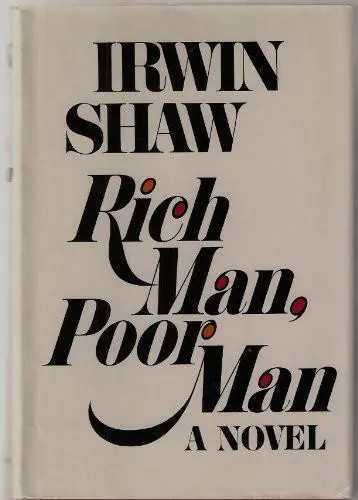
- Название:Rich Man, Poor Man
- Автор:
- Издательство:Delacorte Press, NY
- Жанр:
- Год:1970
- ISBN:9780385288583
- Рейтинг книги:5 / 5. Голосов: 1
-
Избранное:Добавить в избранное
- Отзывы:
-
Ваша оценка:
Rich Man, Poor Man: краткое содержание, описание и аннотация
Предлагаем к чтению аннотацию, описание, краткое содержание или предисловие (зависит от того, что написал сам автор книги «Rich Man, Poor Man»). Если вы не нашли необходимую информацию о книге — напишите в комментариях, мы постараемся отыскать её.
Rich Man, Poor Man — читать онлайн бесплатно полную книгу (весь текст) целиком
Ниже представлен текст книги, разбитый по страницам. Система сохранения места последней прочитанной страницы, позволяет с удобством читать онлайн бесплатно книгу «Rich Man, Poor Man», без необходимости каждый раз заново искать на чём Вы остановились. Поставьте закладку, и сможете в любой момент перейти на страницу, на которой закончили чтение.
Интервал:
Закладка:
‘Not much.’ The boy certainly had a point there. Atheists did have a religious responsibility towards their children.
‘And money,’ Billy said, his voice low but intense, as a waitress passed nearby. ‘Where’s the money going to come for my big fat education now that Colin’s dead?’
‘Don’t worry about that,’ Rudolph said. ‘I’ve told your mother I’d take care of it’
Billie looked at him malevolently, as though Rudolph had just confessed that he had been plotting against him. ‘I don’t like you enough, Uncle Rudy,’ he said, ‘to take that from you.’ Rudolph was shaken, but he managed to speak calmly. After all, Billy was only fourteen, only a child. ‘Why don’t you like me well enough?’
‘Because you belong here,’ Billy’ said. ‘Send your own son here.’ ‘I won’t comment on that’
‘I’m sorry I said it. But I meant it’ There was a pressure of tears in the long-lashed blue, Abbott eyes.
‘I admire you for saying it’ Rudolph said. ‘By the time boys reach your age they usually have learned to dissemble for rich uncles.’
‘What am I doing here, on the other side of the country, when my mother is sitting alone, all by herself, night after night, crying?’ Billie went on, in a rush. ‘A man like Colin is killed and what am I supposed to be doing - cheering at a silly football game or listening to some boy scout in a black
suit telling us Jesus saves. I’ll tell you something -‘ The tears were rolling down his cheeks now and he was mopping them with a handkerchief, but speaking fiercely at the same time. ‘If you don’t get me out of here, I’m going to run away. And, somehow, I’m going to turn up in that house where my mother is, and any way I can help her I’m going to help her.’
‘All right,’ Rudolph said. ‘We can stop talking about it. I don’t know what I can do, but I promise you I’ll do something. Fair enough?’
Billy nodded miserably, mopped some more, put the handkerchief away.
‘Now let’s finish our lunch,’ Rudolph said. He didn’t eat much more, but watched Billy clean his plate, then order apple pie a la mode and clean that plate. Fourteen was an all-absorbing age. Tears, death, pity, apple pie, and ice cream mingled without shame.
After lunch, in the car driving over to the school, Rudolph said, ‘Go up to your room. Pack a bag. Then come down and wait for me in the car.’
He watched the boy go into the building, neat in his Sunday-go-to-chapel suit, then got out of the car and followed. Behind him, a touch-tackle game was in progress on the drying lawn, boys crying, Throw it to me, throw it to me.’ in one of the hundreds of games of their youth that Bill never joined.
The Common Room off the hallway was full of boys playing ping-pong, sitting over chess boards, reading magazines, listening to the Giant game on a transistor radio. From upstairs came the roar of a folk-singing group from another radio. Politely, the boys around the ping-pong table made way for him, older man, as he walked across the room, towards the doorway of the Fan-weather’s apartment They seemed like fine good boys, good looking, healthy, well mannered, content, the hope of America. If he were a father he would have been happy to see his own son in this company this Sunday afternoon. But among them, his nephew, misfitted, felt that he was going to die. The Constitutional right to be a misfit.
He rang the bell to the Fairweather apartment and the door was opened by a tall, slightly stooping man, with a lock of hair hanging over his forehead, a healthy complexion, a ready and welcoming smile. What nerves a man must have to be able to live in a house full of boys like this.
‘Mr Fairweather?’ Rudolph said,
‘Yes?’ Amiable, easy.
‘I hate to disturb you, but I’d Eke to talk to you for a moment. I’m Billy Abbott’s uncle. I was…’
‘Oh, yes,’ Fairweather said. He extended his hand. ‘My wife told me you paid her a visit before lunch. Won’t you please come in?’ He led the way down a book-lined hallway into the book-lined livingroom, the noise from the Common Room miraculously extinguished with the closing of the door. Sanctuary from youth. Insulation from the young by books. Rudolph wondered if perhaps when Denton had offered him the post at the college, the book-lined life, he had made the wrong choice.
Mrs Fairweather was sitting on the couch, drinking a cup of coffee, her child sitting on the floor leaning against her knee, turning the pages of a picture book, the setter sprawled, asleep, against her. Mrs Fairweather smiled at him, raised her cup in greeting.
They can’t be that happy, Rudolph thought, conscious of jealousy.
‘Please sit down,’ Fairweather said. ‘Would you like some coffee?’
‘No, thank you, I’ve just had some. And I can only stay a minute.’ Rudolph sat, stiffly, feeling awkward because he was an uncle, not a father.
Fairweather sat comfortably next to his wife. He was wearing green-stained tennis shoes and a wool shirt, making the most of Sunday afternoon. ‘Did you have a good talk with Billy?’ he asked. There was a little pleasant holdover of the South in his voice, gentlemanly Tidewater Virginia.
‘I had a talk,’ Rudolph said. ‘I don’t know how good it was. Mr Fairweather, I want to take Billy away with me. For a few days at least. I think it’s absolutely necessary.’ The Fairweathers exchanged glances. ‘It’s as bad as that, is it?’ the man said. ‘Pretty bad.’
‘We’ve done everything we can,’ Fairweather said, but without apology.
‘I realise that,’ Rudolph said. ‘It’s just that Billy’s a certain kind of boy, certain things have happened to him - in the past, recently …’ He wondered if the Fairweathers had ever heard of Colin Burke, mourned the vanished talent. ‘There’s no need to go into it. A boy’s reasons can be fantasy, but his feelings can be horribly real.’ ‘So you want to take Billy away?’ Mr Fairweather said. ‘Yes.’
When?’
‘In ten minutes.’
‘Oh, dear,’ Mrs Fairweather said.
‘For how long?’ Fairweather asked calmly.
I don’t know. A few days. A month. Perhaps permanently.’
There was an uncomfortable silence. From outside the window, came the sound of a boy calling signals in the touch-tackle game, 22,45,38, Hut! Fairweather stood up and went over to the table where the coffee pot was standing and poured himself a cup. ‘You’re sure you don’t want some, Mr Jordache?’
Rudolph shook his head.
‘The Christmas holidays come in just two and a half weeks,’ Fairweather said. ‘And the term-end examinations begin in a few days. Don’t you think it would be wiser to wait until then?’
‘I don’t think it would be wise for me to leave here this afternoon without Billy,’ Rudolph said.
‘Have you spoken to the headmaster?’ Fairweather asked.
‘No.’
‘I think it would be advisable to consult with him,’ Fairweather said. ‘I don’t really have the authority to . -. . ‘
The less fuss we make, the fewer people who talk to Billy,’ Rudolph said, the better it will be for the boy. Believe me.’
Again the Fairweathers exchanged glances.
‘Charles,’ Mrs Fairweather said to her husband, ‘I think we could explain to the headmaster.’
Fairweather sipped thoughtfully at his coffee, still standing at the table. A ray of pale sunlight came through the windows, outlining him against the bookshelves behind him. Healthy, pondering man, head of family, doctor of young souls.
‘I suppose we could,’ he said. ‘I suppose we could explain. You will call me in the next day or two and tell me what’s been decided, won’t you?’
‘Of course.’
Fairweather sighed. There’re so many defeats in this quiet profession, Mr Jordache,’ he said. Tell Billy he’s welcome to come back any time he wishes. He’s bright enough to make up any time he’s lost.’
Читать дальшеИнтервал:
Закладка:
Похожие книги на «Rich Man, Poor Man»
Представляем Вашему вниманию похожие книги на «Rich Man, Poor Man» списком для выбора. Мы отобрали схожую по названию и смыслу литературу в надежде предоставить читателям больше вариантов отыскать новые, интересные, ещё непрочитанные произведения.






Обсуждение, отзывы о книге «Rich Man, Poor Man» и просто собственные мнения читателей. Оставьте ваши комментарии, напишите, что Вы думаете о произведении, его смысле или главных героях. Укажите что конкретно понравилось, а что нет, и почему Вы так считаете.