Irwin Shaw - Rich Man, Poor Man
Здесь есть возможность читать онлайн «Irwin Shaw - Rich Man, Poor Man» весь текст электронной книги совершенно бесплатно (целиком полную версию без сокращений). В некоторых случаях можно слушать аудио, скачать через торрент в формате fb2 и присутствует краткое содержание. Год выпуска: 1970, ISBN: 1970, Издательство: Delacorte Press, NY, Жанр: Классическая проза, на английском языке. Описание произведения, (предисловие) а так же отзывы посетителей доступны на портале библиотеки ЛибКат.
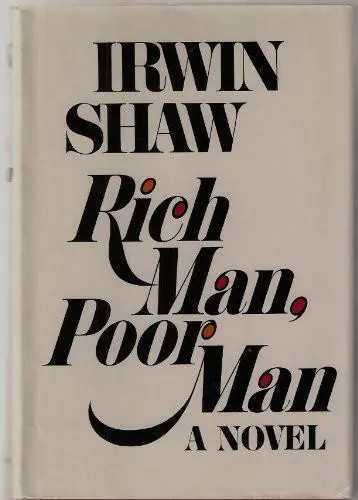
- Название:Rich Man, Poor Man
- Автор:
- Издательство:Delacorte Press, NY
- Жанр:
- Год:1970
- ISBN:9780385288583
- Рейтинг книги:5 / 5. Голосов: 1
-
Избранное:Добавить в избранное
- Отзывы:
-
Ваша оценка:
Rich Man, Poor Man: краткое содержание, описание и аннотация
Предлагаем к чтению аннотацию, описание, краткое содержание или предисловие (зависит от того, что написал сам автор книги «Rich Man, Poor Man»). Если вы не нашли необходимую информацию о книге — напишите в комментариях, мы постараемся отыскать её.
Rich Man, Poor Man — читать онлайн бесплатно полную книгу (весь текст) целиком
Ниже представлен текст книги, разбитый по страницам. Система сохранения места последней прочитанной страницы, позволяет с удобством читать онлайн бесплатно книгу «Rich Man, Poor Man», без необходимости каждый раз заново искать на чём Вы остановились. Поставьте закладку, и сможете в любой момент перейти на страницу, на которой закончили чтение.
Интервал:
Закладка:
‘I’d like to see you as soon as can be, Rudy.’ Calderwood sounded testy. As he bad grown older he had become impatient and bad tempered. He seemed to resent his increasing wealth and the men who had made it possible, as he resented the necessity of depending more and more upon dealing with financial and legal people in New York for important decisions.
‘Ill be in the office on Tuesday morning, Mr Calderwood,’ Rudolph said. ‘Can’t it wait until then?’
‘No, it can’t wait until then. And I don’t want to see you in
the office. I want you to come to the house.’ The voice on the telephone was grating and tense. ‘I’ll wait until tomorrow night after supper, Rudy.’
‘Of course, Mr Calderwood,’ Rudy said. The phone clicked, as Calderwood hung up, without saying goodbye.
Rudolph frowned at the phone as he put it down. He had tickets for the Giant game at the Stadium for himself and Jean Sunday afternoon and Calderwood’s summons meant he’d have to miss it. Jean had had a boy friend on the team when she went to Michigan and she knew a surprising amount about football so it was always fun to go to a game with her. Why didn’t the old man just lie down and die?
The phone rang again and this time it was Gretchen. Ever since Burke’s death, something had gone out of her voice, a sharpness, an eagerness, a quick music that had been special to her ever since she was a young girl. She sounded pleased to hear Rudolph, but dully pleased, like an invalid responding to a visit in her hospital bed. She said she was all right, that she was being kept busy going through Colin’s papers and sorting them and answering letters of condolence that still came drifting in and conferring with lawyers about the estate. She thanked him for the cheque he had mailed her the week before, saying that when the estate was finally settle she would pay back all the money he bad sent her.
‘Don’t worry about that,’ Rudolph said. ‘Please. You don’t have to pay back anything.’
She ignored that. ‘I’m glad you called,’ she said. ‘I was going to call you myself and ask for another favour.’
‘What it is?’ he asked, then said, ‘hold on a second,’ because the bell was ringing on the intercom from downstairs. He hurried over to the box and pushed the button.
There’s a Miss Prescott in the lobby, Mr Jordache.’ It was the doorman, protecting him.
‘Send her up, please,’ Rudolph said, and went back to the phone. ‘I’m sorry, Gretchen,’ said, ‘what were you saying?’
‘I got a letter from Billy from school yesterday,’ she said, ‘and I don’t like the way it sounds. There’s nothing that you can grasp in it, but that’s the way he is, he never really tells you what’s bothering him, but somehow I have the feeling he’s in despair. Do you think you could find the time to go and visit him and see what’s wrong?’
Rudolph hesitated. He doubted that the boy liked him enough to confide in him and he was afraid he might do more
harm than good by going to the school. ‘Of course I’ll, go,’ he said, ‘if you want. But don’t you think it might be better if his father went?’
‘No,’ Gretchen said. Tie’s a bungler. If there’s a wrong word to be said, hell say it.’
The front door was ringing now. ‘Hold on again, Gretchen,’ Rudolph said. There’s somebody at the door.’ He hurried over to the door and threw it open ‘I’m on the phone,’ he said to Jean and trotted back into the room. ‘Back again, Gretchen,’ he said, using his sister’s name to show Jean he wasn’t talking to another lady. ‘I tell you what I’ll do - I’ll drive up to the school tomorrow morning and take him to lunch and see what’s up.’
‘I hate to bother you,’ Gretchen said. ‘But the letter was so -so dark.’
‘It’s probably nothing. He came in second in a race or he flunked an algebra exam or something like that. You know how kids are.’
‘Not Billy. I tell you, he’s in despair.’ She sounded unlike herself, near tears.
‘I’ll call you tomorrow night, after I see him,’ Rudolph said. ‘Will you be home?’ ‘Ill be home,’ she said.
He put down the phone slowly, thinking of his sister alone, waiting for a telephone call, in the isolated house on the mountain crest, overlooking the city and (lie sea, going over her dead husband’s papers. He shook his head. He would worry about her tomorrow. He smiled across the room at Jean, sitting neatly on a straight-backed wooden chair, wearing red-woollen stockings and moccasins, her hair brushed and bright and pulled together low on the nape of her neck in a black-velvet bow, and falling down her back freely below the bow. Her face, as always, looked scrubbed and schoolgirlish. The slender, beloved body was lost in a floppy camel’s-hair polo coat. She was twenty-four years old, but at moments like this she seemed no more than sixteen. She had been out on a job and she had her her camera equipment with her, which she had dumped carelessly on the floor next to the front door.
You look as though I ought to offer you a glass of milk and a cookie,’ he said.
“You can offer me a drink,’ she said. ‘I’ve been on the streets since seven this morning. Not too much water.’
He went over and kissed her forehead. She smiled, rewarding him. Young girls, he thought, as he went into the
kitchen and got a pitcher of water.
While she drank the bourbon, she checked the list of art galleries in Sunday’s Times. When he was free on Saturdays they usually made the rounds of galleries. She worked as a freelance photographer and many of her assignments were for art magazines and catalogue publishers,
‘Put on comfortable shoes,’ she said. ‘We’re in for a long afternoon.’ She had a surprisingly low voice, with husky overtones, for such a small girl.
‘Where you walk,’ he said, ‘I shall follow.’
They were just going out the door when the phone rang again. ‘Let it ring,’ he said. ‘Let’s get out of here.’
She stopped in the doorway. ‘Do you mean to say you can hear a telephone ring and not answer it?’
‘I certainly can.’
‘I never could. It might be something absolutely wonderful.’
‘Nothing wonderful has ever happened to me over the phone. Let’s get out of here.’
‘Answer it. It’ll bother you all day if you don’t.’
‘No it won’t.’
‘It’ll bother me, I’ll answer it.’ She started back into the room.
‘All right, all right.’ He pushed past her and picked up the phone.
It was his mother, calling from Whitby. From the tone in which she said, ‘Rudolph,’ he knew the conversation was not going to be wonderful.
‘Rudolph,’ she said, ‘I don’t want to interfere with your holiday - ‘ It was his mother’s fixed conviction that he left Whitby for New York only for unseemly, secret pleasures. ‘But the heating’s gone off and I’m freezing in this draughty old place - ‘ Rudolph had bought a fine old low-ceilinged eighteenth-century farmhouse on the outskirts of town three years before, but his mother referred to it at all times as this crumbling dark hole or this draughty old place.
‘Can’t Martha do anything about it?’ Rudolph asked. Martha was the live-in maid who kept the house, cooked, and took care of his mother, a job for which Rudolph felt she was grossly underpaid.
‘Martha!’ his mother snorted. ‘I’m tempted to fire her on the spot.’
‘Mom
‘When I told her to go down to look at the furnace, she flatly refused’ His mother’s voice rose a half octave. ‘She’s afraid of cellars. She said for me to put on a sweater. If you
weren’t so lenient with her, she wouldn’t be so free with her advice about putting on sweaters, I guarantee. She’s so fat, swilling down our food, she wouldn’t feel cold at the North Pole. When you get back home, if you ever do deign to come back home, I implore you to have a word with that woman.’
Читать дальшеИнтервал:
Закладка:
Похожие книги на «Rich Man, Poor Man»
Представляем Вашему вниманию похожие книги на «Rich Man, Poor Man» списком для выбора. Мы отобрали схожую по названию и смыслу литературу в надежде предоставить читателям больше вариантов отыскать новые, интересные, ещё непрочитанные произведения.









Обсуждение, отзывы о книге «Rich Man, Poor Man» и просто собственные мнения читателей. Оставьте ваши комментарии, напишите, что Вы думаете о произведении, его смысле или главных героях. Укажите что конкретно понравилось, а что нет, и почему Вы так считаете.