Irwin Shaw - Rich Man, Poor Man
Здесь есть возможность читать онлайн «Irwin Shaw - Rich Man, Poor Man» весь текст электронной книги совершенно бесплатно (целиком полную версию без сокращений). В некоторых случаях можно слушать аудио, скачать через торрент в формате fb2 и присутствует краткое содержание. Год выпуска: 1970, ISBN: 1970, Издательство: Delacorte Press, NY, Жанр: Классическая проза, на английском языке. Описание произведения, (предисловие) а так же отзывы посетителей доступны на портале библиотеки ЛибКат.
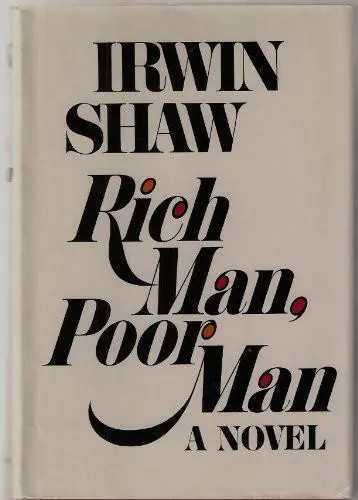
- Название:Rich Man, Poor Man
- Автор:
- Издательство:Delacorte Press, NY
- Жанр:
- Год:1970
- ISBN:9780385288583
- Рейтинг книги:5 / 5. Голосов: 1
-
Избранное:Добавить в избранное
- Отзывы:
-
Ваша оценка:
Rich Man, Poor Man: краткое содержание, описание и аннотация
Предлагаем к чтению аннотацию, описание, краткое содержание или предисловие (зависит от того, что написал сам автор книги «Rich Man, Poor Man»). Если вы не нашли необходимую информацию о книге — напишите в комментариях, мы постараемся отыскать её.
Rich Man, Poor Man — читать онлайн бесплатно полную книгу (весь текст) целиком
Ниже представлен текст книги, разбитый по страницам. Система сохранения места последней прочитанной страницы, позволяет с удобством читать онлайн бесплатно книгу «Rich Man, Poor Man», без необходимости каждый раз заново искать на чём Вы остановились. Поставьте закладку, и сможете в любой момент перейти на страницу, на которой закончили чтение.
Интервал:
Закладка:
‘It must give you an awful lot of satisfaction,’ Johnny said, ‘coming back to your old town on a day like this.’
Rudolph reflected for an instant. ‘It’s just another town,’ he said offhandedly. “Let’s go look at the merchandise.’
He led them on a tour of the shops. Gretchen’s acquisitive instinct was, as Colin had once told her, subnormal, and the gigantic assembly of things to buy, that insensate flood of objects which streamed inexorably from the factories of America saddened her.
Everything, or almost everything that most depressed Gretchen about the age in which she lived, was crammed into this artfully rustic conglomeration of white buildings, and it was her brother, whom she loved, and who softly and modestly surveyed this concrete, material proof of his cunning, who had put it all together. When he told her the history of the Jordaches, she would reserve one chapter for herself.
After the shops, Rudolph showed them around the theatre. A touring company from New York was to open that night in
a comedy and a lighting rehearsal was in progress when they went into the auditorium. Here old man Calderwood’s taste had not been the deciding factor. Dull-pink walls and deep-red plush on the chairs softened the clean severity of the interior lines of the building and Gretchen could tell, from the ease with which the director was getting complicated lighting cues, that no expense had been spared on the board backstage. For the first time in years she felt a pang of regret that she had given up the theatre.
‘It’s lovely, Rudy,’ she said.
‘I had to show you one thing of which you could approve,’ he said quietly.
She reached out and touched his hand, begging forgiveness with gesture for her unspoken criticism of the rest of his accomplishment.
‘Finally,’ he said, we’re going to have six theatres like this around the country and we’re going to put on our own plays and run them at least two weeks in each place. That way each play will be guaranteed a run of three months at a minimum and we won’t have to depend upon anybody else. If Colin ever wants to put on a play for me… ‘
‘I’m sure he’d love to work in a place like this,’ Gretchen said. ‘He’s always grumbling about the old barns on Broadway. When he gets to New York I’ll bring him up to see it Though maybe it’s not such a good idea …’
‘Why not?’ Rudolph asked.
‘He sometimes gels into terrible fights with the people he works with.’
‘He won’t fight with me,’ Rudolph said confidently. He and Burke had liked each other from their first meeting. ‘I am deferential and respectful in the presence of artists. Now for that drink.’
Gretchen looked at her watch. ‘I’m afraid I’ll have to skip it Colin’s calling me at the hotel at eight o’clock and he fumes if I’m not there when the phone rings. Johnny, do you mind if we leave now?’
‘At your service, ma’am,’ Johnny said.
Gretchen kissed Rudolph goodbye and left him in the theatre, his face glowing in the light reflected from the stage, with Miss Prescott changing lenses and clicking away, pretty, agile, busy.
Johnny and Gretchen passed the bar going towards the car and she was glad they hadn’t gone in because she was sure that the man she glimpsed, in the dark interior, bent over a drink,
was Teddy Boylan, and even after fifteen years she knew he had the power to disturb her. She didn’t want to be disturbed.
The phone was ringing when she opened the door to her room. The call was from California, but it wasn’t Colin. It was the head of the studio and he was calling to say that Colin had been killed in an automobile accident at one o’clock that day. He had been dead all afternoon and she hadn’t known it.
She thanked the man on the phone calmly for his muted words of sympathy and hung up and for a long while sat alone in the hotel room without turning on the light.
1960
The bell rang for the last round of the sparring session and Schultzy called, ‘See if you can crowd him more, Tommy.’ The boxer Quayles was going to meet in five days was a crowder and Thomas was supposed to imitate his style. But Quayles was a hard man to crowd, a dancer and jabber, quick and slippery on his feet and with fast hands. He never hurt anybody much, but he had come a long way with his cleverness. The bout was going to be nationally televised and Quayles was getting twenty thousand dollars for his end Thomas, on the supporting card, was going to get six hundred. It would have been less if Schultzy, who handled both fighters, at least for the record, hadn’t held out for the money with the promoters. There was Mafia money behind the fight and those boys didn’t go in for charity.
The training ring was set up in a theatre and the people who came to watch the sessions sat in the orchestra seats in their fancy Las Vegas shirts and canary-yellow pants. Thomas felt more like an actor than a fighter up there on the stage.
He shuffled towards Quayles, who had a mean flat face and dead-cold pale eyes under the leather headguard. When Quayles sparred with Thomas, there was always a little derisive smile on his lips, as though it was absurd for Thomas to be in the same ring with him. He made a point of never talking to
Thomas, not as much as a good morning, even though they were both in the same stable. The only satisfaction Thomas got out of Quayles was that he was screwing Quayles’s wife and one day he was going to let Quayles know it.
Quayles danced in and out, tapping Thomas sharply, slipping Thomas’s hooks easily, showing off for the crowd, letting Thomas swing at him in a corner and just bobbing his head, untouched, as the crowd yelled.
Sparring partners were not supposed to damage main-eyenters, but this was the last round of the training schedule and Thomas attacked doggedly, ignoring punishment, to get just one good one in, sit the bastard down on the seat of his fancy pants. Quayles realised what Thomas was trying to do and the smile on his face became loftier than ever as he flicked away, danced in and out, picked off punches in mid-air. He wasn’t even sweating at the end of the round and there wasn’t a mark on his body, although Thomas had been hacking away trying to reach him there, for a solid two minutes.
When the bell rang, Quayles said, ‘You ought to pay me for a boxing lesson, you bum.’
I hope you get killed Friday, you cheap ham,’ Thomas said, then climbed down and went into the showers, while Quayles did some rope skipping and calisthenics and worked on the light bag. He never got tired, the bastard, and he was a glutton for work, and would probably wind up middleweight champion, with a million bucks in the bank.
When Thomas came back out after his shower, his skin reddened under the eyes by Quayles jabs, Quayles was still at it, showing off, shadow boxing, with the hicks in the crowd in their circus clothes oh-ing and ah-ing.
Schultzy gave him the envelope with the fifty bucks in it for his two rounds and he walked quickly through the crowd and out into the glare of the searing Las Vegas afternoon. After the air-conditioned theatre the heat seemed artificial and malevolent, as though the entire town were being cooked by some diabolical scientist who wanted to destroy it in the most painful way possible.
He was thirsty after the workout and went across the blazing street to one of the big hotels. The lobby was dark and cold The expensive hookers were on patrol and the old ladies were playing the slot machines. The crap and roulette tables were in action as he passed them on his way to the bar. Everybody in the whole stinking town was loaded with money. Except him. He had lost over five hundred dollars, almost all the
money he had earned, at the crap tables in the last two weeks. He felt the envelope with Schultzy’s fifty in his pocket and fought back the urge to try the dice. He ordered a beer from the barman. His weight was okay and Schultzy wasn’t there to bawl him out. Anyway, Schultzy didn’t much care what he did any more, now that he had a contender in the stable. He wondered how much of the Schultzy’s end of the purse he had to give to the gunslingers.
Читать дальшеИнтервал:
Закладка:
Похожие книги на «Rich Man, Poor Man»
Представляем Вашему вниманию похожие книги на «Rich Man, Poor Man» списком для выбора. Мы отобрали схожую по названию и смыслу литературу в надежде предоставить читателям больше вариантов отыскать новые, интересные, ещё непрочитанные произведения.





Обсуждение, отзывы о книге «Rich Man, Poor Man» и просто собственные мнения читателей. Оставьте ваши комментарии, напишите, что Вы думаете о произведении, его смысле или главных героях. Укажите что конкретно понравилось, а что нет, и почему Вы так считаете.