Irwin Shaw - Rich Man, Poor Man
Здесь есть возможность читать онлайн «Irwin Shaw - Rich Man, Poor Man» весь текст электронной книги совершенно бесплатно (целиком полную версию без сокращений). В некоторых случаях можно слушать аудио, скачать через торрент в формате fb2 и присутствует краткое содержание. Год выпуска: 1970, ISBN: 1970, Издательство: Delacorte Press, NY, Жанр: Классическая проза, на английском языке. Описание произведения, (предисловие) а так же отзывы посетителей доступны на портале библиотеки ЛибКат.
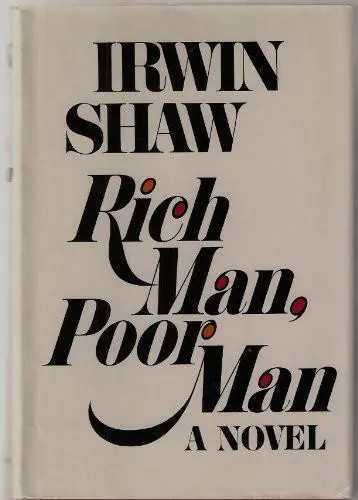
- Название:Rich Man, Poor Man
- Автор:
- Издательство:Delacorte Press, NY
- Жанр:
- Год:1970
- ISBN:9780385288583
- Рейтинг книги:5 / 5. Голосов: 1
-
Избранное:Добавить в избранное
- Отзывы:
-
Ваша оценка:
Rich Man, Poor Man: краткое содержание, описание и аннотация
Предлагаем к чтению аннотацию, описание, краткое содержание или предисловие (зависит от того, что написал сам автор книги «Rich Man, Poor Man»). Если вы не нашли необходимую информацию о книге — напишите в комментариях, мы постараемся отыскать её.
Rich Man, Poor Man — читать онлайн бесплатно полную книгу (весь текст) целиком
Ниже представлен текст книги, разбитый по страницам. Система сохранения места последней прочитанной страницы, позволяет с удобством читать онлайн бесплатно книгу «Rich Man, Poor Man», без необходимости каждый раз заново искать на чём Вы остановились. Поставьте закладку, и сможете в любой момент перейти на страницу, на которой закончили чтение.
Интервал:
Закладка:
Off her rocker, he thought. Poor old lady. Rudy hadn’t prepared him for this. But he said, ‘I’ll ask around when I get over there.’
You’re a good boy,’ she said. ‘I always knew deep down that you were essentially a good boy, but swayed by bad companions. If I had had the time to be a proper mother to my family, I could have saved you from so much trouble. You must be strict with your son. Loving, but strict. Is your wife a good mother to him?’
‘She’s okay,’ he said. He preferred not to talk about Teresa. He looked at his watch. The conversation and the dark apartment were depressing him. ‘Look,’ he said, ‘it’s nearly one o’clock. Why don’t I take you out to lunch? I have a car downstairs?’
‘Lunch? In a restaurant. Oh, wouldn’t that be lovely,’ she said girlishly. ‘My big strong son taking his old mother out to lunch.’
‘We’ll go to the best place in town,’ he said.
On his way home, driving Schultzy’s car down towards New York late in the afternoon, he thought about the day, wondering if he would ever make the trip again.
The image of his mother formed in adolescence, that of a scolding, perpetually disapproving hard woman, fanatically devoted to one son, to the detriment of another, was now replaced by that of a harmless and pitiful old lady, pathetically lonely, pleased by the slightest attention, and anxious to be loved.
At lunch he had offered her a cocktail and she had grown a little tipsy, had giggled and said, ‘Oh I do feel naughty.’ After lunch he had driven her around town and was surprised to see that most of it was practically unknown to her. She had lived there for years, but had seen practically nothing of it, not even the university from which her son had been graduated. ‘I had no idea it was such a beautiful place,’ she kept saying over and over again, as they passed through neighbourhoods where comfortable, large houses were set among trees and wintry lawns. And when they passed Calderwood’s, she said, ‘I had
no idea it was so big. You know, I’ve never been in there. And to think that Rudy practically runs it!’
He had parked the car and had walked slowly with her along the ground floor and insisted on buying her a suede handbag for fifteen dollars. She had had the salesgirl wrap up her old bag and carried the new one proudly over her arm as they left the store.
She had talked a great deal in the course of the afternoon, telling him for the first time about her life in the orphanage (‘I was the brightest girl in the class. They gave me a prize when I left.’), about working as a waitress, being ashamed of being illegitimate, about going to night school in Buffalo to improve herself, about not ever letting a man even kiss her until she married Axel Jordache, about only weighing ninety-two pounds on the day of her wedding, about how beautiful Port Philip was the day she and Axel came down to inspect the bakery, about the white excursion boat going by up the river, with the band playing waltzes on the deck, about how nice the neighbourhood was when they first came there and her dream of starting a cosy little restaurant, about her hopes for her family …
When he took her back to the apartment she asked him if she could have the photograph of his son to frame and put on the table in her bedroom and when he gave it to her, she hobbled into her room and came back with a photograph of herself, yellowed with age, taken when she was nineteen, in a long, white dress, slender, grave, beautiful. ‘Here,’ she said. ‘I want you to have this.’
She watched silently as he put it carefully in his wallet in the same place that he had kept his son’s picture.
‘You know,’ she said, ‘I feel closer to you somehow than to anybody in the whole world. We’re the same kind of people. We’re simple. Not like your sister and your brother. I love Rudy, I suppose, and I should, but I don’t understand him. And sometimes I’m just afraid of him. While you … ‘ She laughed. ‘Such a big, strong young man, a man who makes his living with his fists… . But I feel so at home with you, almost as though we were the same age, almost as though I had a brother. And today … today was so wonderful. I’m a prisoner who has just come out from behind the walls.’ He kissed her and held her and she clutched at him briefly. ‘Do you know,’ she said, ‘I haven’t smoked a single cigarette since you arrived.’
He drove slowly through the dusk, thinking about the afternoon. He came to a roadhouse and went in and sat at the empty bar and had a whiskey. He took out his wallet and stared at the young girl who had turned into his mother. He was glad he had come to see her. Perhaps her favour wasn’t worth much, but in the long race for that meagre trophy he had finally won. Alone in the quiet bar he enjoyed an unaccustomed tranquillity. For an hour, at least, he was at peace. Today, there was one less person in the world that he had to hate.
1960
The morning was a pleasant one, except for the smog that lay cupped, a thin, metallic soup, in the Los Angeles basin. Barefooted, in her nightgown, Gretchen went through the open French windows, sliding between the still curtains, out on to the terrace, and looked down from her mountain top at the stained but sunlit city and the distant flat sea below her. She breathed deeply of the September morning air, smelling of wet grass and opening flowers. No sound came from the city and the early, silence was broken only by the calls of a covey of quail crossing the lawn.
Better than New York, she thought for the hundredth time, much better than New York.
She would have liked a cup of coffee, but it Was too early for Doris, the maid, to be up, and if she went into the kitchen to make the coffee herself Doris would be awakened by the sound of running water and clinking metal and would come fussing out, apologising but aggrieved at being deprived of rightful sleep. It was too early to awake Billy, too, especially with the day he had ahead of him, and she knew better than to rouse Colin, whom she had left sleeping in the big bed, flat on his back, frowning, his arms crossed tightly, as though in his dreams he was watching a performance of which he could not possibly approve.
She smiled, thinking of Colin, sleeping, as she sometimes told him, in his important position. His other positions, and she had told him about them in detail, were amused, vulnerable, pornographic and horrified. She had been awakened by a thin shaft of sunlight coming through a rift in the curtains and had been tempted to reach for him and unfold those clenched arms. But Colin never made love in the morning. Mornings were for murder, he said. Used to New York theatrical hours, he had never taken kindly to the matinal necessities of the studios, and was, as he freely admitted, a savage before noon.
She went around to the front of the house, padding happily through the dewy grass with her bare feet, her transparent cotton nightgown blowing around her body as she walked. They had no neighbours and the chance of any cars passing by at this hour was almost nil. Anyway, in California, nobody cared how you dressed. She often sunbathed naked in the garden and her body was a deep brown after the summer. Back East she had always been careful to stay out of the sun, but if you weren’t brown in California people assumed that you were either ill or too poor to take a holiday.
The newspaper was lying in the front driveway, folded and bound by a rubber band. She opened it up and glanced at the headlines as she walked slowly back around the house. Nixon and Kennedy had their pictures on the front page and they were promising everybody everything. She mourned briefly for Adlai Stevenson and wondered if it was morally right for somebody as young and good looking as John Fitzgerald Kennedy to run for the Presidency. ‘Charm boy,’ Colin called him, but Colin had charm thrown at him every day by actors and its effect on him was almost invariably negative.
Читать дальшеИнтервал:
Закладка:
Похожие книги на «Rich Man, Poor Man»
Представляем Вашему вниманию похожие книги на «Rich Man, Poor Man» списком для выбора. Мы отобрали схожую по названию и смыслу литературу в надежде предоставить читателям больше вариантов отыскать новые, интересные, ещё непрочитанные произведения.







Обсуждение, отзывы о книге «Rich Man, Poor Man» и просто собственные мнения читателей. Оставьте ваши комментарии, напишите, что Вы думаете о произведении, его смысле или главных героях. Укажите что конкретно понравилось, а что нет, и почему Вы так считаете.