Irwin Shaw - Rich Man, Poor Man
Здесь есть возможность читать онлайн «Irwin Shaw - Rich Man, Poor Man» весь текст электронной книги совершенно бесплатно (целиком полную версию без сокращений). В некоторых случаях можно слушать аудио, скачать через торрент в формате fb2 и присутствует краткое содержание. Год выпуска: 1970, ISBN: 1970, Издательство: Delacorte Press, NY, Жанр: Классическая проза, на английском языке. Описание произведения, (предисловие) а так же отзывы посетителей доступны на портале библиотеки ЛибКат.
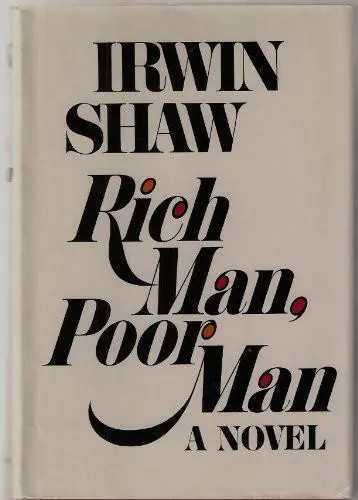
- Название:Rich Man, Poor Man
- Автор:
- Издательство:Delacorte Press, NY
- Жанр:
- Год:1970
- ISBN:9780385288583
- Рейтинг книги:5 / 5. Голосов: 1
-
Избранное:Добавить в избранное
- Отзывы:
-
Ваша оценка:
Rich Man, Poor Man: краткое содержание, описание и аннотация
Предлагаем к чтению аннотацию, описание, краткое содержание или предисловие (зависит от того, что написал сам автор книги «Rich Man, Poor Man»). Если вы не нашли необходимую информацию о книге — напишите в комментариях, мы постараемся отыскать её.
Rich Man, Poor Man — читать онлайн бесплатно полную книгу (весь текст) целиком
Ниже представлен текст книги, разбитый по страницам. Система сохранения места последней прочитанной страницы, позволяет с удобством читать онлайн бесплатно книгу «Rich Man, Poor Man», без необходимости каждый раз заново искать на чём Вы остановились. Поставьте закладку, и сможете в любой момент перейти на страницу, на которой закончили чтение.
Интервал:
Закладка:
‘Does my beloved wife know you have this on me?’ ‘No. And she’s not going to.’
‘In days to come,’ Willie said, ‘I shall sing the praises of my shining brother-in-law. Look, I shall tell my son, look closely at your noble uncle and you will be able to discern the shimmer of his halo. Christ, there must be a drink somewhere in this hotel.’
Rudolph brought out the bottle. With all his jokes, if ever a man looked as though he needed a drink, it was Willie at this moment. He drank off half of the glass. ‘Who’s picking up the tab for the research?’ he asked. ‘I am.’
‘What does it come to?’ ‘Five hundred and fifty dollars.’
‘You should’ve come to me,’ Willie said. ‘I’d’ve given you the information for half the price. Do you want me to pay you back?’
‘Forget it,’ Rudolph said. ‘I never gave you a wedding present. Consider this my wedding present.’
‘Better than a silver platter. I thank you, brother-in-law. Is there more in that bottle?’ Rudolph poured. ‘You’d better keep sober,’ he said. ‘You’re
going to have some serious conversation ahead of you.’
‘Yeah.’ Willie nodded. ‘It was a sorrowful day for everybody when I bought your sister a bottle of champagne at the Algonquin bar.’ He smiled wanly. ‘I loved her that afternoon and I love her now and there I am in the trash basket.’ He gestured to where the shreds of the detective’s report lay scattered in the tin bucket, decorated with a hunting print, riders with bright-red coats. ‘Do you know what love is?’
‘No.’
‘Neither do I.’ Willie stood up. “Well, I’ll leave you. Thanks for an interesting half hour.’
He went out without offering to shake hands.
He was incredulous when he came to the house. He looked again at the piece of paper Rudolph had given him to make sure that he was at the right address. Still over a store. And in a neighbourhood that was hardly any better than the old one in Port Philip. Seeing Rudolph in the fancy room at the Hotel Warwick and hearing him talk you’d think that he was just rolling in dough. Well, if he was, he wasn’t wasting any of it on rent.
Maybe he just kept the old lady in this joint and had a rich pad for himself in some other part of town. He wouldn’t put it past the bastard.
Thomas went into the dingy vestibule, saw the name Jordache printed next to a bell, rang. He waited, but the buzzer remained silent. He had called and told his mother he was coming to visit today, and she said she’d be at home. He couldn’t make it on a Sunday, because when he suggested it to Teresa, she’d started to cry. Sunday was her day, she wept, and she wasn’t going to be done out of it by an old hag who hadn’t even bothered to send a card when her grandson was born. So they’d left the kid with a sister of Teresa’s up in the Bronx and they’d gone to a movie on Broadway and had dinner at Toots Shor’s, where a sportswriter recognised Thomas, which made Teresa’s day for her and maybe it was worth the twenty bucks the dinner had cost.
Thomas pushed the bell again. Still, there was no response. Probably, Thomas thought bitterly, at the last minute Rudolph called and said he wanted his mother to come down to New
York and shine his shoes or something, and she’d rushed off, falling all over herself with joy.
He started to turn away, half relieved that he didn’t have to face her. It hadn’t been such a hot idea to begin with. Let sleeping mothers lie. He was just about out of the door when he heard the buzzer. He went back, opened the door and went up the steps.
The door opened at the first floor landing and there she was, looking a hundred years old. She took a couple of steps towards him and he understood why he had to wait for the buzzer. The way she walked it must have taken her five minutes to cross the room. She was crying already and had her arms outstretched to embrace him.
‘My son, my son,’ she cried, as her arms, thin sticks, went around him.’ I thought I’d never see your face again.’
There was a strong smell of toilet water. He kissed her wet cheek gently, wondering what he felt.
Clinging to his arm, she led him into the apartment. The living room was tiny and dark and he recognised the furniture from the apartment on Vanderhoff Street. It had been old and worn-out then. Now it was practically in ruins. Through an open door he could look into an adjoining room and see a desk, a single bed, books everywhere.
If he can afford to buy all those books, Thomas thought, he sure can afford to buy some new furniture.
‘Sit down, sit down,’ she said excitedly, guiding him to the one threadbare easy chair. ‘What a wonderful day.’ Her voice was thin, made reedy by years of complaint. Her legs were swollen, shapeless, and she wore wide, soft, invalid’s shoes, like a cripple. She moved as though she had been broken a long time ago in an accident. ‘You look splendid. Absolutely splendid. He remembered those words she used, out of Gone With the Wind. ‘I was afraid my little boy’s face would be all battered, but you’ve turned out handsomely. You resemble my side of the family, that’s plain to see, Irish. Not like the other two.’ She moved in a slow awkward flutter before him as he sat stiffly in the chair. She was wearing a flowered dress that blew loosely about her thin body. Her thick legs stuck out below her skirt like an error in engineering, another woman’s limbs. ‘That’s a lovely grey suit,’ she said, touching his sleeve. ‘A gentleman’s suit. I was afraid you’d still be in a sweater.’ She laughed gaily, his childhood already a romance. ‘Ah, I knew Fate couldn’t be so unkind,’ she said, ‘not letting me see my child’s face before I die. Now let me see my grandson’s face. You must have a picture. I’m sure you carry one in your wallet, like all proud fathers.’ Thomas took but a picture of his child. ‘What’s his name?’ his mother asked. ‘Wesley,’ Thomas said.
‘Wesley Pease,’ his mother said. ‘It’s a fine name.’ Thomas didn’t bother to remind her that the boy’s name was Wesley Jordache, nor did he tell her that he had fought Teresa for a week to try to get her to settle for a less fancy name. But Teresa had wept and carried on and he’d given in.
His mother stared at the photograph, her eyes dampening. She kissed the snapshot. ‘Dear little beautiful thing,’ she said. Thomas didn’t remember her ever kissing him as a child. ‘You must take me to see him, she said. ‘Sure.’ ‘Soon.’
‘When I come back from England,’ he said, ‘England! We’ve just found each other again and you’re leaving for the other side of the earth!’ ‘It’s only for a couple of weeks.’
‘You must be doing very well,’ she said, ‘to be able to afford vacations like that.’
I have a job to do there,’ he said. He was reluctant to use the word fight. They pay my way.’ He didn’t want her to get the idea that he was rich, which he wasn’t, by a long shot. In the Jordache family, it was safer to cry poverty. One woman grabbing at every cent that came into the house was enough for one family.
I hope you’re saving your money,’ she said. ‘In your profession , . . ‘
‘Sure,’ he said. ‘Don’t worry about me. He looked around him. ‘It’s a cinch Rudy’s saving his money.’
‘Oh,’ she said. The apartment. It’s not very grand, is it? But I can’t complain. Rudy pays for a woman to come in and clean every day and do the shopping for me the days I can’t make the stairs. And he say’s he’s looking for a bigger place. On the ground floor somewhere, so it’ll be easier for me, without steps. He doesn’t talk to me much about his work, but there was an article last month in the paper all about how he was one of the up-and-coming young businessmen in town, so I suppose he’s doing well enough. But he’s right to be thrifty. Money was the tragedy of the family. It made an old woman of me before my time.’ She sighed, self-pitying. ‘Your father was demented on the subject. I couldn’t get ten dollars from him for the barest necessities of life without a pitched battle every time. When you’re in England you might make some confidential inquiries, find out if anyone has seen him there. He’s liable to be anyplace, that man. After all, he was European, and it would be the most natural thing in the world for him to go back there to hide out.’
Читать дальшеИнтервал:
Закладка:
Похожие книги на «Rich Man, Poor Man»
Представляем Вашему вниманию похожие книги на «Rich Man, Poor Man» списком для выбора. Мы отобрали схожую по названию и смыслу литературу в надежде предоставить читателям больше вариантов отыскать новые, интересные, ещё непрочитанные произведения.







Обсуждение, отзывы о книге «Rich Man, Poor Man» и просто собственные мнения читателей. Оставьте ваши комментарии, напишите, что Вы думаете о произведении, его смысле или главных героях. Укажите что конкретно понравилось, а что нет, и почему Вы так считаете.