Arnold Bennett - The Old Wives' Tale
Здесь есть возможность читать онлайн «Arnold Bennett - The Old Wives' Tale» весь текст электронной книги совершенно бесплатно (целиком полную версию без сокращений). В некоторых случаях можно слушать аудио, скачать через торрент в формате fb2 и присутствует краткое содержание. Год выпуска: 2005, ISBN: 2005, Издательство: Kessinger Publishing, Жанр: Классическая проза, на английском языке. Описание произведения, (предисловие) а так же отзывы посетителей доступны на портале библиотеки ЛибКат.
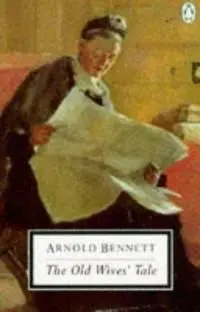
- Название:The Old Wives' Tale
- Автор:
- Издательство:Kessinger Publishing
- Жанр:
- Год:2005
- ISBN:9781417903672
- Рейтинг книги:5 / 5. Голосов: 1
-
Избранное:Добавить в избранное
- Отзывы:
-
Ваша оценка:
The Old Wives' Tale: краткое содержание, описание и аннотация
Предлагаем к чтению аннотацию, описание, краткое содержание или предисловие (зависит от того, что написал сам автор книги «The Old Wives' Tale»). Если вы не нашли необходимую информацию о книге — напишите в комментариях, мы постараемся отыскать её.
The Old Wives' Tale — читать онлайн бесплатно полную книгу (весь текст) целиком
Ниже представлен текст книги, разбитый по страницам. Система сохранения места последней прочитанной страницы, позволяет с удобством читать онлайн бесплатно книгу «The Old Wives' Tale», без необходимости каждый раз заново искать на чём Вы остановились. Поставьте закладку, и сможете в любой момент перейти на страницу, на которой закончили чтение.
Интервал:
Закладка:
A long time afterwards--it seemed like a century--she did actually and unmistakably see the woman sitting by her bed, and the woman was crying.
"Why are you crying?" Sophia asked wonderingly.
And the other, younger, woman, who was standing at the foot of the bed, replied:
"You do well to ask! It is you who have hurt her, in your delirium, when you so madly demanded the scissors."
The stout woman smiled with the tears on her cheeks; but Sophia wept, from remorse. The stout woman looked old, worn, and untidy. The other one was much younger. Sophia did not trouble to inquire from them who they were.
That little conversation formed a brief interlude in the delirium, which overtook her again and distorted everything. She forgot, however, that she was destined to die.
One day her brain cleared. She could be sure that she had gone to sleep in the morning and not wakened till the evening. Hence she had not been put into the bath.
"Have I had my baths?" she questioned.
It was the doctor who faced her.
"No," he said, "the baths are finished."
She knew from his face that she was out of danger. Moreover, she was conscious of a new feeling in her body, as though the fount of physical energy within her, long interrupted, had recommenced to flow--but very slowly, a trickling. It was a rebirth. She was not glad, but her body itself was glad; her body had an existence of its own.
She was now often left by herself in the bedroom. To the right of the foot of the bed was a piano in walnut, and to the left a chimney-piece with a large mirror. She wanted to look at herself in the mirror. But it was a very long way off. She tried to sit up, and could not. She hoped that one day she would be able to get as far as the mirror. She said not a word about this to either of the two women.
Often they would sit in the bedroom and talk without ceasing. Sophia learnt that the stout woman was named Foucault, and the other Laurence. Sometimes Laurence would address Madame Foucault as Aimee, but usually she was more formal. Madame Foucault always called the other Laurence.
Sophia's curiosity stirred and awoke. But she could not obtain any very exact information as to where she was, except that the house was in the Rue Breda, off the Rue Notre Dame de Lorette. She recollected vaguely that the reputation of the street was sinister. It appeared that, on the day when she had gone out with Chirac, the upper part of the Rue Notre Dame de Lorette was closed for repairs--(this she remembered)--and that the cabman had turned up the Rue Breda in order to make a detour, and that it was just opposite to the house of Madame Foucault that she had lost consciousness. Madame Foucault happened to be getting into a cab at the moment; but she had told Chirac nevertheless to carry Sophia into the house, and a policeman had helped. Then, when the doctor came, it was discovered that she could not be moved, save to a hospital, and both Madame Foucault and Laurence were determined that no friend of Chirac's should be committed to the horrors of a Paris hospital. Madame Foucault had suffered in one as a patient, and Laurence had been a nurse in another. ...
Chirac was now away. The women talked loosely of a war.
"How kind you have been!" murmured Sophia, with humid eyes.
But they silenced her with gestures. She was not to talk. They seemed to have nothing further to tell her. They said Chirac would be returning perhaps soon, and that she could talk to him. Evidently they both held Chirac in affection. They said often that he was a charming boy.
Bit by bit Sophia comprehended the length and the seriousness of her illness, and the immense devotion of the two women, and the terrific disturbance of their lives, and her own debility. She saw that the women were strongly attached to her, and she could not understand why, as she had never done anything for them, whereas they had done everything for her. She had not learnt that benefits rendered, not benefits received, are the cause of such attachments.
All the time she was plotting, and gathering her strength to disobey orders and get as far as the mirror. Her preliminary studies and her preparations were as elaborate as those of a prisoner arranging to escape from a fortress. The first attempt was a failure. The second succeeded. Though she could not stand without support, she managed by clinging to the bed to reach a chair, and to push the chair in front of her until it approached the mirror. The enterprise was exciting and terrific. Then she saw a face in the glass: white, incredibly emaciated, with great, wild, staring eyes; and the shoulders were bent as though with age. It was a painful, almost a horrible sight. It frightened her, so that in her alarm she recoiled from it. Not attending sufficiently to the chair, she sank to the ground. She could not pick herself up, and she was caught there, miserably, by her angered jailers. The vision of her face taught her more efficiently than anything else the gravity of her adventure. As the women lifted her inert, repentant mass into the bed, she reflected, "How queer my life is!" It seemed to her that she ought to have been trimming hats in the showroom instead of being in that curtained, mysterious, Parisian interior.
II
One day Madame Foucault knocked at the door of Sophia's little room (this ceremony of knocking was one of the indications that Sophia, convalescent, had been reinstated in her rights as an individual), and cried:
"Madame, one is going to leave you all alone for some time."
"Come in," said Sophia, who was sitting up in an armchair, and reading.
Madame Foucault opened the door. "One is going to leave you all alone for some time," she repeated in a low, confidential voice, sharply contrasting with her shriek behind the door.
Sophia nodded and smiled, and Madame Foucault also nodded and smiled. But Madame Foucault's face quickly resumed its anxious expression.
"The servant's brother marries himself to-day, and she implored me to accord her two days--what would you? Madame Laurence is out. And I must go out. It is four o'clock. I shall re-enter at six o'clock striking. Therefore ..."
"Perfectly," Sophia concurred.
She looked curiously at Madame Foucault, who was carefully made up and arranged for the street, in a dress of yellow tussore with blue ornaments, bright lemon-coloured gloves, a little blue bonnet, and a little white parasol not wider when opened than her shoulders. Cheeks, lips, and eyes were heavily charged with rouge, powder, or black. And that too abundant waist had been most cunningly confined in a belt that descended beneath, instead of rising above, the lower masses of the vast torso. The general effect was worthy of the effort that must have gone to it. Madame Foucault was not rejuvenated by her toilette, but it almost procured her pardon for the crime of being over forty, fat, creased, and worn out. It was one of those defeats that are a triumph.
"You are very chic," said Sophia, uttering her admiration.
"Ah!" said Madame Foucault, shrugging the shoulders of disillusion. "Chic! What does that do?"
But she was pleased.
The front-door banged. Sophia, by herself for the first time in the flat into which she had been carried unconscious and which she had never since left, had the disturbing sensation of being surrounded by mysterious rooms and mysterious things. She tried to continue reading, but the sentences conveyed nothing to her. She rose--she could walk now a little--and looked out of the window, through the interstices of the pattern of the lace curtains. The window gave on the courtyard, which was about sixteen feet below her. A low wall divided the courtyard from that of the next house. And the windows of the two houses, only to be distinguished by the different tints of their yellow paint, rose tier above tier in level floors, continuing beyond Sophia's field of vision. She pressed her face against the glass, and remembered the St. Luke's Square of her childhood; and just as there from the showroom window she could not even by pressing her face against the glass see the pavement, so here she could not see the roof; the courtyard was like the bottom of a well. There was no end to the windows; six storeys she could count, and the sills of a seventh were the limit of her view. Every window was heavily curtained, like her own. Some of the upper ones had green sunblinds. Scarcely any sound! Mysteries brooded without as well as within the flat of Madame Foucault. Sophia saw a bodiless hand twitch at a curtain and vanish. She noticed a green bird in a tiny cage on a sill in the next house. A woman whom she took to be the concierge appeared in the courtyard, deposited a small plant in the track of a ray of sunshine that lighted a corner for a couple of hours in the afternoon, and disappeared again. Then she heard a piano-- somewhere. That was all. The feeling that secret and strange lives were being lived behind those baffling windows, that humanity was everywhere intimately pulsing around her, oppressed her spirit yet not quite unpleasantly. The environment softened her glance upon the spectacle of existence, insomuch that sadness became a voluptuous pleasure. And the environment threw her back on herself, into a sensuous contemplation of the fundamental fact of Sophia Scales, formerly Sophia Baines.
Читать дальшеИнтервал:
Закладка:
Похожие книги на «The Old Wives' Tale»
Представляем Вашему вниманию похожие книги на «The Old Wives' Tale» списком для выбора. Мы отобрали схожую по названию и смыслу литературу в надежде предоставить читателям больше вариантов отыскать новые, интересные, ещё непрочитанные произведения.










Обсуждение, отзывы о книге «The Old Wives' Tale» и просто собственные мнения читателей. Оставьте ваши комментарии, напишите, что Вы думаете о произведении, его смысле или главных героях. Укажите что конкретно понравилось, а что нет, и почему Вы так считаете.