Arnold Bennett - The Old Wives' Tale
Здесь есть возможность читать онлайн «Arnold Bennett - The Old Wives' Tale» весь текст электронной книги совершенно бесплатно (целиком полную версию без сокращений). В некоторых случаях можно слушать аудио, скачать через торрент в формате fb2 и присутствует краткое содержание. Год выпуска: 2005, ISBN: 2005, Издательство: Kessinger Publishing, Жанр: Классическая проза, на английском языке. Описание произведения, (предисловие) а так же отзывы посетителей доступны на портале библиотеки ЛибКат.
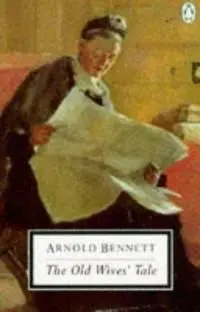
- Название:The Old Wives' Tale
- Автор:
- Издательство:Kessinger Publishing
- Жанр:
- Год:2005
- ISBN:9781417903672
- Рейтинг книги:5 / 5. Голосов: 1
-
Избранное:Добавить в избранное
- Отзывы:
-
Ваша оценка:
The Old Wives' Tale: краткое содержание, описание и аннотация
Предлагаем к чтению аннотацию, описание, краткое содержание или предисловие (зависит от того, что написал сам автор книги «The Old Wives' Tale»). Если вы не нашли необходимую информацию о книге — напишите в комментариях, мы постараемся отыскать её.
The Old Wives' Tale — читать онлайн бесплатно полную книгу (весь текст) целиком
Ниже представлен текст книги, разбитый по страницам. Система сохранения места последней прочитанной страницы, позволяет с удобством читать онлайн бесплатно книгу «The Old Wives' Tale», без необходимости каждый раз заново искать на чём Вы остановились. Поставьте закладку, и сможете в любой момент перейти на страницу, на которой закончили чтение.
Интервал:
Закладка:
He stepped into a tobacco-shop, and came out with a longer cigar than the first one, a more expensive article, stripped off its collar and lighted it as a millionaire might have lighted it. This was the man who swore that he did not possess five francs.
She tracked him as far as the Rue de Rivoli, and then lost him. There were vast surging crowds in the Rue de Rivoli, and much bunting, and soldiers and gesticulatory policemen. The general effect of the street was that all things were brightly waving in the breeze. She was caught in the crowd as in the current of a stream, and when she tried to sidle out of it into a square, a row of smiling policemen barred her passage; she was a part of the traffic that they had to regulate. She drifted till the Louvre came into view. After all, Gerald had only strolled forth to see the sight of the day, whatever it might be! She knew not what it was. She had no curiosity about it. In the middle of all that thickening mass of humanity, staring with one accord at the vast monument of royal and imperial vanities, she thought, with her characteristic grimness, of the sacrifice of her whole career as a school-teacher for the chance of seeing Gerald once a quarter in the shop. She gloated over that, as a sick appetite will gloat over tainted food. And she saw the shop, and the curve of the stairs up to the showroom, and the pier-glass in the showroom.
Then the guns began to boom again, and splendid carriages swept one after another from under a majestic archway and glittered westward down a lane of spotless splendid uniforms. The carriages were laden with still more splendid uniforms, and with enchanting toilets. Sophia, in her modestly stylish black, mechanically noticed how much easier it was for attired women to sit in a carriage now that crinolines had gone. That was the sole impression made upon her by this glimpse of the last fete of the Napoleonic Empire. She knew not that the supreme pillars of imperialism were exhibiting themselves before her; and that the eyes of those uniforms and those toilettes were full of the legendary beauty of Eugenie, and their ears echoing to the long phrases of Napoleon the Third about his gratitude to his people for their confidence in him as shown by the plebiscite, and about the ratification of constitutional reforms guaranteeing order, and about the empire having been strengthened at its base, and about showing force by moderation and envisaging the future without fear, and about the bosom of peace and liberty, and the eternal continuance of his dynasty.
She just wondered vaguely what was afoot.
When the last carriage had rolled away, and the guns and acclamations had ceased, the crowd at length began to scatter. She was carried by it into the Place du Palais Royal, and in a few moments she managed to withdraw into the Rue des Bons Enfants and was free.
The coins in her purse amounted to three sous, and therefore, though she felt exhausted to the point of illness, she had to return to the hotel on foot. Very slowly she crawled upwards in the direction of the Boulevard, through the expiring gaiety of the city. Near the Bourse a fiacre overtook her, and in the fiacre were Gerald and a woman. Gerald had not seen her; he was talking eagerly to his ornate companion. All his body was alive. The fiacre was out of sight in a moment, but Sophia judged instantly the grade of the woman, who was evidently of the discreet class that frequented the big shops of an afternoon with something of their own to sell.
Sophia's grimness increased. The pace of the fiacre, her fatigued body, Gerald's delightful, careless vivacity, the attractive streaming veil of the nice, modest courtesan--everything conspired to increase it.
III
Gerald returned to the bedroom which contained his wife and all else that he owned in the world at about nine o'clock that evening. Sophia was in bed. She had been driven to bed by weariness. She would have preferred to sit up to receive her husband, even if it had meant sitting up all night, but her body was too heavy for her spirit. She lay in the dark. She had eaten nothing. Gerald came straight into the room. He struck a match, which burned blue, with a stench, for several seconds, and then gave a clear, yellow flame. He lit a candle; and saw his wife.
"Oh!" he said; "you're there, are you?"
She offered no reply.
"Won't speak, eh?" he said. "Agreeable sort of wife! Well, have you made up your mind to do what I told you? I've come back especially to know."
She still did not speak.
He sat down, with his hat on, and stuck out his feet, wagging them to and fro on the heels.
"I'm quite without money," he went on. "And I'm sure your people will be glad to lend us a bit till I get some. Especially as it's a question of you starving as well as me. If I had enough to pay your fares to Bursley I'd pack you off. But I haven't."
She could only hear his exasperating voice. The end of the bed was between her eyes and his.
"Liar!" she said, with uncompromising distinctness. The word reached him barbed with all the poison of her contempt and disgust.
There was a pause.
"Oh! I'm a liar, am I? Thanks. I lied enough to get you, I'll admit. But you never complained of that. I remember be-ginning the New Year well with a thumping lie just to have a sight of you, my vixen. But you didn't complain then. I took you with only the clothes on your back. And I've spent every cent I had on you. And now I'm spun, you call me a liar."
She said nothing.
"However," he went on, "this is going to come to an end, this is!"
He rose, changed the position of the candle, putting it on a chest of drawers, and then drew his trunk from the wall, and knelt in front of it.
She gathered that he was packing his clothes. At first she did not comprehend his reference to beginning the New Year. Then his meaning revealed itself. That story to her mother about having been attacked by ruffians at the bottom of King Street had been an invention, a ruse to account plausibly for his presence on her mother's doorstep! And she had never suspected that the story was not true. In spite of her experience of his lying, she had never suspected that that particular statement was a lie. What a simpleton she was!
There was a continual movement in the room for about a quarter of an hour. Then a key turned in the lock of the trunk.
His head popped up over the foot of the bed. "This isn't a joke, you know," he said.
She kept silence.
"I give you one more chance. Will you write to your mother--or Constance if you like--or won't you?"
She scorned to reply in any way.
"I'm your husband," he said. "And it's your duty to obey me, particularly in an affair like this. I order you to write to your mother."
The corners of her lips turned downwards.
Angered by her mute obstinacy, he broke away from the bed with a sudden gesture.
"You do as you like," he cried, putting on his overcoat, "and I shall do as I like. You can't say I haven't warned you. It's your own deliberate choice, mind you! Whatever happens to you you've brought on yourself." He lifted and shrugged his shoulders to get the overcoat exactly into place on his shoulders.
She would not speak a word, not even to insist that she was indisposed.
He pushed his trunk outside the door, and returned to the bed.
"You understand," he said menacingly; "I'm off."
She looked up at the foul ceiling.
"Hm!" he sniffed, bringing his reserves of pride to combat the persistent silence that was damaging his dignity. And he went off, sticking his head forward like a pugilist.
"Here!" she muttered. "You're forgetting this."
He turned.
She stretched her hand to the night-table and held up a red circlet.
"What is it?"
"It's the bit of paper off the cigar you bought in the Rue Montmartre this afternoon," she answered, in a significant tone.
Читать дальшеИнтервал:
Закладка:
Похожие книги на «The Old Wives' Tale»
Представляем Вашему вниманию похожие книги на «The Old Wives' Tale» списком для выбора. Мы отобрали схожую по названию и смыслу литературу в надежде предоставить читателям больше вариантов отыскать новые, интересные, ещё непрочитанные произведения.










Обсуждение, отзывы о книге «The Old Wives' Tale» и просто собственные мнения читателей. Оставьте ваши комментарии, напишите, что Вы думаете о произведении, его смысле или главных героях. Укажите что конкретно понравилось, а что нет, и почему Вы так считаете.