Arnold Bennett - The Old Wives' Tale
Здесь есть возможность читать онлайн «Arnold Bennett - The Old Wives' Tale» весь текст электронной книги совершенно бесплатно (целиком полную версию без сокращений). В некоторых случаях можно слушать аудио, скачать через торрент в формате fb2 и присутствует краткое содержание. Год выпуска: 2005, ISBN: 2005, Издательство: Kessinger Publishing, Жанр: Классическая проза, на английском языке. Описание произведения, (предисловие) а так же отзывы посетителей доступны на портале библиотеки ЛибКат.
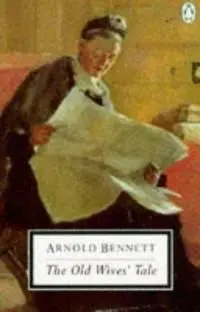
- Название:The Old Wives' Tale
- Автор:
- Издательство:Kessinger Publishing
- Жанр:
- Год:2005
- ISBN:9781417903672
- Рейтинг книги:5 / 5. Голосов: 1
-
Избранное:Добавить в избранное
- Отзывы:
-
Ваша оценка:
The Old Wives' Tale: краткое содержание, описание и аннотация
Предлагаем к чтению аннотацию, описание, краткое содержание или предисловие (зависит от того, что написал сам автор книги «The Old Wives' Tale»). Если вы не нашли необходимую информацию о книге — напишите в комментариях, мы постараемся отыскать её.
The Old Wives' Tale — читать онлайн бесплатно полную книгу (весь текст) целиком
Ниже представлен текст книги, разбитый по страницам. Система сохранения места последней прочитанной страницы, позволяет с удобством читать онлайн бесплатно книгу «The Old Wives' Tale», без необходимости каждый раз заново искать на чём Вы остановились. Поставьте закладку, и сможете в любой момент перейти на страницу, на которой закончили чтение.
Интервал:
Закладка:
Of course the event had been bound to happen. People do not vanish never to be heard of again. The time surely arrives when the secret is revealed. So Sophia said to herself--now!
She had always refused to consider the effect of Gerald's reappearance. She had put the idea of it away from her, determined to convince herself that she had done with him finally and for ever. She had forgotten him. It was years since he had ceased to disturb her thoughts--many years. "He MUST be dead," she had persuaded herself. "It is inconceivable that he should have lived on and never come across me. If he had been alive and learnt that I had made money, he would assuredly have come to me. No, he must be dead!"
And he was not dead! The brief telegram overwhelmingly shocked her. Her life had been calm, regular, monotonous. And now it was thrown into an indescribable turmoil by five words of a telegram, suddenly, with no warning whatever. Sophia had the right to say to herself: "I have had my share of trouble, and more than my share!" The end of her life promised to be as awful as the beginning. The mere existence of Gerald Scales was a menace to her. But it was the simple impact of the blow that affected her supremely, beyond ulterior things. One might have pictured fate as a cowardly brute who had struck this ageing woman full in the face, a felling blow, which however had not felled her. She staggered, but she stuck on her legs. It seemed a shame--one of those crude, spectacular shames which make the blood boil--that the gallant, defenceless creature should be so maltreated by the bully, destiny.
"Oh, Sophia!" Constance moaned. "What trouble is this?"
Sophia's lip curled with a disgusted air. Under that she hid her suffering.
She had not seen him for thirty-six years. He must be over seventy years of age, and he had turned up again like a bad penny, doubtless a disgrace! What had he been doing in those thirty-six years? He was an old, enfeebled man now! He must be a pretty sight! And he lay at Manchester, not two hours away!
Whatever feelings were in Sophia's heart, tenderness was not among them. As she collected her wits from the stroke, she was principally aware of the sentiment of fear. She recoiled from the future.
"What shall you do?" Constance asked. Constance was weeping.
Sophia tapped her foot, glancing out of the window.
"Shall you go to see him?" Constance continued.
"Of course," said Sophia. "I must!"
She hated the thought of going to see him. She flinched from it. She felt herself under no moral obligation to go. Why should she go? Gerald was nothing to her, and had no claim on her of any kind. This she honestly believed. And yet she knew that she must go to him. She knew it to be impossible that she should not go.
"Now?" demanded Constance.
Sophia nodded.
"What about the trains? ... Oh, you poor dear!" The mere idea of the journey to Manchester put Constance out of her wits, seeming a business of unparalleled complexity and difficulty.
"Would you like me to come with you?"
"Oh no! I must go by myself."
Constance was relieved by this. They could not have left the servant in the house alone, and the idea of shutting up the house without notice or preparation presented itself to Constance as too fantastic.
By a common instinct they both descended to the parlour.
"Now, what about a time-table? What about a time-table?" Constance mumbled on the stairs. She wiped her eyes resolutely. "I wonder whatever in this world has brought him at last to that Mr. Boldero's in Deansgate?" she asked the walls.
As they came into the parlour, a great motor-car drove up before the door, and when the pulsations of its engine had died away, Dick Povey hobbled from the driver's seat to the pavement. In an instant he was hammering at the door in his lively style. There was no avoiding him. The door had to be opened. Sophia opened it. Dick Povey was over forty, but he looked considerably younger. Despite his lameness, and the fact that his lameness tended to induce corpulence, he had a dashing air, and his face, with its short, light moustache, was boyish. He seemed to be always upon some joyous adventure.
"Well, aunties," he greeted the sisters, having perceived Constance behind Sophia; he often so addressed them. "Has Dr. Stirling warned you that I was coming? Why haven't you got your things on?"
Sophia observed a young woman in the car.
"Yes," said he, following her gaze, "you may as well look. Come down, miss. Come down, Lily. You've got to go through with it." The young woman, delicately confused and blushing, obeyed. "This is Miss Lily Holl," he went on. "I don't know whether you would remember her. I don't think you do. It's not often she comes to the Square. But, of course, she knows you by sight. Granddaughter of your old neighbour, Alderman Holl! We are engaged to be married, if you please."
Constance and Sophia could not decently pour out their griefs on the top of such news. The betrothed pair had to come in and be congratulated upon their entry into the large realms of mutual love. But the sisters, even in their painful quandary, could not help noticing what a nice, quiet, ladylike girl Lily Holl was. Her one fault appeared to be that she was too quiet. Dick Povey was not the man to pass time in formalities, and he was soon urging departure.
"I'm sorry we can't come," said Sophia. "I've got to go to Manchester now. We are in great trouble."
"Yes, in great trouble," Constance weakly echoed.
Dick's face clouded sympathetically. And both the affianced began to see that to which the egotism of their happiness had blinded them. They felt that long, long years had elapsed since these ageing ladies had experienced the delights which they were feeling.
"Trouble? I'm sorry to hear that!" said Dick.
"Can you tell me the trains to Manchester?" asked Sophia.
"No," said Dick, quickly, "But I can drive you there quicker than any train, if it's urgent. Where do you want to go to?"
"Deansgate," Sophia faltered.
"Look here," said Dick, "it's half-past three. Put yourself in my hands; I'll guarantee at Deansgate you shall be before half-past five. I'll look after you."
"But----"
"There isn't any 'but.' I'm quite free for the afternoon and evening."
At first the suggestion seemed absurd, especially to Constance. But really it was too tempting to be declined. While Sophia made ready for the journey, Dick and Lily Holl and Constance conversed in low, solemn tones. The pair were waiting to be enlightened as to the nature of the trouble; Constance, however, did not enlighten them. How could Constance say to them: "Sophia has a husband that she hasn't seen for thirty-six years, and he's dangerously ill, and they've telegraphed for her to go?" Constance could not. It did not even occur to Constance to order a cup of tea.
III
Dick Povey kept his word. At a quarter-past five he drew up in front of No. 49, Deansgate, Manchester. "There you are!" he said, not without pride. "Now, we'll come back in about a couple of hours or so, just to take your orders, whatever they are." He was very comforting, with his suggestion that in him Sophia had a sure support in the background.
Without many words Sophia went straight into the shop. It looked like a jeweller's shop, and a shop for bargains generally. Only the conventional sign over a side-entrance showed that at heart it was a pawnbroker's. Mr. Till Boldero did a nice business in the Five Towns, and in other centres near Manchester, by selling silver-ware second-hand, or nominally second hand, to persons who wished to make presents to other persons or to themselves. He would send anything by post on approval. Occasionally he came to the Five Towns, and he had once, several years before, met Constance. They had talked. He was the son of a cousin of the late great and wealthy Boldero, sleeping partner in Birkinshaws, and Gerald's uncle. It was from Constance that he had learnt of Sophia's return to Bursley. Constance had often remarked to Sophia what a superior man Mr. Till Boldero was.
Читать дальшеИнтервал:
Закладка:
Похожие книги на «The Old Wives' Tale»
Представляем Вашему вниманию похожие книги на «The Old Wives' Tale» списком для выбора. Мы отобрали схожую по названию и смыслу литературу в надежде предоставить читателям больше вариантов отыскать новые, интересные, ещё непрочитанные произведения.








Обсуждение, отзывы о книге «The Old Wives' Tale» и просто собственные мнения читателей. Оставьте ваши комментарии, напишите, что Вы думаете о произведении, его смысле или главных героях. Укажите что конкретно понравилось, а что нет, и почему Вы так считаете.