Arnold Bennett - The Old Wives' Tale
Здесь есть возможность читать онлайн «Arnold Bennett - The Old Wives' Tale» весь текст электронной книги совершенно бесплатно (целиком полную версию без сокращений). В некоторых случаях можно слушать аудио, скачать через торрент в формате fb2 и присутствует краткое содержание. Год выпуска: 2005, ISBN: 2005, Издательство: Kessinger Publishing, Жанр: Классическая проза, на английском языке. Описание произведения, (предисловие) а так же отзывы посетителей доступны на портале библиотеки ЛибКат.
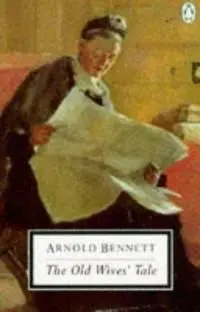
- Название:The Old Wives' Tale
- Автор:
- Издательство:Kessinger Publishing
- Жанр:
- Год:2005
- ISBN:9781417903672
- Рейтинг книги:5 / 5. Голосов: 1
-
Избранное:Добавить в избранное
- Отзывы:
-
Ваша оценка:
The Old Wives' Tale: краткое содержание, описание и аннотация
Предлагаем к чтению аннотацию, описание, краткое содержание или предисловие (зависит от того, что написал сам автор книги «The Old Wives' Tale»). Если вы не нашли необходимую информацию о книге — напишите в комментариях, мы постараемся отыскать её.
The Old Wives' Tale — читать онлайн бесплатно полную книгу (весь текст) целиком
Ниже представлен текст книги, разбитый по страницам. Система сохранения места последней прочитанной страницы, позволяет с удобством читать онлайн бесплатно книгу «The Old Wives' Tale», без необходимости каждый раз заново искать на чём Вы остановились. Поставьте закладку, и сможете в любой момент перейти на страницу, на которой закончили чтение.
Интервал:
Закладка:
"You'll never get a servant to stay in that cellar-kitchen, for one thing," said Sophia, keeping calm.
"Oh! I don't know about that! I don't know about that! That Bennion woman didn't object to it, anyway. It's all very well for you, Sophia, to talk like that. But I know Bursley perhaps better than you do." She was tart again. "And I can assure you that my house is looked upon as a very good house indeed."
"Oh! I don't say it isn't; I don't say it isn't. But you would be better away from it. Every one says that."
"Every one?" Constance looked up, dropping her work. "Who? Who's been talking about me?"
"Well," said Sophia, "the doctor, for instance."
"Dr. Stirling? I like that! He's always saying that Bursley is one of the healthiest climates in England. He's always sticking up for Bursley."
"Dr. Stirling thinks you ought to go away more--not stay always in that dark house." If Sophia had sufficiently reflected she would not have used the adjective 'dark.' It did not help her cause.
"Oh, does he!" Constance fairly snorted. "Well, if it's of any interest to Dr. Stirling, I like my dark house."
"Hasn't he ever told you you ought to go away more?" Sophia persisted.
"He may have mentioned it," Constance reluctantly admitted.
"When he was talking to me he did a good deal more than mention it. And I've a good mind to tell you what he said."
"Do!" said Constance, politely.
"You don't realize how serious it is, I'm afraid," said Sophia. "You can't see yourself." She hesitated a moment. Her blood being stirred by Constance's peculiar inflection of the phrase 'my dark house,' her judgment was slightly obscured. She decided to give Constance a fairly full version of the conversation between herself and the doctor.
"It's a question of your health," she finished. "I think it's my duty to talk to you seriously, and I have done. I hope you'll take it as it's meant."
"Oh, of course!" Constance hastened to say. And she thought: "It isn't yet three months that we've been together, and she's trying already to get me under her thumb."
A pause ensued. Sophia at length said: "There's no doubt that both your sciatica and your palpitations are due to nerves. And you let your nerves get into a state because you worry over trifles. A change would do you a tremendous amount of good. It's just what you need. Really, you must admit, Constance, that the idea of living always in a place like St. Luke's Square, when you are perfectly free to do what you like and go where you like--you must admit it's rather too much."
Constance put her lips together and bent over her embroidery.
"Now, what do you say?" Sophia gently entreated.
"There's some of us like Bursley, black as it is!" said Constance. And Sophia was surprised to detect tears in her sister's voice.
"Now, my dear Constance," she remonstrated.
"It's no use!" cried Constance, flinging away her work, and letting her tears flow suddenly. Her face was distorted. She was behaving just like a child. "It's no use! I've got to go back home and look after things. It's no use. Here we are pitching money about in this place. It's perfectly sinful. Drives, carriages, extras! A shilling a day extra for each dog. I never heard of such goings-on. And I'd sooner be at home. That's it. I'd sooner be at home." This was the first reference that Constance had made for a long time to the question of expense, and incomparably the most violent. It angered Sophia.
"We will count it that you are here as my guest," said Sophia, loftily, "if that is how you look at it."
"Oh no!" said Constance. "It isn't the money I grudge. Oh no, we won't." And her tears were falling thick.
"Yes, we will," said Sophia, coldly. "I've only been talking to you for your own good. I--"
"Well," Constance interrupted her despairingly, "I wish you wouldn't try to domineer over me!"
"Domineer!" exclaimed Sophia, aghast. "Well, Constance, I do think--"
She got up and went to her bedroom, where the dogs were imprisoned. They escaped to the stairs. She was shaking with emotion. This was what came of trying to help other people! Imagine Constance ...! Truly Constance was most unjust, and quite unlike her usual self! And Sophia encouraged in her breast the feeling of injustice suffered. But a voice kept saying to her: "You've made a mess of this. You've not conquered this time. You're beaten. And the situation is unworthy of you, of both of you. Two women of fifty quarreling like this! It's undignified. You've made a mess of things." And to strangle the voice, she did her best to encourage the feeling of injustice suffered.
'Domineer!'
And Constance was absolutely in the wrong. She had not argued at all. She had merely stuck to her idea like a mule! How difficult and painful would be the next meeting with Constance, after this grievous miscarriage!
As she was reflecting thus the door burst open, and Constance stumbled, as it were blindly, into the bedroom. She was still weeping.
"Sophia!" she sobbed, supplicatingly, and all her fat body was trembling. "You mustn't kill me ... I'm like that--you can't alter me. I'm like that. I know I'm silly. But it's no use!" She made a piteous figure.
Sophia was aware of a lump in her throat.
"It's all right, Constance; it's all right. I quite understand. Don't bother any more."
Constance, catching her breath at intervals, raised her wet, worn face and kissed her.
Sophia remembered the very words, 'You can't alter her,' which she had used in remonstrating with Cyril. And now she had been guilty of precisely the same unreason as that with which she had reproached Cyril! She was ashamed, both for herself and for Constance. Assuredly it had not been such a scene as women of their age would want to go through often. It was humiliating. She wished that it could have been blotted out as though it had never happened. Neither of them ever forgot it. They had had a lesson. And particularly Sophia had had a lesson. Having learnt, they left the Rutland, amid due ceremonies, and returned to St. Luke's Square.
CHAPTER IV
END OF SOPHIA
I
The kitchen steps were as steep, dark, and difficult as ever. Up those steps Sophia Scales, nine years older than when she had failed to persuade Constance to leave the Square, was carrying a large basket, weighted with all the heaviness of Fossette. Sophia, despite her age, climbed the steps violently, and burst with equal violence into the parlour, where she deposited the basket on the floor near the empty fireplace. She was triumphant and breathless. She looked at Constance, who had been standing near the door in the attitude of a shocked listener.
"There!" said Sophia. "Did you hear how she talked?"
"Yes," said Constance. "What shall you do?"
"Well," said Sophia. "I had a very good mind to order her out of the house at once. But then I thought I would take no notice. Her time will be up in three weeks. It's best to be indifferent. If once they see they can upset you However, I wasn't going to leave Fossette down there to her tender mercies a moment longer. She's simply not looked after her at all."
Sophia went on her knees to the basket, and, pulling aside the dog's hair, round about the head, examined the skin. Fossette was a sick dog and behaved like one. Fossette, too, was nine years older, and her senility was offensive. She was to no sense a pleasant object.
"See here," said Sophia.
Constance also knelt to the basket.
"And here," said Sophia. "And here."
The dog sighed, the insincere and pity-seeking sigh of a spoilt animal. Fossette foolishly hoped by such appeals to be spared the annoying treatment prescribed for her by the veterinary surgeon.
While the sisters were coddling her, and protecting her from her own paws, and trying to persuade her that all was for the best, another aged dog wandered vaguely into the room: Spot. Spot had very few teeth, and his legs were stiff. He had only one vice, jealousy. Fearing that Fossette might be receiving the entire attention of his mistresses, he had come to inquire into the situation. When he found the justification of his gloomiest apprehensions, he nosed obstinately up to Constance, and would not be put off. In vain Constance told him at length that he was interfering with the treatment. In vain Sophia ordered him sharply to go away. He would not listen to reason, being furious with jealousy. He got his foot into the basket.
Читать дальшеИнтервал:
Закладка:
Похожие книги на «The Old Wives' Tale»
Представляем Вашему вниманию похожие книги на «The Old Wives' Tale» списком для выбора. Мы отобрали схожую по названию и смыслу литературу в надежде предоставить читателям больше вариантов отыскать новые, интересные, ещё непрочитанные произведения.








Обсуждение, отзывы о книге «The Old Wives' Tale» и просто собственные мнения читателей. Оставьте ваши комментарии, напишите, что Вы думаете о произведении, его смысле или главных героях. Укажите что конкретно понравилось, а что нет, и почему Вы так считаете.