Arnold Bennett - The Old Wives' Tale
Здесь есть возможность читать онлайн «Arnold Bennett - The Old Wives' Tale» весь текст электронной книги совершенно бесплатно (целиком полную версию без сокращений). В некоторых случаях можно слушать аудио, скачать через торрент в формате fb2 и присутствует краткое содержание. Год выпуска: 2005, ISBN: 2005, Издательство: Kessinger Publishing, Жанр: Классическая проза, на английском языке. Описание произведения, (предисловие) а так же отзывы посетителей доступны на портале библиотеки ЛибКат.
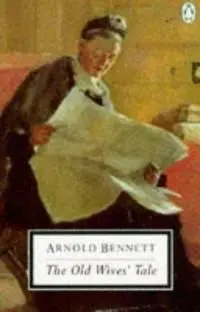
- Название:The Old Wives' Tale
- Автор:
- Издательство:Kessinger Publishing
- Жанр:
- Год:2005
- ISBN:9781417903672
- Рейтинг книги:5 / 5. Голосов: 1
-
Избранное:Добавить в избранное
- Отзывы:
-
Ваша оценка:
The Old Wives' Tale: краткое содержание, описание и аннотация
Предлагаем к чтению аннотацию, описание, краткое содержание или предисловие (зависит от того, что написал сам автор книги «The Old Wives' Tale»). Если вы не нашли необходимую информацию о книге — напишите в комментариях, мы постараемся отыскать её.
The Old Wives' Tale — читать онлайн бесплатно полную книгу (весь текст) целиком
Ниже представлен текст книги, разбитый по страницам. Система сохранения места последней прочитанной страницы, позволяет с удобством читать онлайн бесплатно книгу «The Old Wives' Tale», без необходимости каждый раз заново искать на чём Вы остановились. Поставьте закладку, и сможете в любой момент перейти на страницу, на которой закончили чтение.
Интервал:
Закладка:
"Mr. Matthew will come with me," said Constance.
"Certainly, with pleasure," said Matthew.
And she passed through the little crowd of gapers on Mr. Shawcross's arm.
"Just take care of yourself, missis," said Mr. Shawcross to her, through the window of the cab. "It's fainting weather, and we're none of us any younger, seemingly."
She nodded.
"I'm awfully sorry I upset you, Mrs. Povey," said Matthew, when the cab moved.
She shook her head, refusing his apology as unnecessary. Tears filled her eyes. In less than a minute the cab had stopped in front of Constance's light-grained door. She demanded her reticule from Matthew, who had carried it since it fell. She would pay the cabman. Never before had Matthew permitted a woman to pay for a cab in which he had ridden; but there was no arguing with Constance. Constance was dangerous.
Amy Bates, still inhabiting the cave, had seen the cab-wheels through the grating of her window and had panted up the kitchen stairs to open the door ere Constance had climbed the steps. Amy, decidedly over forty, was a woman of authority. She wanted to know what was the matter, and Constance had to tell her that she had 'felt unwell.' Amy took the hat and mantle and departed to prepare a cup of tea. When they were alone Constance said to Matthew:
"Now. Mr. Matthew, will you please tell me?"
"It's only this," he began.
And as he told it, in quite a few words, it indeed had the air of being 'only that.' And yet his voice shook, in sympathy with the ageing woman's controlled but visible emotion. It seemed to him that gladness should have filled the absurd little parlour, but the spirit that presided had no name; it was certainly not joy. He himself felt very sad, desolated. He would have given much money to have been spared the experience. He knew simply that in the memory of the stout, comical, nice woman in the rocking-chair he had stirred old, old things, wakened slumbers that might have been eternal. He did not know that he was sitting on the very spot where the sofa had been on which Samuel Povey lay when a beautiful and shameless young creature of fifteen extracted his tooth. He did not know that Constance was sitting in the very chair in which the memorable Mrs. Baines had sat in vain conflict with that same unconquerable girl. He did not know ten thousand matters that were rushing violently about in the vast heart of Constance.
She cross-questioned him in detail. But she did not put the questions which he in his innocence expected; such as, if her sister looked old, if her hair was grey, if she was stout or thin. And until Amy, mystified and resentful, had served the tea, on a little silver tray, she remained comparatively calm. It was in the middle of a gulp of tea that she broke down, and Matthew had to take the cup from her.
"I can't thank you, Mr. Matthew," she wept. "I couldn't thank you enough."
"But I've done nothing," he protested.
She shook her head. "I never hoped for this. Never hoped for it!" she went on. "It makes me so happy--in a way. ... You mustn't take any notice of me. I'm silly. You must kindly write down that address for me. And I must write to Cyril at once. And I must see Mr. Critchlow."
"It's really very funny that Cyril hasn't written to you," said Matthew.
"Cyril has not been a good son," she said with sudden, solemn coldness. "To think that he should have kept that ...!" She wept again.
At length Matthew saw the possibility of leaving. He felt her warm, soft, crinkled hand round his fingers.
"You've behaved very nicely over this," she said. "And very cleverly. In EVERY thing--both over there and here. Nobody could have shown a nicer feeling than you've shown. It's a great comfort to me that my son has got you for a friend."
When he thought of his escapades, and of all the knowledge, unutterable in Bursley, fantastically impossible in Bursley, which he had imparted to her son, he marvelled that the maternal instinct should be so deceived. Still, he felt that her praise of him was deserved.
Outside, he gave vent to a 'Phew' of relief. He smiled, in his worldliest manner. But the smile was a sham. A pretence to himself! A childish attempt to disguise from himself how profoundly he had been moved by a natural scene!
IV
On the night when Matthew Peel-Swynnerton spoke to Mrs. Scales, Matthew was not the only person in the Pension Frensham who failed to sleep. When the old portress came downstairs from her errand, she observed that her mistress was leaving the mahogany retreat.
"She is sleeping tranquilly, the poor one!" said the portress, discharging her commission, which had been to learn the latest news of the mistress's indisposed dog, Fossette. In saying this her ancient, vibrant voice was rich with sympathy for the suffering animal. And she smiled. She was rather like a figure out of an almshouse, with her pink, apparently brittle skin, her tight black dress, and frilled white cap. She stooped habitually, and always walked quickly, with her head a few inches in advance of her feet. Her grey hair was scanty. She was old; nobody perhaps knew exactly how old. Sophia had taken her with the Pension, over a quarter of a century before, because she was old and could not easily have found another place. Although the clientele was almost exclusively English, she spoke only French, explaining herself to Britons by means of benevolent smiles.
"I think I shall go to bed, Jacqueline," said the mistress, in reply.
A strange reply, thought Jacqueline. The unalterable custom of Jacqueline was to retire at midnight and to rise at five-thirty. Her mistress also usually retired about midnight, and during the final hour mistress and portress saw a good deal of each other. And considering that Jacqueline had just been sent up into the mistress's own bedroom to glance at Fossette, and that the bulletin was satisfactory, and that madame and Jacqueline had several customary daily matters to discuss, it seemed odd that madame should thus be going instantly to bed. However, Jacqueline said nothing but:
"Very well, madame. And the number 32?"
"Arrange yourself as you can," said the mistress, curtly.
"It is well, madame. Good evening, madame, and a good night."
Jacqueline, alone in the hall, re-entered her box and set upon one of those endless, mysterious tasks which occupied her when she was not rushing to and fro or whistling up the tubes.
Sophia, scarcely troubling even to glance into Fossette's round basket, undressed, put out the light, and got into bed. She felt extremely and inexplicably gloomy. She did not wish to reflect; she strongly wished not to reflect; but her mind insisted on reflection--a monotonous, futile, and distressing reflection. Povey! Povey! Could this be Constance's Povey, the unique Samuel Povey? That is to say, not he, but his son, Constance's son. Had Constance a grown-up son? Constance must be over fifty now, perhaps a grandmother! Had she really married Samuel Povey? Possibly she was dead. Certainly her mother must be dead, and Aunt Harriet and Mr. Critchlow. If alive, her mother must be at least eighty years of age.
The cumulative effect of merely remaining inactive when one ought to be active, was terrible. Undoubtedly she should have communicated with her family. It was silly not to have done so. After all, even if she had, as a child, stolen a trifle of money from her wealthy aunt, what would that have mattered? She had been proud. She was criminally proud. That was her vice. She admitted it frankly. But she could not alter her pride. Everybody had some weak spot. Her reputation for sagacity, for commonsense, was, she knew, enormous; she always felt, when people were talking to her, that they regarded her as a very unusually wise woman. And yet she had been guilty of the capital folly of cutting herself off from her family. She was ageing, and she was alone in the world. She was enriching herself; she had the most perfectly managed and the most respectable Pension in the world (she sincerely believed), and she was alone in the world. Acquaintances she had--French people who never offered nor accepted hospitality other than tea or wine, and one or two members of the English commercial colony-- but her one friend was Fossette, aged three years! She was the most solitary person on earth. She had heard no word of Gerald, no word of anybody. Nobody whatever could truly be interested in her fate. This was what she had achieved after a quarter of a century of ceaseless labour and anxiety, during which she had not once been away from the Rue Lord Byron for more than thirty hours at a stretch. It was appalling--the passage of years; and the passage of years would grow more appalling. Ten years hence, where would she be? She pictured herself dying. Horrible!
Читать дальшеИнтервал:
Закладка:
Похожие книги на «The Old Wives' Tale»
Представляем Вашему вниманию похожие книги на «The Old Wives' Tale» списком для выбора. Мы отобрали схожую по названию и смыслу литературу в надежде предоставить читателям больше вариантов отыскать новые, интересные, ещё непрочитанные произведения.







Обсуждение, отзывы о книге «The Old Wives' Tale» и просто собственные мнения читателей. Оставьте ваши комментарии, напишите, что Вы думаете о произведении, его смысле или главных героях. Укажите что конкретно понравилось, а что нет, и почему Вы так считаете.