Arnold Bennett - The Old Wives' Tale
Здесь есть возможность читать онлайн «Arnold Bennett - The Old Wives' Tale» весь текст электронной книги совершенно бесплатно (целиком полную версию без сокращений). В некоторых случаях можно слушать аудио, скачать через торрент в формате fb2 и присутствует краткое содержание. Год выпуска: 2005, ISBN: 2005, Издательство: Kessinger Publishing, Жанр: Классическая проза, на английском языке. Описание произведения, (предисловие) а так же отзывы посетителей доступны на портале библиотеки ЛибКат.
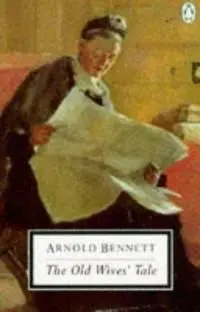
- Название:The Old Wives' Tale
- Автор:
- Издательство:Kessinger Publishing
- Жанр:
- Год:2005
- ISBN:9781417903672
- Рейтинг книги:5 / 5. Голосов: 1
-
Избранное:Добавить в избранное
- Отзывы:
-
Ваша оценка:
The Old Wives' Tale: краткое содержание, описание и аннотация
Предлагаем к чтению аннотацию, описание, краткое содержание или предисловие (зависит от того, что написал сам автор книги «The Old Wives' Tale»). Если вы не нашли необходимую информацию о книге — напишите в комментариях, мы постараемся отыскать её.
The Old Wives' Tale — читать онлайн бесплатно полную книгу (весь текст) целиком
Ниже представлен текст книги, разбитый по страницам. Система сохранения места последней прочитанной страницы, позволяет с удобством читать онлайн бесплатно книгу «The Old Wives' Tale», без необходимости каждый раз заново искать на чём Вы остановились. Поставьте закладку, и сможете в любой момент перейти на страницу, на которой закончили чтение.
Интервал:
Закладка:
When by hazard Sophia observed a fault in the daily conduct of the house, her first impulse was to go to the root of it and cure it, her second was to leave it alone, or to palliate it by some superficial remedy. Unperceived, and yet vaguely suspected by various people, the decline of the Pension Frensham had set in. The tide, having risen to its highest, was receding, but so little that no one could be sure that it had turned. Every now and then it rushed up again and washed the furthest stone.
Sophia and Constance exchanged several letters. Sophia said repeatedly that she could not leave Paris. At length she roundly asked Constance to come and pay her a visit. She made the suggestion with fear--for the prospect of actually seeing her beloved Constance alarmed her--but she could do no less than make it. And in a few days she had a reply to say that Constance would have come, under Cyril's charge, but that her sciatica was suddenly much worse, and she was obliged to lie down every day after dinner to rest her legs. Travelling was impossible for her. The fates were combining against Sophia's decision.
And now Sophia began to ask herself about her duty to Constance. The truth was that she was groping round to find an excuse for reversing her decision. She was afraid to reverse it, yet tempted. She had the desire to do something which she objected to doing. It was like the desire to throw one's self over a high balcony. It drew her, drew her, and she drew back against it. The Pension was now tedious to her. It bored her even to pretend to be the supervising head of the Pension. Throughout the house discipline had loosened.
She wondered when Mr. Mardon would renew his overtures for the transformation of her enterprise into a limited company. In spite of herself she would deliberately cross his path and give him opportunities to begin on the old theme. He had never before left her in peace for so long a period. No doubt she had, upon his last assault, absolutely convinced him that his efforts had no smallest chance of success, and he had made up his mind to cease them. With a single word she could wind him up again. The merest hint, one day when he was paying his bill, and he would be beseeching her. But she could not utter the word.
Then she began to say openly that she did not feel well, that the house was too much for her, and that the doctor had imperatively commanded rest. She said this to every one except Mardon. And every one somehow persisted in not saying it to Mardon. The doctor having advised that she should spend more time in the open air, she would take afternoon drives in the Bois with Fossette. It was October. But Mr. Mardon never seemed to hear of those drives.
One morning he met her in the street outside the house.
"I'm sorry to hear you're so unwell," he said confidentially, after they had discussed the health of Fossette.
"So unwell!" she exclaimed as if resenting the statement. "Who told you I was so unwell?"
"Jacqueline. She told me you often said that what you needed was a complete change. And it seems the doctor says so, too."
"Oh! doctors!" she murmured, without however denying the truth of Jacqueline's assertion. She saw hope in Mr. Mardon's eyes.
"Of course, you know," he said, still more confidentially, "if you SHOULD happen to change your mind, I'm always ready to form a little syndicate to take this"--he waved discreetly at the Pension--"off your hands."
She shook her head violently, which was strange, considering that for weeks she had been wishing to hear such words from Mr. Mardon.
"You needn't give it up altogether," he said. "You could retain your hold on it. We'd make you manageress, with a salary and a share in the profits. You'd be mistress just as much as you are now."
"Oh!" said she carelessly. "IF I GAVE IT UP, I SHOULD GIVE IT UP ENTIRELY. No half measures for me."
With the utterance of that sentence, the history of Frensham's as a private understanding was brought to a close. Sophia knew it. Mr. Mardon knew it. Mr. Mardon's heart leapt. He saw in his imagination the formation of the preliminary syndicate, with himself at its head, and then the re-sale by the syndicate to a limited company at a profit. He saw a nice little profit for his own private personal self of a thousand or so--gained in a moment. The plant, his hope, which he had deemed dead, blossomed with miraculous suddenness.
"Well," he said. "Give it up entirely, then! Take a holiday for life. You've deserved it, Mrs. Scales."
She shook her head once again.
"Think it over," he said.
"I gave you my answer years ago," she said obstinately, while fearing lest he should take her at her word.
"Oblige me by thinking it over," he said. "I'll mention it to you again in a few days."
"It will be no use," she said.
He took his leave, waddling down the street in his vague clothes, conscious of his fame as Lewis Mardon, the great house-agent of the Champs Elysees, known throughout Europe and America.
In a few days he did mention it again.
"There's only one thing that makes me dream of it even for a moment," said Sophia. "And that is my sister's health."
"Your sister!" he exclaimed. He did not know she had a sister. Never had she spoken of her family.
"Yes. Her letters are beginning to worry me."
"Does she live in Paris?"
"No. In Staffordshire. She has never left home."
And to preserve her pride intact she led Mr. Mardon to think that Constance was in a most serious way, whereas in truth Constance had nothing worse than her sciatica, and even that was somewhat better.
Thus she yielded.
CHAPTER II
THE MEETING
I
Soon after dinner one day in the following spring, Mr. Critchlow knocked at Constance's door. She was seated in the rocking-chair in front of the fire in the parlour. She wore a large 'rough' apron, and with the outlying parts of the apron she was rubbing the moisture out of the coat of a young wire-haired fox-terrier, for whom no more original name had been found than 'Spot.' It is true that he had a spot. Constance had more than once called the world to witness that she would never have a young dog again, because, as she said, she could not be always running about after them, and they ate the stuffing out of the furniture. But her last dog had lived too long; a dog can do worse things than eat furniture; and, in her natural reaction against age in dogs, and also in the hope of postponing as long as possible the inevitable sorrow and upset which death causes when it takes off a domestic pet, she had not known how to refuse the very desirable fox- terrier aged ten months that an acquaintance had offered to her. Spot's beautiful pink skin could be seen under his disturbed hair; he was exquisitely soft to the touch, and to himself he was loathsome. His eyes continually peeped forth between corners of the agitated towel, and they were full of inquietude and shame.
Amy was assisting at this performance, gravely on the watch to see that Spot did not escape into the coal-cellar. She opened the door to Mr. Critchlow's knock. Mr. Critchlow entered without any formalities, as usual. He did not seem to have changed. He had the same quantity of white hair, he wore the same long white apron, and his voice (which showed however an occasional tendency to shrillness) had the same grating quality. He stood fairly straight. He was carrying a newspaper in his vellum hand.
"Well, missis!" he said.
"That will do, thank you, Amy," said Constance, quietly. Amy went slowly.
"So ye're washing him for her!" said Mr. Critchlow.
"Yes," Constance admitted. Spot glanced sharply at the aged man.
"An' ye seen this bit in the paper about Sophia?" he asked, holding the Signal for her inspection.
Читать дальшеИнтервал:
Закладка:
Похожие книги на «The Old Wives' Tale»
Представляем Вашему вниманию похожие книги на «The Old Wives' Tale» списком для выбора. Мы отобрали схожую по названию и смыслу литературу в надежде предоставить читателям больше вариантов отыскать новые, интересные, ещё непрочитанные произведения.








Обсуждение, отзывы о книге «The Old Wives' Tale» и просто собственные мнения читателей. Оставьте ваши комментарии, напишите, что Вы думаете о произведении, его смысле или главных героях. Укажите что конкретно понравилось, а что нет, и почему Вы так считаете.