Arnold Bennett - The Old Wives' Tale
Здесь есть возможность читать онлайн «Arnold Bennett - The Old Wives' Tale» весь текст электронной книги совершенно бесплатно (целиком полную версию без сокращений). В некоторых случаях можно слушать аудио, скачать через торрент в формате fb2 и присутствует краткое содержание. Год выпуска: 2005, ISBN: 2005, Издательство: Kessinger Publishing, Жанр: Классическая проза, на английском языке. Описание произведения, (предисловие) а так же отзывы посетителей доступны на портале библиотеки ЛибКат.
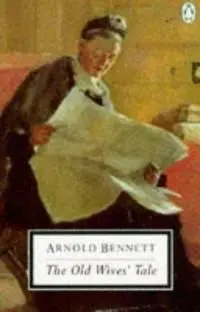
- Название:The Old Wives' Tale
- Автор:
- Издательство:Kessinger Publishing
- Жанр:
- Год:2005
- ISBN:9781417903672
- Рейтинг книги:5 / 5. Голосов: 1
-
Избранное:Добавить в избранное
- Отзывы:
-
Ваша оценка:
The Old Wives' Tale: краткое содержание, описание и аннотация
Предлагаем к чтению аннотацию, описание, краткое содержание или предисловие (зависит от того, что написал сам автор книги «The Old Wives' Tale»). Если вы не нашли необходимую информацию о книге — напишите в комментариях, мы постараемся отыскать её.
The Old Wives' Tale — читать онлайн бесплатно полную книгу (весь текст) целиком
Ниже представлен текст книги, разбитый по страницам. Система сохранения места последней прочитанной страницы, позволяет с удобством читать онлайн бесплатно книгу «The Old Wives' Tale», без необходимости каждый раз заново искать на чём Вы остановились. Поставьте закладку, и сможете в любой момент перейти на страницу, на которой закончили чтение.
Интервал:
Закладка:
"Have a whiskey?" asked Mr. Mardon, suddenly. "Very good here!" he added.
"Thanks!" drawled Peel-Swynnerton.
The temptation to listen to Mr. Mardon as long as Mr. Mardon would talk was not to be overcome. And presently, when the old men had departed, they were frankly telling each other stories in the dimness of the retreat. Then, when the supply of stories came to an end, Mr. Mardon smacked his lips over the last drop of whiskey and ejaculated: "Yes!" as if giving a general confirmation to all that had been said.
"Do have one with me," said Matthew, politely. It was the least he could do.
The second supply of whiskies was brought into the Lounge by Mr. Mardon's Marie. He smiled on her familiarly, and remarked that he supposed she would soon be going to bed after a hard day's work. She gave a moue and a flounce in reply, and swished out.
"Carries herself well, doesn't she?" observed Mr. Mardon, as though Marie had been an exhibit at an agricultural show. "Ten years ago she was very fresh and pretty, but of course it takes it out of 'em, a place like this!"
"But still," said Peel-Swynnerton, "they must like it or they wouldn't stay--that is, unless things are very different here from what they are in England."
The conversation seemed to have stimulated him to examine the woman question in all its bearings, with philosophic curiosity.
"Oh! They LIKE it," Mr. Mardon assured him, as one who knew. "Besides, Mrs. Scales treats 'em very well. I know THAT. She's told me. She's very particular"--he looked around to see if walls had ears--"and, by Jove, you've got to be; but she treats 'em well. You'd scarcely believe the wages they get, and pickings. Now at the Hotel Moscow--know the Hotel Moscow?"
Happily Peel-Swynnerton did. He had been advised to avoid it because it catered exclusively for English visitors, but in the Pension Frensham he had accepted something even more exclusively British than the Hotel Moscow. Mr. Mardon was quite relieved at his affirmative.
"The Hotel Moscow is a limited company now," said he; "English."
"Really?"
"Yes. I floated it. It was my idea. A great success! That's how I know all about the Hotel Moscow." He looked at the walls again. "I wanted to do the same here," he murmured, and Peel-Swynnerton had to show that he appreciated this confidence. "But she never would agree. I've tried her all ways. No go! It's a thousand pities."
"Paying thing, eh?"
"This place? I should say it was! And I ought to be able to judge, I reckon. Mrs. Scales is one of the shrewdest women you'd meet in a day's march. She's made a lot of money here, a lot of money. And there's no reason why a place like this shouldn't be five times as big as it is. Ten times. The scope's unlimited, my dear sir. All that's wanted is capital. Naturally she has capital of her own, and she could get more. But then, as she says, she doesn't want the place any bigger. She says it's now just as big as she can handle. That isn't so. She's a woman who could handle anything--a born manager--but even if it was so, all she would have to do would be to retire--only leave us the place and the name. It's the name that counts. And she's made the name of Frensham worth something, I can tell you!"
"Did she get the place from her husband?" asked Peel-Swynnerton. Her own name of Scales intrigued him.
Mr. Mardon shook his head. "Bought it on her own, after the husband's time, for a song--a song! I know, because I knew the original Frenshams."
"You must have been in Paris a long time," said Peel-Swynnerton.
Mr. Mardon could never resist an opportunity to talk about himself. His was a wonderful history. And Peel-Swynnerton, while scorning the man for his fatuity, was impressed. And when that was finished--
"Yes!" said Mr. Mardon after a pause,, reaffirming everything in general by a single monosyllable.
Shortly afterwards he rose, saying that his habits were regular.
"Good-night,' he said with a mechanical smile.
"G-good-night," said Peel-Swynnerton, trying to force the tone of fellowship and not succeeding. Their intimacy, which had sprung up like a mushroom, suddenly fell into dust. Peel-Swynnerton's unspoken comment to Mr. Mardon's back was: "Ass!" Still, the sum of Peel-Swynnerton's knowledge had indubitably been increased during the evening. And the hour was yet early. Half-past ten! The Folies-Marigny, with its beautiful architecture and its crowds of white toilettes, and its frothing of champagne and of beer, and its musicians in tight red coats, was just beginning to be alive-- and at a distance of scarcely a stone's-throw! Peel-Swynnerton pictured the terraced, glittering hall, which had been the prime origin of his exceeding foolishness. And he pictured all the other resorts, great and small, garlanded with white lanterns, in the Champs Elysees; and the sombre aisles of the Champs Elysees where mysterious pale figures walked troublingly under the shade of trees, while snatches of wild song or absurd brassy music floated up from the resorts and restaurants. He wanted to go out and spend those fifty francs that remained in his pocket. After all, why not telegraph to England for more money? "Oh, damn it!" he said savagely, and stretched his arms and got up. The Lounge was very small, gloomy and dreary.
One brilliant incandescent light burned in the hall, crudely illuminating the wicker fauteuils, a corded trunk with a blue-and- red label on it, a Fitzroy barometer, a map of Paris, a coloured poster of the Compagnie Transatlantique, and the mahogany retreat of the hall-portress. In that retreat was not only the hall- portress--an aged woman with a white cap above her wrinkled pink face--but the mistress of the establishment. They were murmuring together softly; they seemed to be well disposed to one another. The portress was respectful, but the mistress was respectful also. The hall, with its one light tranquilly burning, was bathed in an honest calm, the calm of a day's work accomplished, of gradual relaxation from tension, of growing expectation of repose. In its simplicity it affected Peel-Swynnerton as a medicine tonic for nerves might have affected him. In that hall, though exterior nocturnal life was but just stirring into activity, it seemed that the middle of the night had come, and that these two women alone watched in a mansion full of sleepers. And all the recitals which Peel-Swynnerton and Mr. Mardon had exchanged sank to the level of pitiably foolish gossip. Peel-Swynnerton felt that his duty to the house was to retire to bed. He felt, too, that he could not leave the house without saying that he was going out, and that he lacked the courage deliberately to tell these two women that he was going out--at that time of night! He dropped into one of the chairs and made a second attempt to peruse The Referee. Useless! Either his mind was outside in the Champs Elysees, or his gaze would wander surreptitiously to the figure of Mrs. Scales. He could not well distinguish her face because it was in the shadow of the mahogany.
Then the portress came forth from her box, and, slightly bent, sped actively across the hall, smiling pleasantly at the guest as she passed him, and disappeared up the stairs. The mistress was alone in the retreat. Peel-Swynnerton jumped up brusquely, dropping the paper with a rustle, and approached her.
"Excuse me," he said deferentially. "Have any letters come for me to-night?"
He knew that the arrival of letters for him was impossible, since nobody knew his address.
"What name?" The question was coldly polite, and the questioner looked him full in the face. Undoubtedly she was a handsome woman. Her hair was greying at the temples, and the skin was withered and crossed with lines. But she was handsome. She was one of those women of whom to their last on earth the stranger will say: "When she was young she must have been worth looking at!"--with a little transient regret that beautiful young women cannot remain for ever young. Her voice was firm and even, sweet in tone, and yet morally harsh from incessant traffic--with all varieties of human nature. Her eyes were the impartial eyes of one who is always judging. And evidently she was a proud, even a haughty creature, with her careful, controlled politeness. Evidently she considered herself superior to no matter what guest. Her eyes announced that she had lived and learnt, that she knew more about life than any one whom she was likely to meet, and that having pre-eminently succeeded in life, she had tremendous confidence in herself. The proof of her success was the unique Frensham's. A consciousness of the uniqueness of Frensham's was also in those eyes. Theoretically Matthew Peel-Swynnerton's mental attitude towards lodging-house keepers was condescending, but here it was not condescending. It had the real respectfulness of a man who for the moment at any rate is impressed beyond his calculations. His glance fell as he said--
Читать дальшеИнтервал:
Закладка:
Похожие книги на «The Old Wives' Tale»
Представляем Вашему вниманию похожие книги на «The Old Wives' Tale» списком для выбора. Мы отобрали схожую по названию и смыслу литературу в надежде предоставить читателям больше вариантов отыскать новые, интересные, ещё непрочитанные произведения.








Обсуждение, отзывы о книге «The Old Wives' Tale» и просто собственные мнения читателей. Оставьте ваши комментарии, напишите, что Вы думаете о произведении, его смысле или главных героях. Укажите что конкретно понравилось, а что нет, и почему Вы так считаете.