Олдос Хаксли - Antic Hay
Здесь есть возможность читать онлайн «Олдос Хаксли - Antic Hay» весь текст электронной книги совершенно бесплатно (целиком полную версию без сокращений). В некоторых случаях можно слушать аудио, скачать через торрент в формате fb2 и присутствует краткое содержание. Год выпуска: 2017, Издательство: epubBooks Classics, Жанр: Классическая проза, на английском языке. Описание произведения, (предисловие) а так же отзывы посетителей доступны на портале библиотеки ЛибКат.
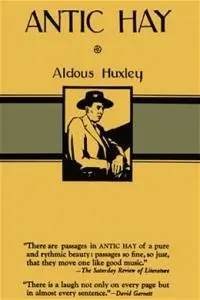
- Название:Antic Hay
- Автор:
- Издательство:epubBooks Classics
- Жанр:
- Год:2017
- ISBN:нет данных
- Рейтинг книги:5 / 5. Голосов: 1
-
Избранное:Добавить в избранное
- Отзывы:
-
Ваша оценка:
Antic Hay: краткое содержание, описание и аннотация
Предлагаем к чтению аннотацию, описание, краткое содержание или предисловие (зависит от того, что написал сам автор книги «Antic Hay»). Если вы не нашли необходимую информацию о книге — напишите в комментариях, мы постараемся отыскать её.
Antic Hay — читать онлайн бесплатно полную книгу (весь текст) целиком
Ниже представлен текст книги, разбитый по страницам. Система сохранения места последней прочитанной страницы, позволяет с удобством читать онлайн бесплатно книгу «Antic Hay», без необходимости каждый раз заново искать на чём Вы остановились. Поставьте закладку, и сможете в любой момент перейти на страницу, на которой закончили чтение.
Интервал:
Закладка:
Aridly, the desert of sand stretched out with not a tree and not even a mirage, except perhaps the vague and desperate hope that he might get there before she started, that she might conceivably have changed her mind. Ah, if only he'd read the letter a little earlier! But he hadn't woken up before eleven, he hadn't been down before half–past. Sitting at the breakfast–table, he had read the letter through.
The eggs and bacon had grown still colder, if that was possible, than they were. He had read it through, he had rushed to the A.B.C. There was no practicable train before the two o'clock.
If he had taken the seven–twenty–seven he would certainly have got there before she started. Ah, if only he had woken up a little earlier! But then he would have had to go to bed a little earlier. And in order to go to bed earlier, he would have had to abandon Mrs Viveash before she had bored herself to that ultimate point of fatigue at which she did at last feel ready for repose. And to abandon Mrs Viveash—ah, that was really impossible, she wouldn't allow herself to be left alone. If only he hadn't gone to the London Library yesterday! A wanton, unnecessary visit it had been. For after all, the journey was short; he didn't need a book for the train. And the Life of Beckford , for which he had asked, proved, of course, to be out—and he had been utterly incapable of thinking of any other book, among the two or three hundred thousand on the shelves, that he wanted to read. And, in any case, what the devil did he want with a Life of Beckford ? Hadn't he his own life, the life of Gumbril, to attend to? Wasn't one life enough, without making superfluous visits to the London Library in search of other lives? And then what a stroke of bad luck to have run into Mrs Viveash at that very moment! What an abject weakness to have let himself be bullied into sending that telegram. 'A little indisposed….' Oh, my God! Gumbril shut his eyes and ground his teeth together; he felt himself blushing with a retrospective shame.
And of course it was quite useless taking the train, like this, to Robertsbridge. She'd be gone, of course. Still, there was always the desperate hope. There was the mirage across the desiccated plains, the mirage one knew to be deceptive and which, on a second glance, proved not even to be a mirage, but merely a few livery spots behind the eyes. Still, it was amply worth doing—as a penance, and to satisfy the conscience and to deceive oneself with an illusion of action. And then the fact that he was to have spent the afternoon with Rosie and had put her off—that too was highly satisfying. And not merely put her off, but—ultimate clownery in the worst of deliriously bad taste—played a joke on her. 'Impossible come to you, meet me 213 Sloane Street, second floor, a little indisposed.' He wondered how she'd get on with Mr Mercaptan; for it was to his rococo boudoir and Crébillon–souled sofa that he had on the spur of the clownish moment, as he dashed into the post office on the way to the station, sent her.
Aridly, the desiccated waste extended. Had she been right in her letter? Would it really have lasted no more than a little while and ended as she prophesied, with an agonizing cutting of the tangle? Or could it be that she had held out the one hope of happiness? Wasn't she perhaps the one unique being with whom he might have learned to await in quietness the final coming of that lovely terrible thing, from before the sound of whose secret footsteps more than once and oh! ignobly he had fled? He could not decide, it was impossible to decide until he had seen her again, till he had possessed her, mingled his life with hers. And now she had eluded him; for he knew very well that he would not find her. He sighed and looked out of the window.
The train pulled up at a small suburban station. Suburban, for though London was already some way behind, the little sham half–timbered houses near the station, the newer tile and rough–cast dwellings farther out on the slope of the hill proclaimed with emphasis the presence of the business man, the holder of the season ticket. Gumbril looked at them with a pensive disgust which must have expressed itself on his features; for the gentleman sitting in the corner of the carriage facing his, suddenly leaned forward, tapped him on the knee, and said, 'I see you agree with me, sir, that there are too many people in the world.'
Gumbril, who up till now had merely been aware that somebody was sitting opposite him, now looked with more attention at the stranger. He was a large, square old gentleman of robust and flourishing appearance, with a face of wrinkled brown parchment and a white moustache that merged, in a handsome curve, with a pair of side whiskers, in a manner which reminded one of the photographs of the Emperor Francis Joseph.
'I perfectly agree with you, sir,' Gumbril answered. If he had been wearing his beard, he would have gone on to suggest that loquacious old gentlemen in trains are among the supernumeraries of the planet. As it was, however, he spoke with courtesy, and smiled in his most engaging fashion.
'When I look at all these revolting houses,' the old gentleman continued, shaking his fist at the snuggeries of the season–ticket holders, 'I am filled with indignation. I feel my spleen ready to burst, sir, ready to burst.'
'I can sympathize with you,' said Gumbril. 'The architecture is certainly not very soothing.'
'It's not the architecture I mind so much,' retorted the old gentleman, 'that's merely a question of art, and all nonsense so far as I'm concerned. What disgusts me is the people inside the architecture, the number of them, sir. And the way they breed. Like maggots, sir, like maggots. Millions of them, creeping about the face of the country, spreading blight and dirt wherever they go; ruining everything. It's the people I object to.'
'Ah well,' said Gumbril, 'if you will have sanitary conditions that don't allow plagues to flourish properly; if you will tell mothers how to bring up their children, instead of allowing nature to kill them off in her natural way; if you will import unlimited supplies of corn and meat: what can you expect? Of course the numbers go up.'
The old gentleman waved all this away. 'I don't care what the causes are,' he said. 'That's all one to me. What I do object to, sir, is the effects. Why sir, I am old enough to remember walking through the delicious meadows beyond Swiss Cottage, I remember seeing the cows milked in West Hampstead, sir. And now, what do I see now, when I go there? Hideous red cities pullulating with Jews, sir. Pullulating with prosperous Jews. Am I right in being indignant, sir? Do I do well, like the prophet Jonah, to be angry?'
'You do, sir,' said Gumbril, with growing enthusiasm, 'and the more so since this frightful increase in population is the world's most formidable danger at the present time. With populations that in Europe alone expand by millions every year, no political foresight is possible. A few years of this mere bestial propagation will suffice to make nonsense of the wisest schemes of to–day—or would suffice,' he hastened to correct himself, 'if any wise schemes were being matured at the present.'
'Very possibly, sir,' said the old gentleman, 'but what I object to is seeing good cornland being turned into streets, and meadows, where cows used to graze, covered with houses full of useless and disgusting human beings. I resent seeing the country parcelled out into back gardens.'
'And is there any prospect,' Gumbril earnestly asked, 'of our ever being able in the future to support the whole of our population? Will unemployment ever decrease?'
'I don't know, sir,' the old gentleman replied. 'But the families of the unemployed will certainly increase.'
'You are right, sir,' said Gumbril, 'they will. And the families of the employed and the prosperous will as steadily grow smaller. It is regrettable that birth control should have begun at the wrong end of the scale. There seems to be a level of poverty below which it doesn't seem worth while practising birth control, and a level of education below which birth control is regarded as morally wrong. Strange, how long it has taken for the ideas of love and procreation to dissociate themselves in the human mind. In the majority of minds they are still, even in this so–called twentieth century, indivisibly wedded. Still,' he continued hopefully, 'progress is being made, progress is certainly, though slowly, being made. It is gratifying to find, for example, in the latest statistics, that the clergy, as a class, are now remarkable for the smallness of their families. The old jest is out of date. Is it too much to hope that these gentlemen may bring themselves in time to preach what they already practise?'
Читать дальшеИнтервал:
Закладка:
Похожие книги на «Antic Hay»
Представляем Вашему вниманию похожие книги на «Antic Hay» списком для выбора. Мы отобрали схожую по названию и смыслу литературу в надежде предоставить читателям больше вариантов отыскать новые, интересные, ещё непрочитанные произведения.

![Олдос Хаксли - О дивный новый мир [Прекрасный новый мир]](/books/11834/oldos-haksli-o-divnyj-novyj-mir-prekrasnyj-novyj-thumb.webp)



Обсуждение, отзывы о книге «Antic Hay» и просто собственные мнения читателей. Оставьте ваши комментарии, напишите, что Вы думаете о произведении, его смысле или главных героях. Укажите что конкретно понравилось, а что нет, и почему Вы так считаете.