Олдос Хаксли - Antic Hay
Здесь есть возможность читать онлайн «Олдос Хаксли - Antic Hay» весь текст электронной книги совершенно бесплатно (целиком полную версию без сокращений). В некоторых случаях можно слушать аудио, скачать через торрент в формате fb2 и присутствует краткое содержание. Год выпуска: 2017, Издательство: epubBooks Classics, Жанр: Классическая проза, на английском языке. Описание произведения, (предисловие) а так же отзывы посетителей доступны на портале библиотеки ЛибКат.
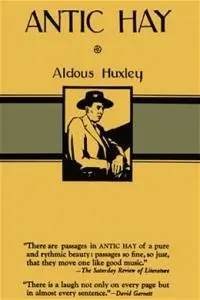
- Название:Antic Hay
- Автор:
- Издательство:epubBooks Classics
- Жанр:
- Год:2017
- ISBN:нет данных
- Рейтинг книги:5 / 5. Голосов: 1
-
Избранное:Добавить в избранное
- Отзывы:
-
Ваша оценка:
Antic Hay: краткое содержание, описание и аннотация
Предлагаем к чтению аннотацию, описание, краткое содержание или предисловие (зависит от того, что написал сам автор книги «Antic Hay»). Если вы не нашли необходимую информацию о книге — напишите в комментариях, мы постараемся отыскать её.
Antic Hay — читать онлайн бесплатно полную книгу (весь текст) целиком
Ниже представлен текст книги, разбитый по страницам. Система сохранения места последней прочитанной страницы, позволяет с удобством читать онлайн бесплатно книгу «Antic Hay», без необходимости каждый раз заново искать на чём Вы остановились. Поставьте закладку, и сможете в любой момент перейти на страницу, на которой закончили чтение.
Интервал:
Закладка:
'No,' said Mrs Viveash. 'And why do you?'
'Oh, I don't know. Or rather, I do know,' Gumbril corrected himself, and laughed again.
The young man suddenly began to boast. 'I lost two hundred pounds yesterday playing chemin de fer ,' he said, and looked round for applause.
Coleman patted his curly head. 'Delicious child!' he said. 'You're positively Hogarthian.'
Angrily, the boy pushed him away. 'What are you doing?' he shouted; then turned and addressed himself once more to the others. 'I couldn't afford it, you know—not a bloody penny of it. Not my money, either.' He seemed to find it exquisitely humorous. 'And that two hundred wasn't all,' he added, almost expiring with mirth.
'Tell Coleman how you borrowed his beard, Theodore.'
Gumbril was looking intently into his glass, as though he hoped to see in its pale mixture of gin and Sauterne visions, as in a crystal, of the future. Mrs Viveash touched him on the arm and repeated her injunction.
'Oh, that!' said Gumbril rather irritably. 'No. It isn't an interesting story.'
'Oh yes, it is! I insist,' said Mrs Viveash, commanding peremptorily from her death–bed.
Gumbril drank his gin and Sauterne. 'Very well then,' he said reluctantly, and began.
'I don't know what my governor will say,' the young man put in once or twice. But nobody paid any attention to him. He relapsed into a sulky and, it seemed to him, very dignified silence. Under the warm, jolly tipsiness he felt a chill of foreboding. He poured out some more whisky.
Gumbril warmed to his anecdote. Expiringly Mrs Viveash laughed from time to time, or smiled her agonizing smile. Coleman whooped like a Redskin.
'And after the concert to these rooms,' said Gumbril.
Well, let everything go. Into the mud. Leave it there, and let the dogs lift their hind legs over it as they pass.
'Ah! the genuine platonic fumblers,' commented Coleman.
'I am Grimaldi,' Gumbril laughed. Further than this it was difficult to see where the joke could go. There, on the divan, where Mrs Viveash and Coleman were now sitting, she had lain sleeping in his arms.
'Towsing, in Elizabethan,' said Coleman.
Unreal, eternal in the secret darkness. A night that was an eternal parenthesis among the other nights and days.
'I feel I'm going to be sick,' said the young man suddenly. He had wanted to go on silently and haughtily sulking; but his stomach declined to take part in the dignified game.
'Good Lord!' said Gumbril, and jumped up. But before he could do anything effective, the young man had fulfilled his own prophecy.
'The real charm about debauchery,' said Coleman philosophically, 'is its total pointlessness, futility, and above all its incredible tediousness. If it really were all roses and exhilaration as these poor children seem to imagine, it would be no better than going to church or studying the higher mathematics. I should never touch a drop of wine or another harlot again. It would be against my principles. I told you it was emetic,' he called to the young man.
'And what are your principles?' asked Mrs Viveash.
'Oh, strictly ethical,' said Coleman.
'You're responsible for this creature,' said Gumbril, pointing to the young man, who was sitting on the floor near the fireplace, cooling his forehead against the marble of the mantelpiece. 'You must take him away. Really, what a bore!' His nose and mouth were all wrinkled up with disgust.
'I'm sorry,' the young man whispered. He kept his eyes shut and his face was exceedingly pale.
'But with pleasure,' said Coleman. 'What's your name?' he asked the young man, 'and where do you live?'
'My name is Porteous,' murmured the young man.
'Good lord!' cried Gumbril, letting himself fall on to the divan beside Mrs Viveash. 'That's the last straw!'
Chapter XVII
The two o'clock snorted out of Charing Cross, but no healths were drunk, this time, to Viscount Lascelles. A desiccating sobriety made arid the corner of the third–class carriage in which Gumbril was sitting. His thoughts were an interminable desert of sand, with not a palm in sight, not so much as a comforting mirage. Once again he fumbled in his breast–pocket, brought out and unfolded the flimsy paper. Once more he read. How many times had he read it before?
'Your telegram made me very unhappy. Not merely because of the accident—though it made me shudder to think that something terrible might have happened, poor darling—but also, selfishly, my own disappointment. I had looked forward so much. I had made a picture of it all so clearly. I should have met you at the station with the horse and trap from the Chequers, and we'd have driven back to the cottage—and you'd have loved the cottage. We'd have had tea and I'd have made you eat an egg with it after your journey. Then we'd have gone for a walk; through the most heavenly wood I found yesterday to a place where there's a wonderful view—miles and miles of it. And we'd have wandered on and on, and sat down under the trees, and the sun would have set, and the twilight would slowly have come to an end, and we'd have gone home again and found the lamps lighted and supper ready—not very grand, I'm afraid, for Mrs Vole isn't the best of cooks. And then the piano; for there is a piano, and I had the tuner come specially from Hastings yesterday, so that it isn't so bad now. And you'd have played; and perhaps I would have made my noises on it. And at last it would have been time for candles and bed. When I heard you were coming, Theodore, I told Mrs Vole a lie about you. I said you were my husband, because she's fearfully respectable, of course; and it would dreadfully disturb her if you weren't. But I told myself that, too. I meant that you should be. You see, I tell you everything. I'm not ashamed. I wanted to give you everything I could, and then we should always be together, loving one another. And I should have been your slave, I should have been your property and lived inside your life. But you would always have had to love me.
'And then, just as I was getting ready to go and call at the Chequers for the horse and trap, your telegram came. I saw the word "accident", and I imagined you all bleeding and smashed—oh, dreadful, dreadful. But then, when you seemed to make rather a joke of it—why did you say "a little indisposed"? that seemed, somehow, so stupid, I thought—and said you were coming to–morrow, it wasn't that which upset me; it was the dreadful, dreadful disappointment. It was like a stab, that disappointment; it hurt so terribly, so unreasonably much. It made me cry and cry, so that I thought I should never be able to stop. And then, gradually, I began to see that the pain of the disappointment wasn't unreasonably great. It wasn't merely a question of your coming being put off for a day; it was a question of its being put off for ever, of my never seeing you again. I saw that that accident had been something really arranged by Providence. It was meant to warn me and show me what I ought to do. I saw how hopelessly impracticable the happiness I had been imagining really was. I saw that you didn't, you couldn't love me in anything like the same way as I loved you. I was only a curious adventure, a new experience, a means to some other end. Mind, I'm not blaming you in the least. I'm only telling you what is true, what I gradually came to realize as true. If you'd come—what then? I'd have given you everything, my body, my mind, my soul, my whole life. I'd have twisted myself into the threads of your life. And then, when in due course you wanted to make an end to this curious little adventure, you would have had to cut the tangle and it would have killed me; it would also have hurt you. At least I think it would. In the end, I thanked God for the accident which had prevented you coming. In this way, Providence lets us off very lightly—you with a bruise or two (for I do hope it really is nothing, my precious darling), and me with a bruise inside, round the heart. But both will get well quite soon. And all our lives, we shall have an afternoon under the trees, an evening of music and in the darkness, a night, an eternity of happiness, to look back on. I shall go away from Robertsbridge at once. Good–bye, Theodore. What a long letter! The last you'll ever get from me. The last—what a dreadful hurting word that is. I shall take it to post at once, for fear, if I leave it, I may be weak enough to change my mind and let you come to–morrow. I shall take it at once, then I shall come home again and pack up and tell some new fib to Mrs Vole. And after that, perhaps I shall allow myself to cry again. Good–bye.'
Читать дальшеИнтервал:
Закладка:
Похожие книги на «Antic Hay»
Представляем Вашему вниманию похожие книги на «Antic Hay» списком для выбора. Мы отобрали схожую по названию и смыслу литературу в надежде предоставить читателям больше вариантов отыскать новые, интересные, ещё непрочитанные произведения.

![Олдос Хаксли - О дивный новый мир [Прекрасный новый мир]](/books/11834/oldos-haksli-o-divnyj-novyj-mir-prekrasnyj-novyj-thumb.webp)
Обсуждение, отзывы о книге «Antic Hay» и просто собственные мнения читателей. Оставьте ваши комментарии, напишите, что Вы думаете о произведении, его смысле или главных героях. Укажите что конкретно понравилось, а что нет, и почему Вы так считаете.