ROBBINS Harold - The Carpetbaggers
Здесь есть возможность читать онлайн «ROBBINS Harold - The Carpetbaggers» весь текст электронной книги совершенно бесплатно (целиком полную версию без сокращений). В некоторых случаях можно слушать аудио, скачать через торрент в формате fb2 и присутствует краткое содержание. Жанр: Классическая проза, на английском языке. Описание произведения, (предисловие) а так же отзывы посетителей доступны на портале библиотеки ЛибКат.
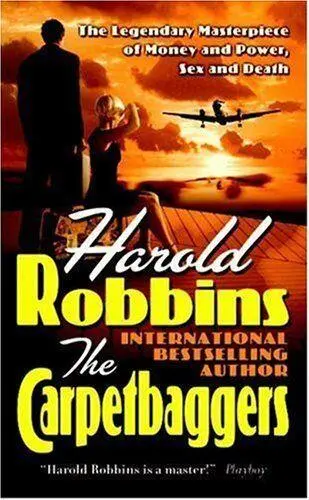
- Название:The Carpetbaggers
- Автор:
- Жанр:
- Год:неизвестен
- ISBN:нет данных
- Рейтинг книги:4 / 5. Голосов: 1
-
Избранное:Добавить в избранное
- Отзывы:
-
Ваша оценка:
The Carpetbaggers: краткое содержание, описание и аннотация
Предлагаем к чтению аннотацию, описание, краткое содержание или предисловие (зависит от того, что написал сам автор книги «The Carpetbaggers»). Если вы не нашли необходимую информацию о книге — напишите в комментариях, мы постараемся отыскать её.
The Carpetbaggers — читать онлайн бесплатно полную книгу (весь текст) целиком
Ниже представлен текст книги, разбитый по страницам. Система сохранения места последней прочитанной страницы, позволяет с удобством читать онлайн бесплатно книгу «The Carpetbaggers», без необходимости каждый раз заново искать на чём Вы остановились. Поставьте закладку, и сможете в любой момент перейти на страницу, на которой закончили чтение.
Интервал:
Закладка:
It was true. But it had been McAllister who'd seen the commercial potential in the damn thing and applied for a patent in the name of Cord Aircraft. Morrissey had a standard employment contract, which provided that all his inventions and designs belonged to the company, but McAllister had been a sport about it. He'd given Morrissey a ten-per-cent interest in the royalties as a bonus and last year, Morrissey's share was in excess of a hundred thousand dollars. The market was getting bigger all the time. Tits weren't going out of fashion for a long time.
Morrissey didn't answer. But then, I hadn't expected him to. He was one of those guys who don't give a damn about money. All he lived for was his work.
I finished my drink and lit a cigarette. Silently I cursed myself. I should have known better than to let a chance remark about my father bug me like that. I could afford it but nobody likes to throw a million dollars down the drain.
"Maybe I can do something," Forrester said.
A ray of hope came into Morrissey's eyes. "Do you think you could?"
Forrester shrugged. "I don't know," he said slowly. "I said maybe."
I stared at him. "What do you mean?"
"It's the best plane I've seen," he said. "I wouldn't like to see us lose it because of the old man's stupidity."
"Thanks," I said. "We'd be grateful for anything you could do."
Forrester smiled. "You don't owe me anything. I’m one of those old-fashioned guys who wouldn't like to see us caught short if things suddenly started popping."
I nodded. "They'll start soon enough. Just as soon as Hitler thinks he's ready."
"When do you think that will be?"
"Three, maybe four years," I said. "When they have enough trained pilots and planes."
"Where'll he get them from? He hasn't got them now."
"He'll get them," I said. "The glider schools are turning out ten thousand pilots a month and before the summer is over, Messerschmitt will have his ME-109's on the production line."
"The general staff thinks he won't do much when he comes up against the Maginot line."
"He won't come up against it," I said. "He'll fly over it."
Forrester nodded. "All the more reason for me to try to get them to check out your plane." He looked at me quizzically. "You talk like you know."
"I know," I answered. "I was there less than nine months ago."
"Oh, yes," he said, "I remember. I saw something about it in the papers. There was some kind of a stink about it, wasn't there?"
I laughed. "There was. Certain people accused me of being a Nazi sympathizer."
"Because of the million dollars you turned over to the Reichsbank?"
I shot a quick glance at him. Forrester wasn't as simple as he pretended to be. "I guess so," I answered. "You see, I transferred the money just the day before Roosevelt slapped on his restriction."
"You knew the restriction was about to be placed, didn't you? You could have saved yourself the money by just waiting one day."
"I couldn't afford to wait," I said. "The money had to be in Germany, that was all there was to it."
"Why? Why did you send them the money when obviously you realize they're our potential enemy?"
"It was ransom for a Jew," I said.
"Some of my best friends are Jews," Forrester answered. "But I can't imagine shelling out a million dollars for one of them."
I stared at him for a moment, then refilled my paper cup. "This one was worth it."
His name was Otto Strassmer and he started out in life as a quality-control engineer in one of the many Bavarian china works. From ceramics he had turned to plastics and it was he who had invented the high-speed injection mold I’d bought and sold to a combine of American manufacturers. Our original deal had been on a royalty basis but after it had been in effect for several years Strassmer wanted to change it. That was in 1933, shortly after Hitler came to power.
He'd come into my hotel room in Berlin, where I’d been on my annual visit to Europe, and explained what he wanted. He was willing to relinquish all future share in royalties for a flat payment of one million dollars, to be held in escrow for him in the United States. This was agreeable to me, of course. His share of the royalties would amount to much more than that over the licensing period. But I didn't understand why. So I asked him.
He got up out of his chair and walked over to the window, "You ask me why, Herr Cord?" he asked in his peculiarly accented English. His hand pointed out the window. "That's why."
I walked over to the window and looked down. There in the street in front of the Adlon, a group of brown-shirted young men, scarcely more than boys, were tormenting an old frock-coated man. Twice while we were watching, they knocked the old man into the gutter. We could see him lying on the edge of the sidewalk, his head in the gutter, blood streaming from his nose. The boys stood there for a moment watching him, then walked away after kicking him several times contemptuously.
I turned to Strassmer questioningly.
"That was a Jew, Herr Cord," he said quietly.
"So what? Why didn't he call the police?"
Strassmer pointed across the street. Two policemen stood on the opposite corner. "They saw everything that happened."
"Why didn't they stop them?"
"They are under instructions not to," he answered. "Hitler claims that Jews have no right under German law."
"What has this got to do with you?"
"I am a Jew," he said simply.
I was silent for a moment. I took out a cigarette and lit it. "What do you want me to do with the money?"
"Keep it until you hear from me." He smiled. "My wife and daughter are already in America. I would be grateful if you'd let them know I'm all right."
"Why don't you join them?" I asked.
"Perhaps I will – in time. But I am German," he said. "And I still hope this madness will one day pass."
But Herr Strassmer's hopes were not to be realized. This I found out less than a year later, as I sat in the office of the Reichsmarschall. "The Jews of the world are doomed, as are the Jews of Germany," he said in his polite voice. "We of the New Order recognize this and welcome our friends and allies from across the sea who wish to join our crusade."
I was silent, waiting for him to speak again.
"We men of the air understand each other," he said.
I nodded. "Yes, Excellency."
"Good," he said, smiling. "Then we do not have to waste time." He threw some papers on the desk. "Under the new laws, the Reich has confiscated the properties of a certain Otto Strassmer. We understand there are certain monies due him which you are hereby instructed to pay over into the Reichsbank."
I didn't like the word "instructed." "I have been trying to get in touch with Herr Strassmer," I said.
Goring smiled again. "Strassmer had a severe breakdown and is presently confined to a hospital."
"I see," I said. I got to my feet.
"The Third Reich will not forget its friends," the Reichsmarschall said. He pressed a button on his desk.
A young German lieutenant appeared in the doorway. "Heil Hitler!" he said, his arm upraised in the Nazi salute.
"Heil Hitler!" Goring replied negligently. He turned to me. "Lieutenant Mueller will escort you to the Messerschmitt plant. I look forward to seeing you again at dinner, Herr Cord."
The Messerschmitt plant opened my eyes. There was nothing like it building airplanes in the United States. The only things comparable were the automobile production lines in Detroit. And when I saw some of the sketches of the ME-109 that adorned Messerschmitt's office, I didn't have to look twice. It was all over but the shouting unless we got up off our collective asses.
That night at dinner, the Reichsmarschall got me to a corner. "What did you think of our factory?"
"I'm impressed," I said.
Читать дальшеИнтервал:
Закладка:
Похожие книги на «The Carpetbaggers»
Представляем Вашему вниманию похожие книги на «The Carpetbaggers» списком для выбора. Мы отобрали схожую по названию и смыслу литературу в надежде предоставить читателям больше вариантов отыскать новые, интересные, ещё непрочитанные произведения.











Обсуждение, отзывы о книге «The Carpetbaggers» и просто собственные мнения читателей. Оставьте ваши комментарии, напишите, что Вы думаете о произведении, его смысле или главных героях. Укажите что конкретно понравилось, а что нет, и почему Вы так считаете.